National Tourist Site
About Thracian Tomb at Starosel
At a glance
| Tourist site | No. 67, Thracian tomb, Starosel |
|---|---|
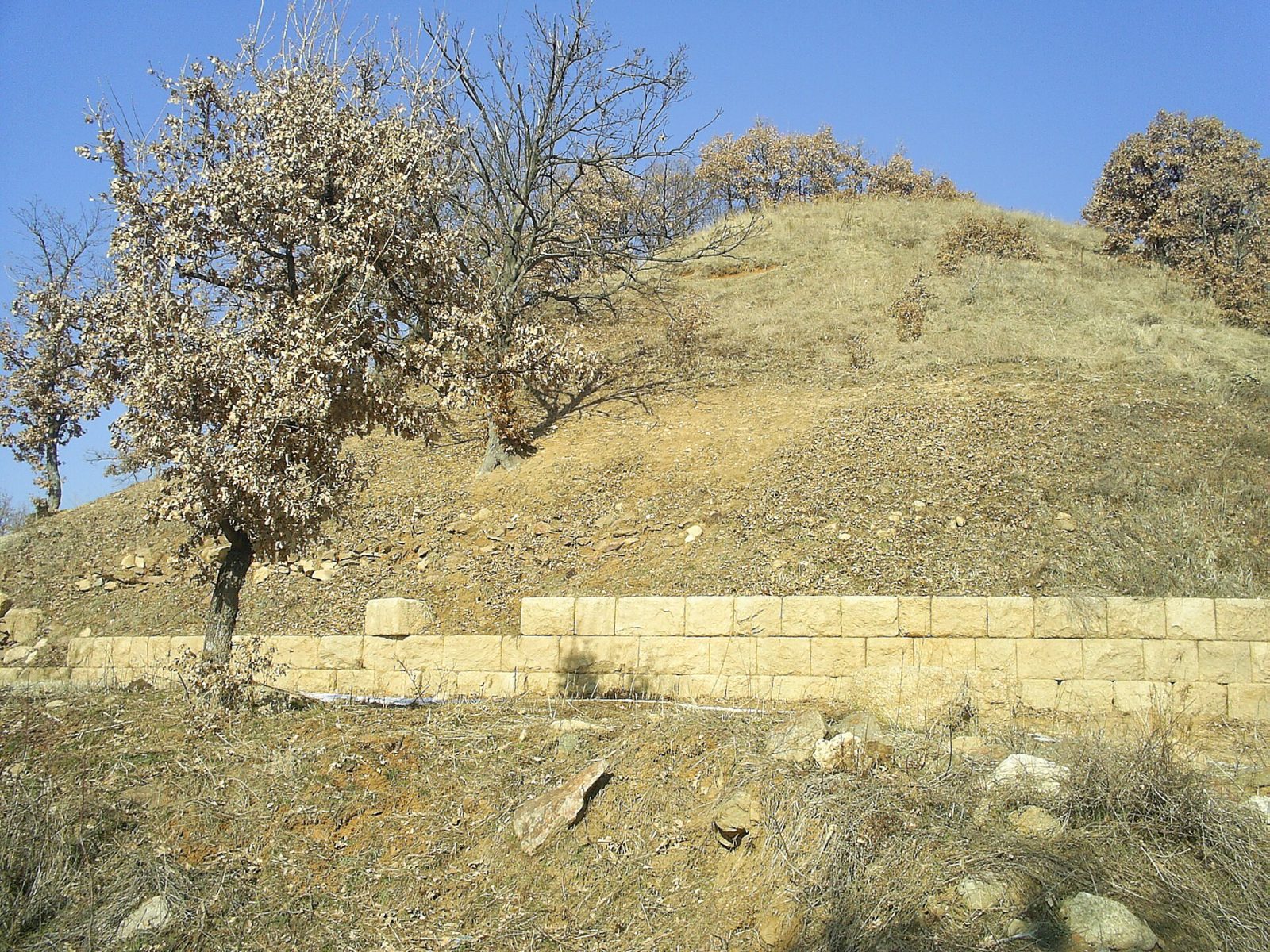
| Where | On a hill above the village of Starosel, Hisarya municipality, at the foot of Sashtinska Sredna Gora, looking over the Thracian Plain |
| Mound | 20 m high and 85 m across, with a stone wall 241 m round |
| Opening hours | Every day 8:30–16:30 |
Source: Bulgarian Tourist Union: Thracian tomb, Starosel (100 National Tourist Sites, in Bulgarian); Wikipedia (English): Starosel1,2
The temple under Chetinyova mound
The archaeologist Georgi Kitov found the cult complex under the Chetinyova mound in 2000 and called it a temple; the Bulgarian Tourist Union describes it as a tomb-heroon, where a dead ruler was honoured as a god. The necropolis has 8 mounds of different sizes, and the union says Chetinyova is the largest of the Thracian mounds known so far.1
The mound is ringed by a stone wall 241 m round that acts like a fortress wall. The entrance is 1.60 m wide and decorated with the zigzag pattern known as “wolf’s teeth”. The tomb is built of finely cut stone blocks joined with iron clamps set in lead.1
| Part | What it is |
|---|---|
| Staircases | A main staircase on the south side and two side staircases |
| Corridor and façade | A corridor leading to a decorated front |
| Chambers | A rectangular chamber and a round chamber |
Source: Bulgarian Tourist Union: Thracian tomb, Starosel (100 National Tourist Sites, in Bulgarian)1
The Bulgarian Tourist Union dates the tomb to probably the 5th–4th century BC and mentions the theory that Sitalces, one of the most powerful kings of the Odrysian kingdom, was buried here. The English Wikipedia links the temple and the nearby royal residence to the reign of Amadocus II (359–351 BC) and calls the temple the largest of its kind in the Balkans.1,2
The wider cult centre
Chetinyova is the centre of a large cult complex of many sanctuaries and several dozen mounds; the union says rich royal burials were found in five of them. The Horizont mound is the exception among them: the only Thracian tomb with columns, two at the sides and six on the front. The English Wikipedia calls the colonnade Doric.1,2
At Kozi Gramadi, at 1,200 m, archaeologists found a royal residence begun under King Cotys I (384–359 BC), with a defensive wall preserved up to 2 m and two bastions. The English Wikipedia says Philip II of Macedon took it in 341 BC from King Teres II, and that lead sling bullets stamped with the names of his generals Cleobulus and Anaxandros were found there.2
Other mounds around Starosel have been studied and conserved but are not open to visitors.1
The village
Vasil Levski visited the old village in 1869 and 1871 and founded a revolutionary committee. During the April Uprising of 1876 it was burnt, and on 25 May 1876 twelve of its rebels were hanged at the Maritsa bridge in Plovdiv. The survivors built a new village 2–3 km down the Pyasachnik river, called Eski Eni Koy, “Old New Village”, until it was renamed Starosel in the 1930s.2
Tickets and opening hours
| Ticket | Price |
|---|---|
| Adults | 4 leva |
| Pupils and pensioners | 1 lev |
| Guided talk | 6 leva |
Source: Bulgarian Tourist Union: Thracian tomb, Starosel (100 National Tourist Sites, in Bulgarian)1
The union lists opening hours of 8:30–16:30 every day.1
The union lists prices in leva, the currency before the euro, so they may be out of date. Checked in November 2026.1
The No. 67 stamp
The Starosel tomb is site No. 67 in “Know Bulgaria – 100 National Tourist Sites”, the movement the Bulgarian Tourist Union started in 1966. Walkers collect a stamp at each site in a booklet: 25 stamps earn a bronze badge, 50 a silver badge and all 100 a gold badge with a certificate.3
More stamps nearby
- No. 67a: the Archaeological Museum and Roman tomb, Hisarya.
- No. 67b: the Roman baths and walls of Diocletianopolis, Hisarya.
- No. 77: the Klisura History Museum.
- No. 44c: Kadrafil peak and Svezhen.
Source: Bulgarian Tourist Union: 100 National Tourist Sites3
For the area, see the Plovdiv province page and our Hisarya guide.
Frequently Asked Questions
Who found the Starosel tomb?
The archaeologist Georgi Kitov, in 2000.
Who was buried at Starosel?
It is not known. The Bulgarian Tourist Union mentions the Odrysian king Sitalces as a theory, while the English Wikipedia links the site to the reign of Amadocus II.
What is the Horizont mound?
The only Thracian tomb with columns, two at the sides and six on the front.
How much is a ticket?
The Bulgarian Tourist Union lists 4 leva for adults and 1 lev for pupils and pensioners.
Which tourist-site number is the Starosel tomb?
No. 67 in the Bulgarian Tourist Union’s 100 National Tourist Sites.
Sources
- Bulgarian Tourist Union: Thracian tomb, Starosel (100 National Tourist Sites, in Bulgarian)
- Wikipedia (English): Starosel
- Bulgarian Tourist Union: 100 National Tourist Sites (in Bulgarian)
Figures checked 12 November 2026. Information only, not investment, tax or legal advice.