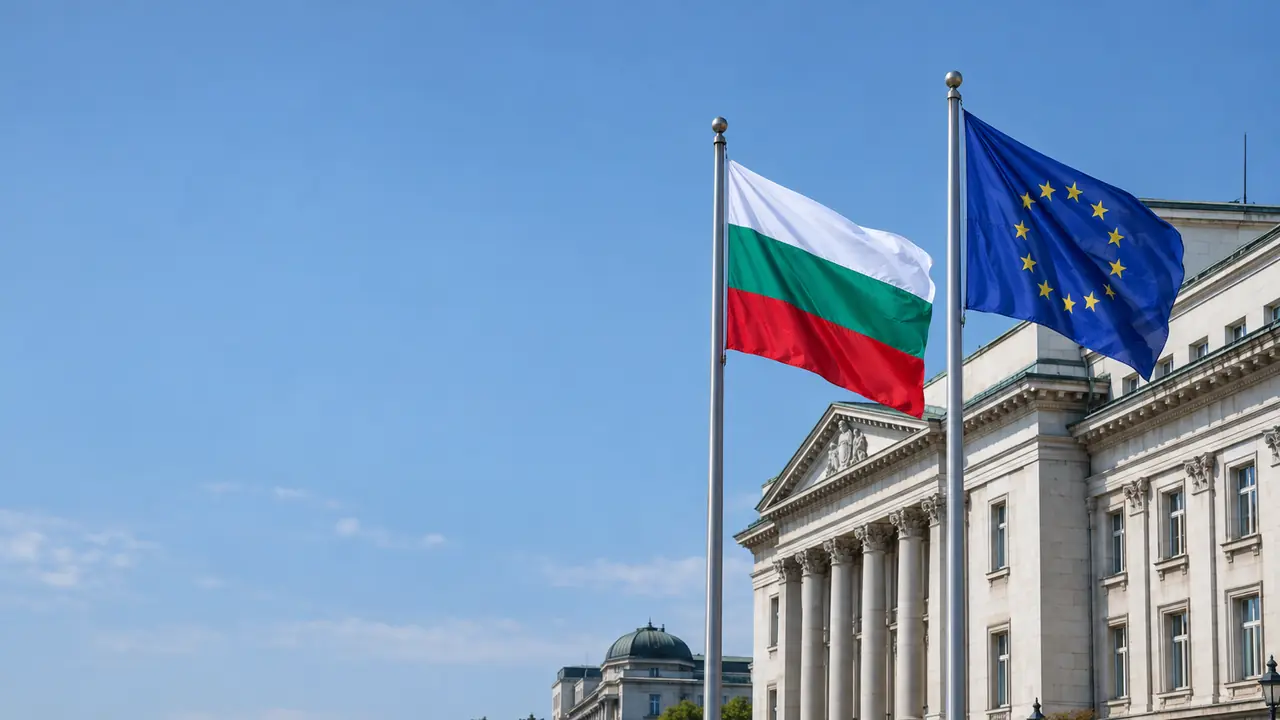
EU, NATO, Euro and Schengen Member
Timeline
| Date | Step |
|---|---|
| 29 March 2004 | Joins NATO, with Estonia, Latvia, Lithuania, Romania, Slovakia and Slovenia |
| 1 January 2007 | Joins the European Union |
| January to June 2018 | Holds the presidency of the Council of the EU |
| 31 March 2024 | Joins Schengen for air and sea travel |
| 1 January 2025 | Land border checks with the rest of Schengen lifted |
| 1 January 2026 | Adopts the euro and becomes the 21st euro area country |
Source: NATO: Relations with Bulgaria and the 2004 enlargement; European Union: Bulgaria country profile; European Commission: Bulgaria and Romania join the Schengen Area; European Central Bank: Bulgaria joins the euro area1,2,3,4
What it means for business
- Single market: goods, services and capital move freely to the other 26 EU countries and their 452 million people, under EU rules on competition, state aid and public procurement.
- Euro: no exchange costs or currency risk with the euro area, prices and accounts in euro, and the European Central Bank as the central bank.
- Schengen: no border checks with the other Schengen countries, so trucks from Bulgaria to Germany no longer wait at internal EU borders.
- NATO: a member of the Western security alliance for more than two decades.
Source: Eurostat: EU population on 1 January 2026; European Central Bank: Bulgaria joins the euro area; European Commission: Bulgaria and Romania join the Schengen Area5,4,3
The euro
The lev was fixed to the euro under a currency board from 1999, at 1.95583 leva to the euro. On 1 January 2026 Bulgaria replaced it with the euro at that same rate, so contracts and prices converted without any change in value.4
Bulgaria is also in the final stage of joining the OECD. The government says it remains a key priority.6
In the EU institutions
| Members of the European Parliament | 17 |
|---|---|
| Area | 110,996 km² |
| Capital | Sofia |
| Currency | Euro |
Source: European Union: Bulgaria country profile2
Frequently Asked Questions
When did Bulgaria join the European Union?
Bulgaria became a member of the European Union on 1 January 2007. Its businesses operate under EU rules, and goods, services and capital can move freely between Bulgaria and the other 26 EU countries.
Is Bulgaria a full member of the Schengen area?
Yes. Bulgaria became a full member of the Schengen area on 1 January 2025, after joining for air and sea travel on 31 March 2024. Land border checks with the rest of Schengen were lifted on 1 January 2025.
When did Bulgaria adopt the euro, and at what exchange rate?
Bulgaria adopted the euro on 1 January 2026, becoming the 21st euro area country. The lev was fixed to the euro at 1.95583 leva to the euro, and contracts and prices converted at that same rate without any change in value.
When did Bulgaria join NATO?
Bulgaria joined NATO on 29 March 2004. It has been a member of the Western security alliance for more than two decades.
What does Bulgaria’s EU membership mean for businesses?
Bulgaria’s EU membership lets goods, services and capital move freely to the other 26 EU countries and their 452 million people. Businesses operate under EU rules on competition, state aid and public procurement.
Is Bulgaria a member of the OECD?
Bulgaria is in the final stage of joining the OECD, and its government says accession remains a key priority for the country.
Sources
- NATO: Relations with Bulgaria and the 2004 enlargement
- European Union: Bulgaria country profile
- European Commission: Bulgaria and Romania join the Schengen Area
- European Central Bank: Bulgaria joins the euro area
- Eurostat: EU population on 1 January 2026
- BTA: Bulgaria’s OECD accession remains a key priority, Foreign Minister says
Figures checked 13 October 2026. Prepared by InvestBulgaria for general information. It is not investment, tax or legal advice; please confirm details with a qualified adviser before acting.
