National Tourist Site
About Plovdiv: Roman Theatre, History and Ethnographic Museums, Hindliyan House
At a glance
| Place | Where | Opening hours |
|---|---|---|
| Roman theatre | Old Town, between Dzhambaz Tepe and Taksim Tepe | November–March 9:00–17:00, April–October 9:30–18:00, every day |
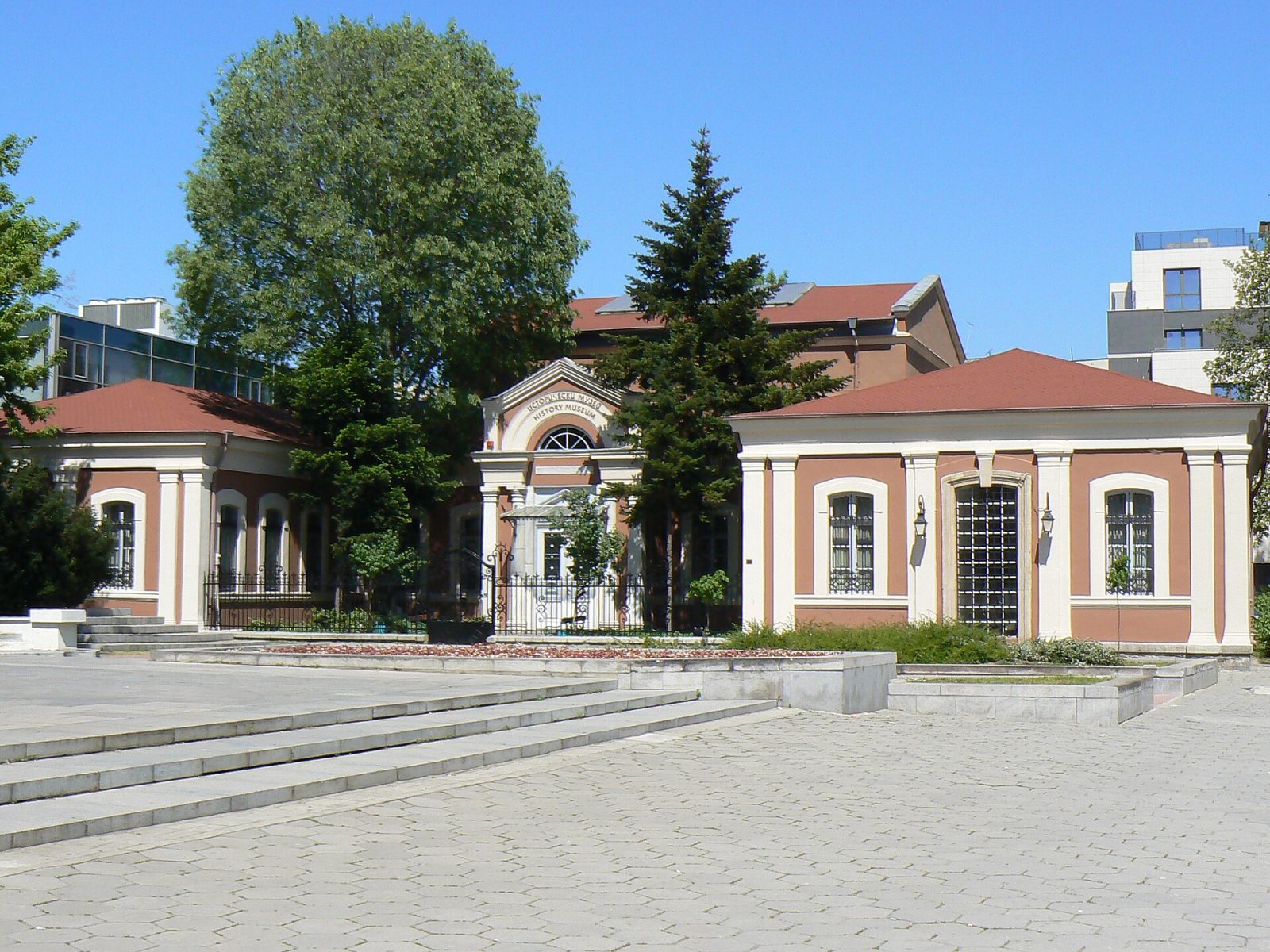
| Regional History Museum | Three buildings in the Old Town | Monday to Friday 8:00–17:00; closed at the weekend |
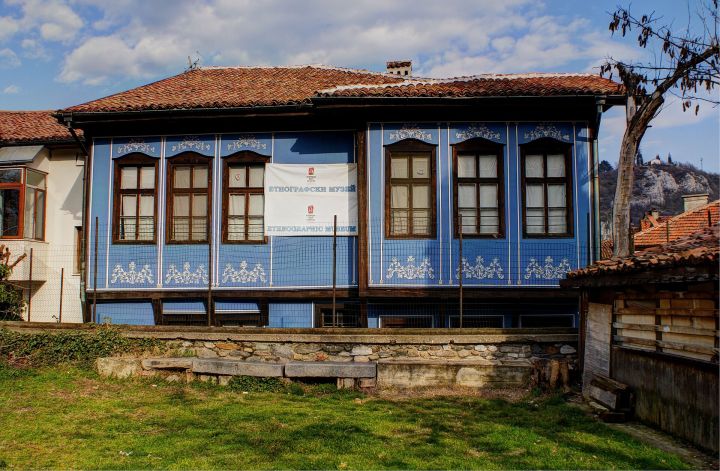
| Regional Ethnographic Museum | 2 Dr Stoyan Chomakov Street | Tuesday to Sunday 9:00–18:00 in summer and 9:00–17:00 in winter; closed on Monday |
| Hindliyan House | 4 Artin Gidikov Street | Tuesday to Sunday, November–March 9:00–17:30, April–October 9:30–18:00; lunch break 12:30–13:00 |
Source: Bulgarian Tourist Union: Roman theatre, Plovdiv (100 National Tourist Sites, in Bulgarian); Bulgarian Tourist Union: History Museum, Plovdiv; Bulgarian Tourist Union: Ethnographic Museum, Plovdiv; Bulgarian Tourist Union: Hindliyan House; Wikipedia (Bulgarian): Hindliyan House1,2,3,4,7
The Roman theatre
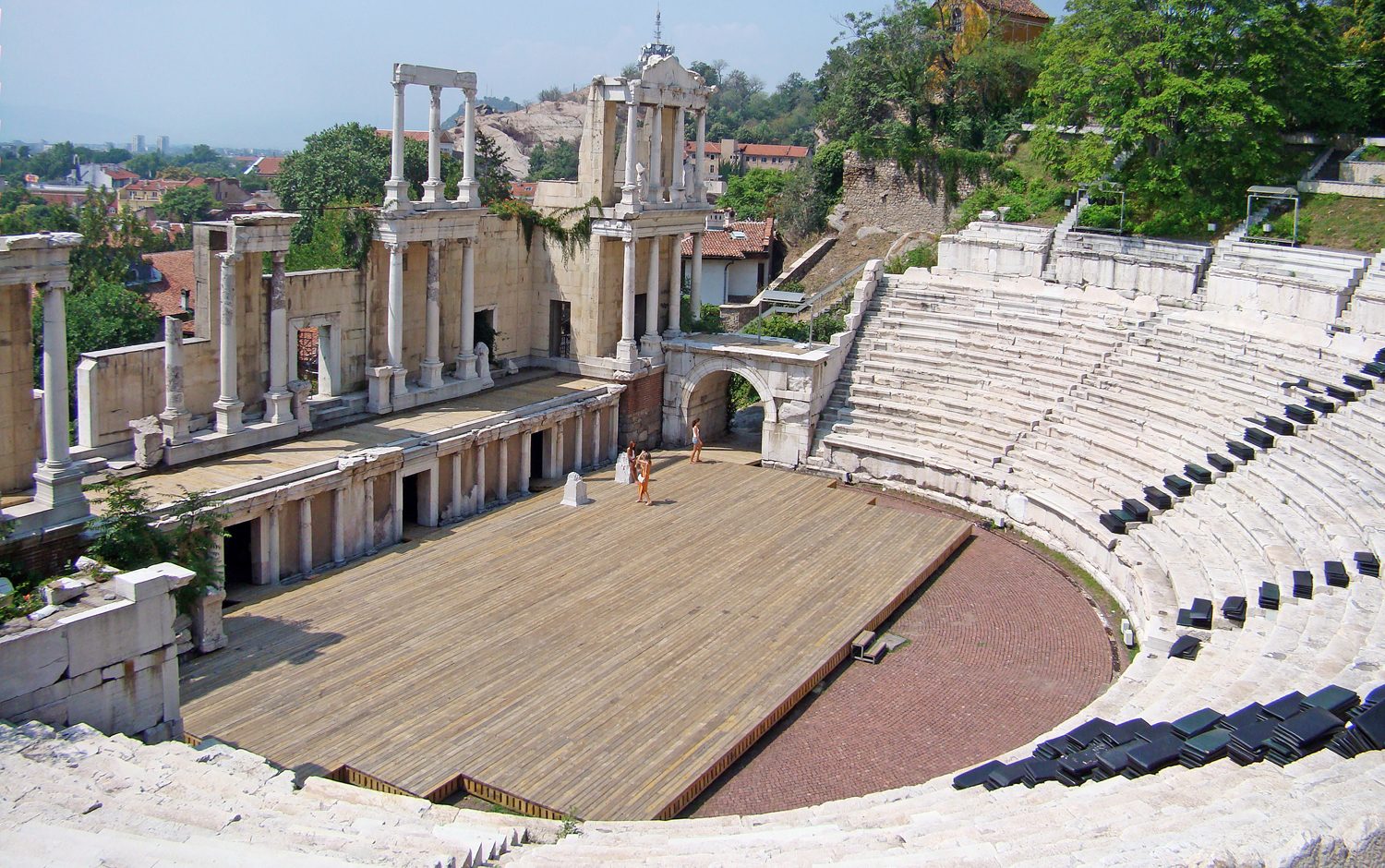
The theatre of Philippopolis sits on the southern slope of the Three Hills, in the saddle between Dzhambaz Tepe and Taksim Tepe, with its seats facing south over the lower town towards the Rhodope Mountains. It is a semicircle with an outer diameter of 82 m. The open seating area, the cavea, has 28 concentric rows of marble seats, divided into two tiers by an aisle and cut by narrow stairways into wedge-shaped sectors around a horseshoe-shaped orchestra 26.64 m across.5,6
Behind the orchestra stands the three-storey stage building. Its 3.16 m stage front is decorated with an Ionic marble colonnade, and the facade facing the audience has two storeys of porticos, Ionic below and Corinthian above, cut by three doors. The English Wikipedia notes that the seats carried the names of the city quarters, that honorary inscriptions show the building served as the seat of the Thracian provincial assembly, and that barriers in front of the first row suggest animal fights were staged here, perhaps for the visit of Emperor Caracalla in 214 AD.5,6
Archaeologists of the Plovdiv Archaeological Museum excavated the theatre from 1968 to 1979, and it was declared an archaeological monument in 1995. The restoration used anastylosis, so new stone is clearly distinguishable from the original. Today the theatre is used again for plays, concerts and opera in the summer months.5,6
The sources differ on when the theatre was built and how many it holds. The Bulgarian Wikipedia and the Bulgarian Tourist Union date it to the reign of Trajan (98–117), early in the 2nd century; the union also mentions a theory that it was built before the Roman period. The English Wikipedia says it was built in the 1st century AD, probably under Domitian. The English Wikipedia gives 5,000–7,000 spectators; the Bulgarian Wikipedia says about 3,500 can attend performances today.1,5,6
The History Museum
According to the Bulgarian Tourist Union, the four departments of the Regional History Museum are spread over three buildings in the Old Town.2
| Exhibition | Where |
|---|---|
| “The Bulgarian National Revival”: documents, objects and valuables of figures in the struggle for church and national independence | The house of Dimitar Georgiadi, a wealthy merchant |
| “The Unification of the Principality of Bulgaria and Eastern Rumelia, 1885” | The former Regional Assembly building |
| “Modern History”: the First Exhibition of 1892 and the city between the two World Wars | The former Regional Assembly building |
| “Book Publishing in Plovdiv during the Revival” | The house of Hristo G. Danov, the publisher the union calls “the Bulgarian Gutenberg”, who lived there until his death in 1911 |
Source: Bulgarian Tourist Union: History Museum, Plovdiv2
The Ethnographic Museum
The idea of an ethnographic museum dates from 1891. On the proposal of the teacher and publisher Stoyu Shishkov, a district museum was founded on 22 January 1917, with Yordan p. Georgiev as director and Shishkov as secretary. By 1930 it held over 500 items, but in 1931–1932 the collection was handed to the National Library and Museum to save money.3
A second start came in 1938, when the mayor Bozhidar Zdravkov chose the Kuyumdzhiev house, which the union calls the most representative house of Revival Plovdiv, as a municipal house museum. It opened on 14 October 1943, became the People’s Ethnographic Museum in 1949, and opened a permanent exhibition in 1952, renewed in 1962.3
Today more than 40,000 items are kept in six collections: farming, crafts, textiles and costume, furniture and interiors, musical instruments and ritual objects, and fine art, with a photo library, a research archive and a library.3
The Hindliyan House
The house of Stepan Hindliyan, founder of one of the four wealthiest Armenian families in Plovdiv, is one of the few symmetrical Plovdiv houses preserved in their original form. Hindliyan was a merchant whose trade took him to India, which gave him his name. Two painters, one of them Italian, decorated not only the walls but also the ceilings.4,7
The Bulgarian Wikipedia adds that the house is symmetrical only inside because of the irregular plot, that the courtyard holds outbuildings, a cellar and a bath, and that this bath, with running hot and cold water, is the only one of its kind preserved. The neighbouring Balabanov House gives the two houses the look of one ensemble. Today the house is a museum and exhibition venue.7
The Bulgarian Tourist Union dates the house to 1834–1835 and says its builders are unknown. The Bulgarian Wikipedia says Hindliyan built it in 1848 as a dowry for his daughter, who married the Armenian merchant Artin Gidikov from Chișinău.4,7
Tickets and opening hours
| Ticket for the theatre and the Hindliyan House | Price listed by the Bulgarian Tourist Union |
|---|---|
| Adults | €3.58 |
| Students and visitors over 65 | €1.53 |
| Family ticket (parents with children aged 7–16) | €7.16 |
| Groups of more than 10, per person | €3.07 |
| Groups of students or over-65s, per person | €1.02 |
Source: Bulgarian Tourist Union: Roman theatre, Plovdiv (100 National Tourist Sites, in Bulgarian)1
These prices apply to all sites of the municipal institute Old Plovdiv except the Episcopal Basilica and the Roman stadium. Entry is free for students and pensioners on the first Thursday of each month, on 6 September, the day of the Unification and of the city of Plovdiv, and during the European and the Plovdiv nights of museums and galleries.1
| Museum ticket | Price listed by the Bulgarian Tourist Union |
|---|---|
| History Museum, adults | 4 leva |
| History Museum, pupils | 1 lev |
| History Museum, family ticket | 5 leva |
| History Museum, “grandparents and grandchild” ticket | 3 leva |
| History Museum, guided talk in a foreign language | 20 leva |
| Ethnographic Museum, adults | 6 leva |
| Ethnographic Museum, pupils and students | 2 leva |
| Ethnographic Museum, family ticket | 10 leva |
| Ethnographic Museum, guided talk in English | 20 leva |
Source: Bulgarian Tourist Union: History Museum, Plovdiv; Bulgarian Tourist Union: Ethnographic Museum, Plovdiv2,3
Children under 7 enter both museums free. The union lists the museum prices in leva, the currency before the euro, so they may be out of date. Its own page for the Hindliyan House still gives 5 leva for adults, while its theatre page includes the house in the euro prices above. Checked in November 2026.1,2,3,4
The No. 41 stamp
The theatre and the three museums share No. 41 in “Know Bulgaria – 100 National Tourist Sites”, the movement the Bulgarian Tourist Union started in 1966. Walkers collect a stamp at each site in a booklet: 25 stamps earn a bronze badge, 50 a silver badge and all 100 a gold badge with a certificate.8
More stamps nearby
- No. 41a: the Roman stadium of Philippopolis, under the main street.
- No. 41b: the Episcopal Basilica, Small Basilica and Irini building.
- No. 42: the Perushtitsa History Museum, south-west of Plovdiv.
- No. 47b: Bachkovo Monastery, south of Asenovgrad.
Source: Bulgarian Tourist Union: 100 National Tourist Sites8
For the city itself, see our Plovdiv city guide and the Plovdiv province page.
Frequently Asked Questions
When was the Plovdiv Roman theatre built?
The Bulgarian Wikipedia and the Bulgarian Tourist Union say under Emperor Trajan, early in the 2nd century; the English Wikipedia says the 1st century AD, probably under Domitian.
Is the Roman theatre still used?
Yes. After its excavation in 1968–1979 and restoration it hosts plays, concerts and opera in the summer months.
How much is a ticket to the Roman theatre?
The Bulgarian Tourist Union lists €3.58 for adults and €1.53 for students and visitors over 65.
Which day is the History Museum closed?
The union gives Monday to Friday, 8:00–17:00, with the museum closed on Saturday and Sunday.
When was the Hindliyan House built?
The Bulgarian Tourist Union says 1834–1835; the Bulgarian Wikipedia says 1848.
Which tourist-site number are the Plovdiv theatre and museums?
No. 41 in the Bulgarian Tourist Union’s 100 National Tourist Sites.
Sources
- Bulgarian Tourist Union: Roman theatre, Plovdiv (100 National Tourist Sites, in Bulgarian)
- Bulgarian Tourist Union: History Museum, Plovdiv (in Bulgarian)
- Bulgarian Tourist Union: Ethnographic Museum, Plovdiv (in Bulgarian)
- Bulgarian Tourist Union: Hindliyan House (in Bulgarian)
- Wikipedia (Bulgarian): Ancient theatre of Philippopolis
- Wikipedia: Roman theatre of Philippopolis
- Wikipedia (Bulgarian): Hindliyan House
- Bulgarian Tourist Union: 100 National Tourist Sites (in Bulgarian)
Figures checked 12 November 2026. Information only, not investment, tax or legal advice.