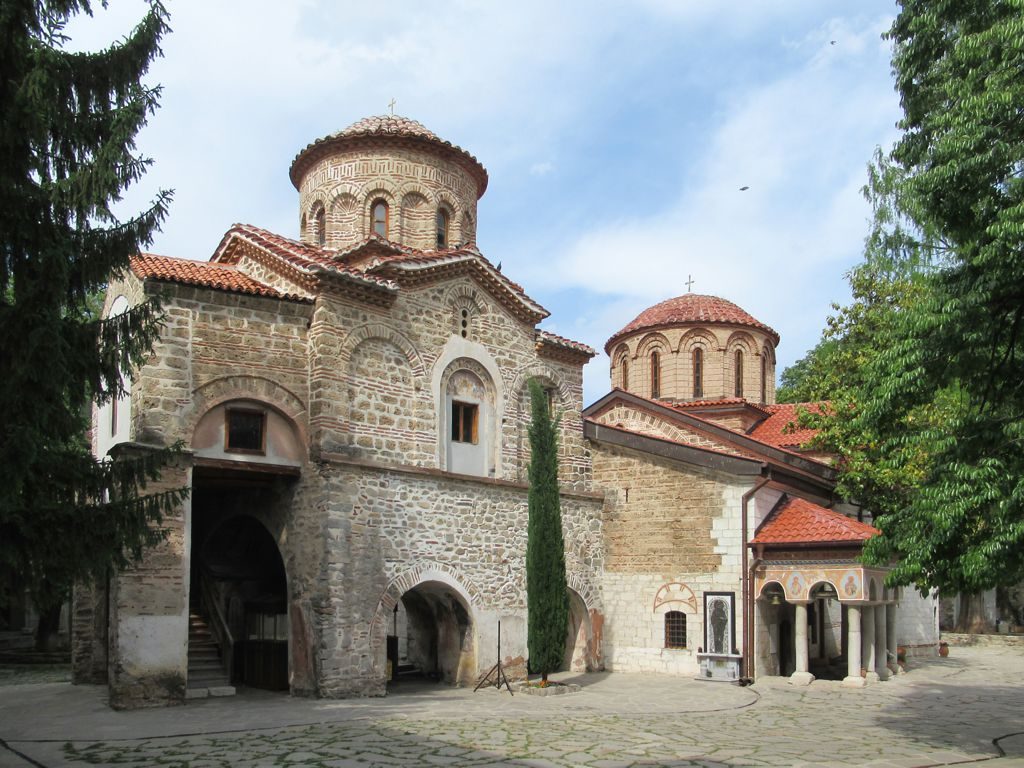
National Tourist Site
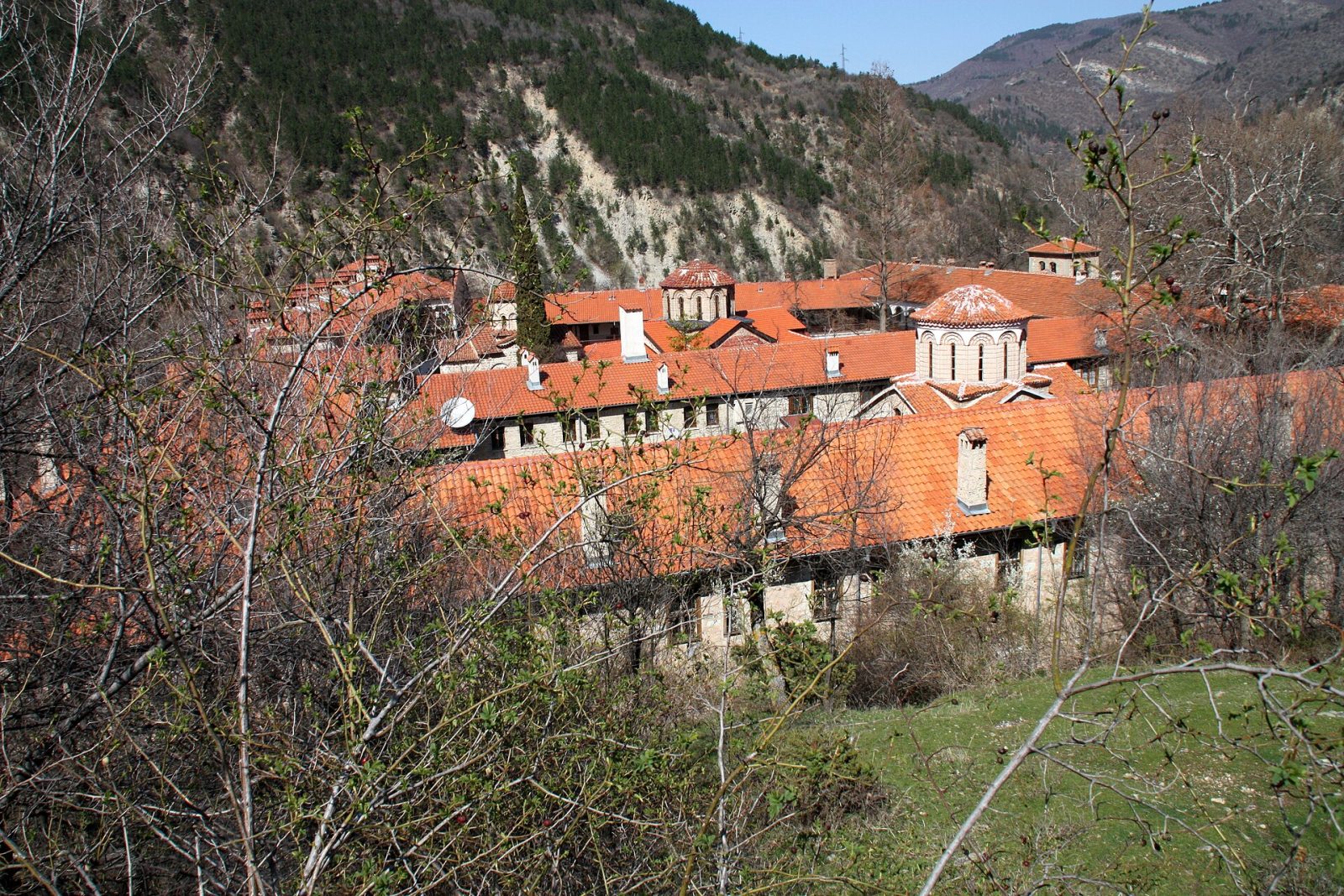
About Bachkovo Monastery
At a glance
| Tourist site | No. 47b, Bachkovo Monastery, village of Bachkovo |
|---|---|
| Where | The valley of the Chepelarska river, also called the Chaya, about 10 km south of Asenovgrad |
| Feast day | 15 August, the Dormition of the Virgin |
| Opening hours | Winter 7:00–19:00, summer 7:00–20:00 |
| Phone | +359 3327 22 77; +359 889 278 583 |
Source: Bulgarian Tourist Union: Bachkovo Monastery (100 National Tourist Sites, in Bulgarian); Wikipedia (Bulgarian): Bachkovo Monastery1,2
Both the Bulgarian Tourist Union and the Bulgarian Wikipedia call Bachkovo the second largest monastery in Bulgaria; the Bulgarian Wikipedia adds “after the Rila Monastery”. It is a stauropegial monastery, answering directly to the head of the church. For the town nearby, see our Asenovgrad guide.1,2
History
The monastery was founded in 1083 by Gregory Pakourianos, a Georgian commander in the service of the Byzantine emperor Alexios I Komnenos, and his brother Abasius. The statute he had written survives in Greek and Georgian copies; it kept lay and church authorities out of the monastery’s affairs and required the monks to know Georgian. Bachkovo grew as a centre of Georgian monasticism, where the philosopher Ioane Petritsi worked.2,3
In 1344 the area passed to the Bulgarian tsar Ivan Alexander, whose portrait survives in the ossuary. After Tarnovo fell in 1393, Patriarch Euthymius was exiled “to Stenimah”, believed to mean Bachkovo, and he died around 1404. The Bulgarian Tourist Union writes that he is thought to be buried under the altar of the church of the Archangels.1,2,3
The English Wikipedia says the monastery was looted and destroyed after the Ottoman conquest and restored near the end of the 15th century. Under Abbot Parteniy the main church of the Dormition was built in 1604. The monastery joined the Bulgarian Exarchate on 8 December 1894 at the monks’ request.2,3
What to see
| Building | What it is |
|---|---|
| Ossuary | The only building left from the 11th century, about 300 m from the monastery: two storeys, a crypt with 14 burial niches below and the church of the Holy Trinity above, with a portrait of Tsar Ivan Alexander |
| Church of the Dormition, 1604 | The main church, which keeps the miracle-working icon of the Virgin |
| Refectory | With a gallery of 17th-century frescoes, including the Last Judgement, the seven Ecumenical Councils and the Akathist hymn, cleaned in 1967–1972 |
| Church of the Archangels | A medieval church whose arched passage was painted by Zahari Zograf in 1841 |
| Church of St Nicholas | Built in 1834–1837 in the south courtyard; Zahari Zograf painted it with more than 600 figures and left his self-portrait |
Source: Bulgarian Tourist Union: Bachkovo Monastery (100 National Tourist Sites, in Bulgarian); Wikipedia (Bulgarian): Bachkovo Monastery; Wikipedia (English): Bachkovo Monastery1,2,3
The English Wikipedia says the monastery museum keeps church plate, icons and books, a sultan’s firman of 1452 and a carved wooden cross with miniatures. The “Panorama” mural on the outer wall of the refectory shows the monastery from above, with its founders in monastic dress.3
The sources differ on several dates. The Bulgarian Tourist Union says the two-storey building with the old kitchen dates from 1601; the English Wikipedia says the refectory was rebuilt in 1601 and the Bulgarian Wikipedia dates it to 1623. The Bulgarian Wikipedia dates Zograf’s St Nicholas frescoes to 1840, and the English Wikipedia dates his Last Judgement there to 1850.1,2,3
The icon of the Virgin
The monastery’s greatest treasure is its icon of the Virgin. Only the faces of the Virgin and Child are visible; the rest is covered by two silver casings. The older casing bears an inscription saying it was given in 1311 by the Georgians Atanasiy and Okropir.2
Every year on the Monday after Easter, for more than 350 years, the icon has been carried in procession to the Kluviya area, where it is said to have been hidden under Ottoman rule. A second procession against illness and disaster is held on the 25th day after Easter. Some pilgrims spend the night in the church of the Annunciation in Asenovgrad and walk to Bachkovo the next day.1
The Bulgarian Tourist Union says the icon itself was given by Georgian pilgrims in 1311, and the English Wikipedia dates the icon to 1310. The Bulgarian Wikipedia ties the 1311 date to the older silver casing.1,2,3
Visiting
The Bulgarian Tourist Union lists opening hours of 7:00–19:00 in winter and 7:00–20:00 in summer, and gives no entry fee for the monastery. Checked in November 2026.1
The No. 47b stamp
The monastery is site No. 47b in “Know Bulgaria – 100 National Tourist Sites”, the movement the Bulgarian Tourist Union started in 1966. Walkers collect a stamp at each site in a booklet: 25 stamps earn a bronze badge, 50 a silver badge and all 100 a gold badge with a certificate.4
More stamps nearby
- No. 47: Asen’s Fortress, above Asenovgrad.
- No. 47a: the Asenovgrad History Museum.
- No. 42: the Perushtitsa History Museum.
- No. 41: the Roman theatre and the Old Town museums, Plovdiv.
Source: Bulgarian Tourist Union: 100 National Tourist Sites4
For the area, see the Plovdiv province page.
Frequently Asked Questions
Who founded the Bachkovo Monastery?
Gregory Pakourianos, a Georgian commander in Byzantine service, and his brother Abasius, in 1083.
What is the oldest building?
The ossuary, about 300 m from the monastery, the only building left from the 11th century.
When is the icon carried in procession?
On the Monday after Easter, to the Kluviya area, and again on the 25th day after Easter.
What are the opening hours?
The Bulgarian Tourist Union lists 7:00–19:00 in winter and 7:00–20:00 in summer.
Which tourist-site number is the Bachkovo Monastery?
No. 47b in the Bulgarian Tourist Union’s 100 National Tourist Sites.
Sources
- Bulgarian Tourist Union: Bachkovo Monastery (100 National Tourist Sites, in Bulgarian)
- Wikipedia (Bulgarian): Bachkovo Monastery
- Wikipedia (English): Bachkovo Monastery
- Bulgarian Tourist Union: 100 National Tourist Sites (in Bulgarian)
Figures checked 12 November 2026. Information only, not investment, tax or legal advice.