National Tourist Site
About Roman Stadium of Philippopolis
At a glance
| Tourist site | No. 41a, “Roman Stadium”, Plovdiv |
|---|---|
| Address | Hristo G. Danov Street, Old Town; the curved end is on Dzhumaya Square |
| Built | Early 2nd century, under Emperor Hadrian (117–138) |
| Opening hours | Every day, November–March 9:30–17:30, April–October 9:30–18:00 |
| Phone | +359 876 192 700; +359 32 62 70 82 |
Source: Bulgarian Tourist Union: Roman Stadium, Plovdiv (100 National Tourist Sites, in Bulgarian); Wikipedia (Bulgarian): Ancient stadium of Philippopolis1,2
The stadium
The stadium lay at the northern edge of the walled city, between the two fortress walls, in the natural fold between the western slope of Taksim Tepe and the eastern slope of Sahat Tepe. It measured about 240 m by 50 m. The running track was one stadion long: 600 Greek or 625 Roman feet, about 180 m. It was declared a national cultural monument in 1995.1,2
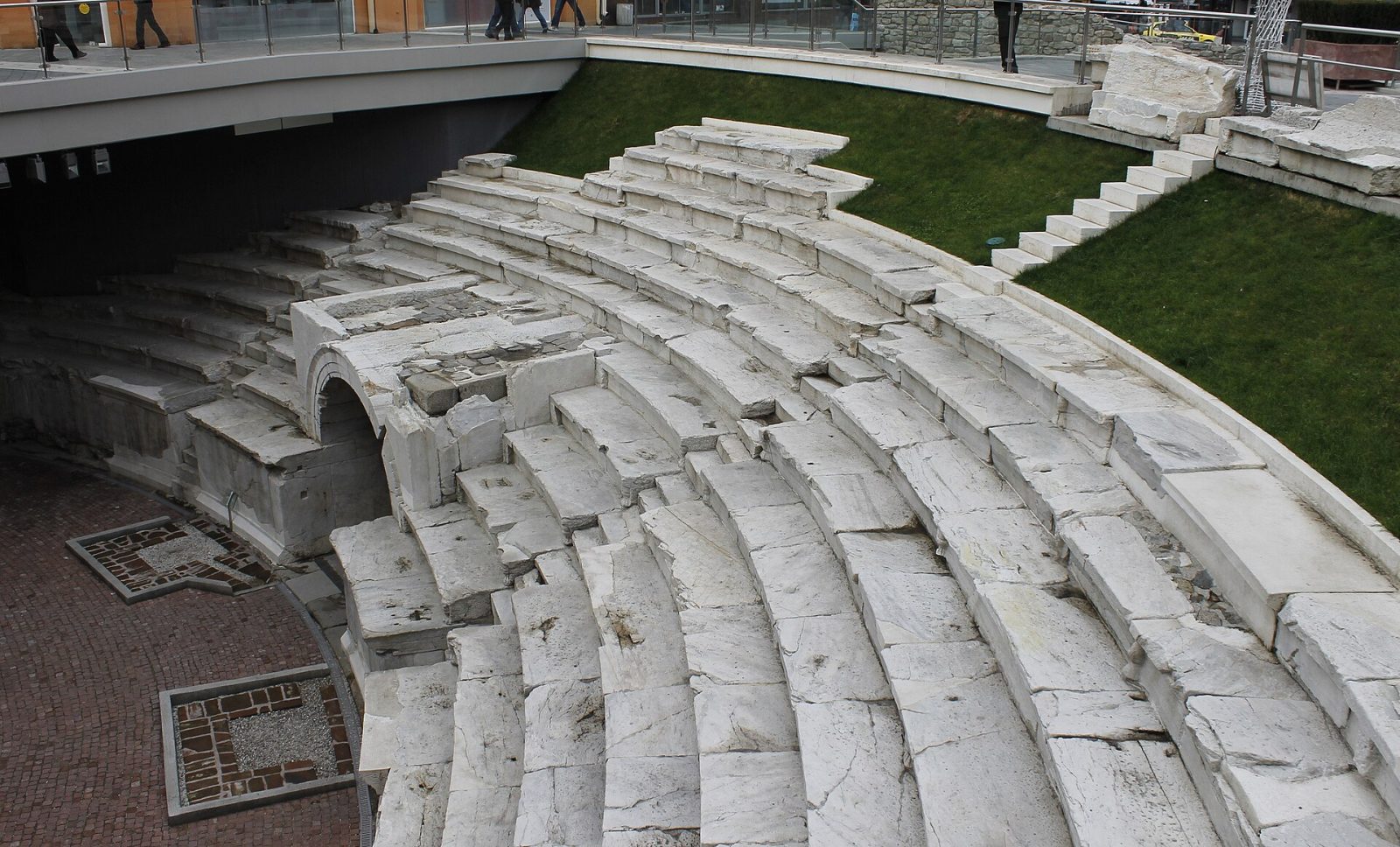
Spectators sat on 14 rows of solid marble blocks, decorated with a stylised lion’s paw, divided by stairways down to the track. The front of the first row was faced with marble slabs 1.80 m high, and the seats of the top row had backrests.2
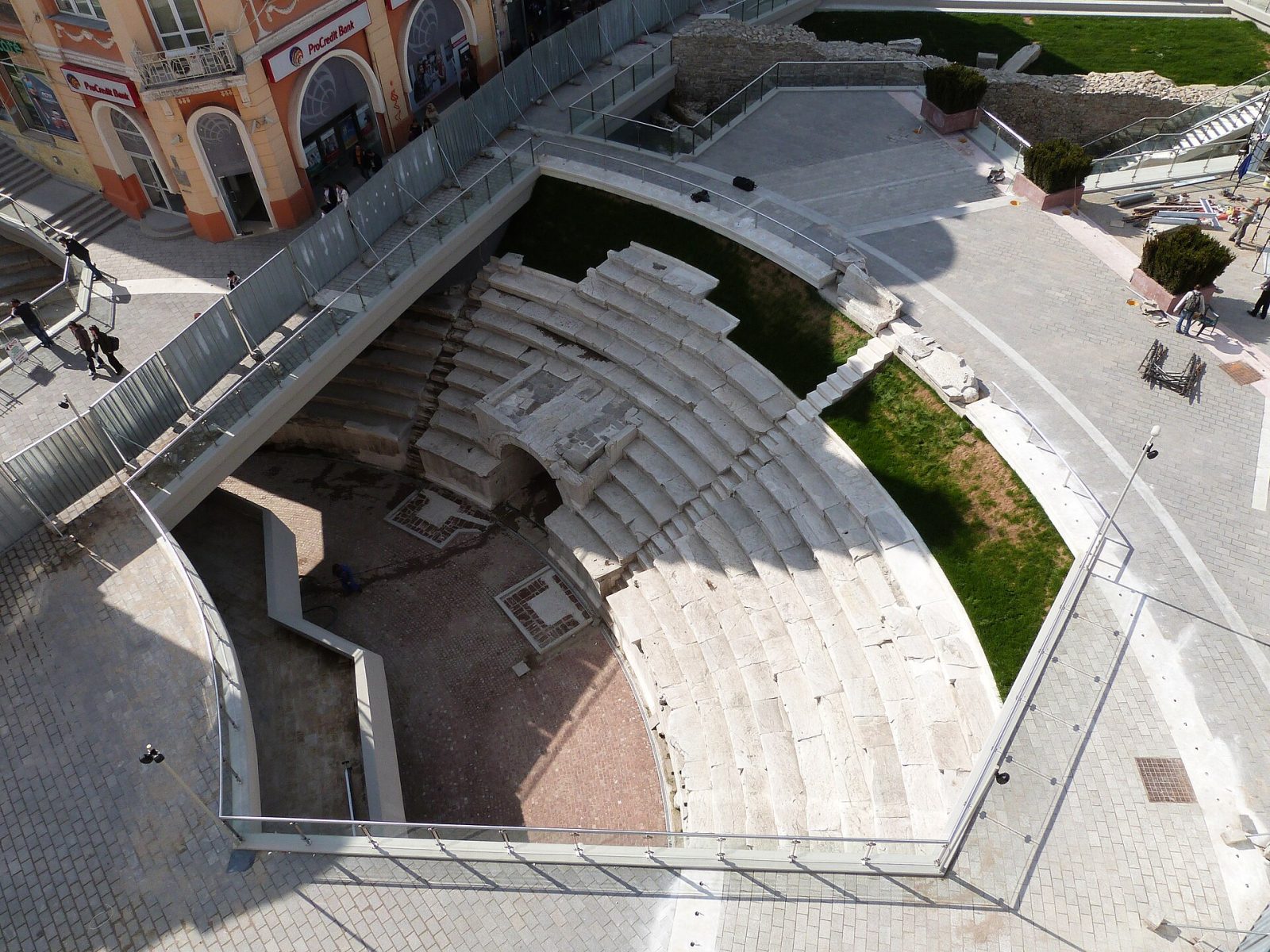
Today the stadium is in the city centre, under the main street. Only its curved northern end, the sphendone, is exposed on Dzhumaya Square; most of the rest lies under the buildings along the street, and the main entrance was where Kamenitsa Square is now.2
What to see
- The sphendone, with its rows of seats and a vaulted entrance underneath that linked the track to an underground passage. A box for officials was built above the vault.
- Part of the city wall of Philippopolis in the north side of the passage, built in the 2nd century and repaired in the 3rd–4th, and the pillars of a 4th-century aqueduct that crossed the area.
- The pillars of the entrance, faced with marble pilasters carved with busts of Hermes, prize vases with palm branches, and the lion skin, club and quiver of Heracles.
- A draughts board scratched into a seat above the box, shown in the Bulgarian Wikipedia’s gallery.
Source: Wikipedia (Bulgarian): Ancient stadium of Philippopolis2
The second and final stage of the reconstruction began on 2 October 2013. It replaced a concrete stair with an openwork staircase, added a platform for wheelchair users between the two levels, and built an information centre, a café on the terrace and a cinema of about 40 seats that shows 3D films about ancient Plovdiv on an oval screen. The Bulgarian Wikipedia gives the cost of that stage as 500,000 leva.2
The games of Philippopolis
Inscriptions and coins show that the city held Pythian games on the Greek model. They were renamed the Alexandrian games for the visit of Emperor Caracalla in 214 and the Kendrisian games for that of Elagabalus in 218. The common assembly of the province of Thrace organised them, and the Philippopolis mint struck special coins with the emperor’s portrait and scenes from the contests.2
A marble slab found in the sphendone shows that Antinous, the favourite of Emperor Hadrian, was also honoured with contests here. Athletes competed in two age groups, men and boys, under officials called agonothetes. The games opened with a contest for heralds and trumpeters and included music, poetry and drama competitions.2
Tickets and opening hours
| Ticket | Price listed by the Bulgarian Tourist Union |
|---|---|
| The exhibition at the sphendone | Free |
| Cinema, adults | €3.68 |
| Cinema, students and visitors over 65 | €1.84 |
| Cinema, groups of more than 10, per person | €3.07 |
| Cinema, groups of students or over-65s, per person | €1.23 |
Source: Bulgarian Tourist Union: Roman Stadium, Plovdiv (100 National Tourist Sites, in Bulgarian)1
The stadium is run by the municipal institute Old Plovdiv, which also runs the Roman theatre, the Hindliyan House and the basilicas. Its sites are free for students and pensioners on the first Thursday of each month, on 6 September and during the European and the Plovdiv nights of museums and galleries.1
The union has two pages for this stamp. The newer one gives the euro prices above; the older one lists a ticket of 5 leva for adults and 2 leva for pupils and students, in the currency before the euro. Checked in November 2026.1,3
The No. 41a stamp
The Roman stadium is site No. 41a in “Know Bulgaria – 100 National Tourist Sites”, the movement the Bulgarian Tourist Union started in 1966. Walkers collect a stamp at each site in a booklet: 25 stamps earn a bronze badge, 50 a silver badge and all 100 a gold badge with a certificate.4
More stamps nearby
- No. 41: the Roman theatre and the Old Town museums, a short walk uphill.
- No. 41b: the Episcopal Basilica, Small Basilica and Irini building.
- No. 42: the Perushtitsa History Museum.
- No. 47: Asen’s Fortress, above Asenovgrad.
Source: Bulgarian Tourist Union: 100 National Tourist Sites4
For the city itself, see our Plovdiv city guide and the Plovdiv province page.
Frequently Asked Questions
How big was the Roman stadium of Plovdiv?
About 240 m long and 50 m wide, with 14 rows of seats for about 30,000 spectators.
Where can I see the stadium?
Its curved northern end is open on Dzhumaya Square; most of the rest lies under the main pedestrian street.
Is the stadium free?
The exhibition at the sphendone is free. The Bulgarian Tourist Union lists €3.68 for adults for the 3D cinema.
When was the stadium built?
Early in the 2nd century, under Emperor Hadrian.
Which tourist-site number is the Roman stadium?
No. 41a in the Bulgarian Tourist Union’s 100 National Tourist Sites.
Sources
- Bulgarian Tourist Union: Roman Stadium, Plovdiv (100 National Tourist Sites, in Bulgarian)
- Wikipedia (Bulgarian): Ancient stadium of Philippopolis
- Bulgarian Tourist Union: Roman Stadium, older page (in Bulgarian)
- Bulgarian Tourist Union: 100 National Tourist Sites (in Bulgarian)
Figures checked 12 November 2026. Information only, not investment, tax or legal advice.