National Tourist Site
About Ossuary of Hristo Botev's Band, Skravena
At a glance
| Where | Village of Skravena, Botevgrad municipality, Sofia Province |
|---|---|
| Opened | 18 May 1982 |
| Key and stamp | At the information centre in the 19 Fevruari 1906 community centre (chitalishte) |
| Phone | 07137 2044 (community centre); 0890 576512 (Tsanka Yordanova) |
Source: Bulgarian Tourist Union: Ossuary monument of Botev’s rebels (100 National Tourist Sites, in Bulgarian); Wikipedia (Bulgarian): Ossuary monument of Botev’s rebels1,2
History
In 1876 Hristo Botev’s band was routed at Vola peak. A group led by Georgi Apostolov set out for Lyutibrod but was ambushed at Rashov Dol near Ritlite on the Iskar and killed to a man; the Bulgarian Wikipedia dates this to 2 June 1876 (21 May old style). The leader of the bashi-bazouks, Saadatin Efendi, had their heads cut off, fixed on stakes and carried to Orhanie, today’s Botevgrad, by way of Skravena.1,2
The whole village was made to watch the procession. The village elders Georgi Stamenov and Petko Studenkovski ransomed the heads, and the same evening the women of Skravena washed them, wrapped them in homespun cloth and buried them in the churchyard, where Pop Dimitar and his son Georgi held the service. In 1882 a stone cross with an inscription was set on the grave.1,2
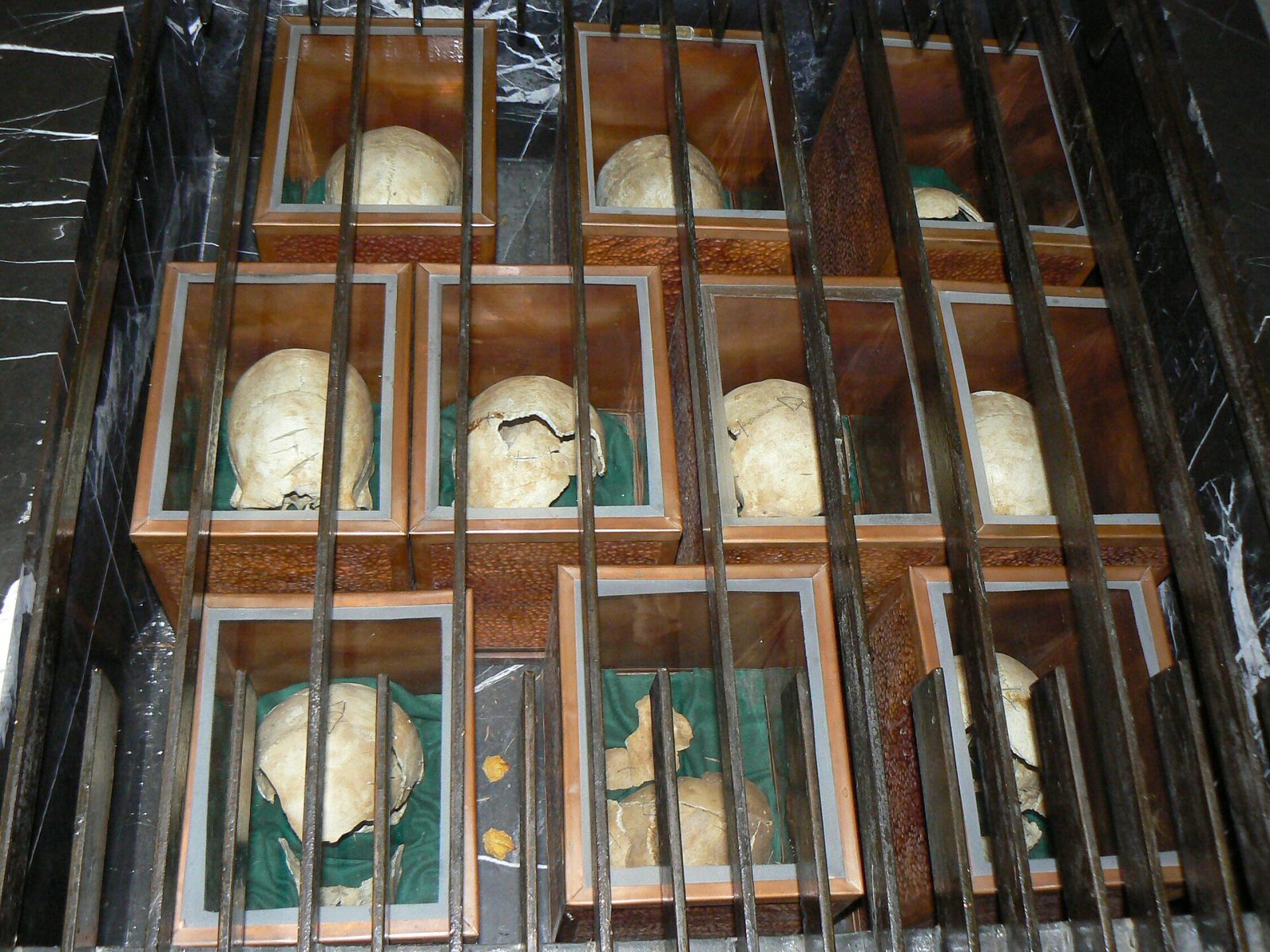
On 3 June 1930, on the proposal of the priest Georgi Popdimitrov, the remains were taken out and placed in a special display case in the church of Sts Cosmas and Damian. On 18 May 1982 they were moved to the present ossuary, designed by the architect Rositsa Grancharova with the sculptor Stefana Boyadzhieva and the artist Bozhidar Ovcharov. A team led by Dr Ek. Zaharieva examined and conserved the skulls, which lie in glass sarcophagi; among them Georgi Apostolov, secretary of the band’s staff and a native of Stara Zagora, was identified. Inside stands the sculpture “Mother’s Pain”.2
The Bulgarian Tourist Union says twelve rebels went with Apostolov and that one of the zaptiehs, Yashar Cholaka, took two of the heads to his village of Ugurtsi, today’s Gurkovo; ten stayed in Skravena. The union also says this ossuary was the reason Orhanie was renamed Botevgrad.1
What to see nearby
Commemorations began right after the Liberation: every year on 3 June the priest held a memorial service at the grave, and from the mid-1930s the event ran over two days, 2 and 3 June, also honouring the men of Skravena who died in the wars.2
- The St Nicholas Monastery, a few kilometres from Skravena, linked with the old settlement of Gramade. Its church was rebuilt on old foundations found by the priest Filip Ivanov of Chelopech, largely through the efforts of the nun Lyudmila, who is buried under the old oak in the yard.
- The Holy Transfiguration Monastery, further away and reachable only on foot. It is not active; it is thought to date from the time of Ivan Asen II, was rebuilt around 1632 and probably painted by Pimen Zografski, and its church was restored in 1930 after Prof. Petar Mutafchiev found its remains in 1915.
Source: Bulgarian Tourist Union: Ossuary monument of Botev’s rebels (100 National Tourist Sites, in Bulgarian)1
Tickets and opening hours
| Period | Hours listed by the Bulgarian Tourist Union |
|---|---|
| Winter, December to February | Monday to Friday 9:00–12:00 and 14:00–18:00 |
| Summer, March to November | Monday to Friday 9:00–12:00 and 14:00–18:00; Saturday and Sunday 10:00–18:00 |
| Tickets | Regular 2 leva; reduced 1 lev |
Source: Bulgarian Tourist Union: Ossuary monument of Botev’s rebels (100 National Tourist Sites, in Bulgarian)1
The union lists prices in leva, the currency before the euro, so they may have changed. The key and the stamp are kept at the community centre, so call ahead. Checked in November 2026.1,2
The No. 82 stamp
The ossuary is site No. 82 in “Know Bulgaria – 100 National Tourist Sites”, the movement the Bulgarian Tourist Union started in 1966. Walkers collect a stamp at each site in a booklet: 25 stamps earn a bronze badge, 50 a silver badge and all 100 a gold badge with a certificate.3
More stamps nearby
- No. 82a: the Botevgrad clock tower and museum.
- No. 63: the Etropole museum and monastery.
- No. 78: the Seven Altars Monastery, near Osenovlag.
- No. 82b: the Elin Pelin House Museum, in Baylovo.
Source: Bulgarian Tourist Union: 100 National Tourist Sites3
See also the Sofia Province page.
Frequently Asked Questions
Whose remains are in the ossuary?
The skulls of ten of Hristo Botev’s rebels from Georgi Apostolov’s group, killed at Rashov Dol near Ritlite in 1876.
Where do I get the key and the stamp?
At the information centre in the 19 Fevruari 1906 community centre in Skravena; phone 07137 2044.
How much is the ticket?
The Bulgarian Tourist Union lists 2 leva regular and 1 lev reduced.
Is it open at weekends?
From March to November, yes, 10:00–18:00. From December to February it is open on weekdays only.
Which tourist-site number is the Skravena ossuary?
No. 82 in the Bulgarian Tourist Union’s 100 National Tourist Sites.
Sources
- Bulgarian Tourist Union: Ossuary monument of Botev’s rebels (100 National Tourist Sites, in Bulgarian)
- Wikipedia (Bulgarian): Ossuary monument of Botev’s rebels
- Bulgarian Tourist Union: 100 National Tourist Sites (in Bulgarian)
Figures checked 12 November 2026. Information only, not investment, tax or legal advice.