National Tourist Site
About Sofia Synagogue
At a glance
| Tourist site | No. 65a, “Sofia Synagogue” |
|---|---|
| Location | Central Sofia, near the Central Market Hall |
| Architect | Friedrich Grünanger of Vienna |
| Opened | 9 September 1909 |
| Status | Cultural monument of national importance since 1956 |
| Museum | The Jewish Museum of History, in the building since 8 May 1992 |
Source: Bulgarian Tourist Union: Sofia Synagogue (100 National Tourist Sites, in Bulgarian); Sofia Synagogue: History; Wikipedia: Sofia Synagogue1,2,3
History of the synagogue
In the early 20th century Sofia’s Jewish community collected donations and invited the Viennese architect Friedrich Grünanger to design a new synagogue on the site of the older “Aava va Hesed” synagogue. The English Wikipedia dates the start of construction to 13 November 1905. The synagogue was opened on 9 September 1909 in the presence of Tsar Ferdinand, his wife Eleonora, Prime Minister Malinov, ministers and diplomats.2,3
On 13 April 1944 a bomb fell in the north-east corner of the building but did not explode; the blast broke the stained-glass windows. The synagogue was declared a cultural monument of national importance in 1956, and a plan in 1982 to turn it into a concert hall was withdrawn after the community opposed it.2
The Bulgarian Tourist Union notes that the synagogue, the Banya Bashi Mosque, the Orthodox church of Sveta Nedelya and the Catholic cathedral of St Joseph form what is called the “square of tolerance”.1
What to see
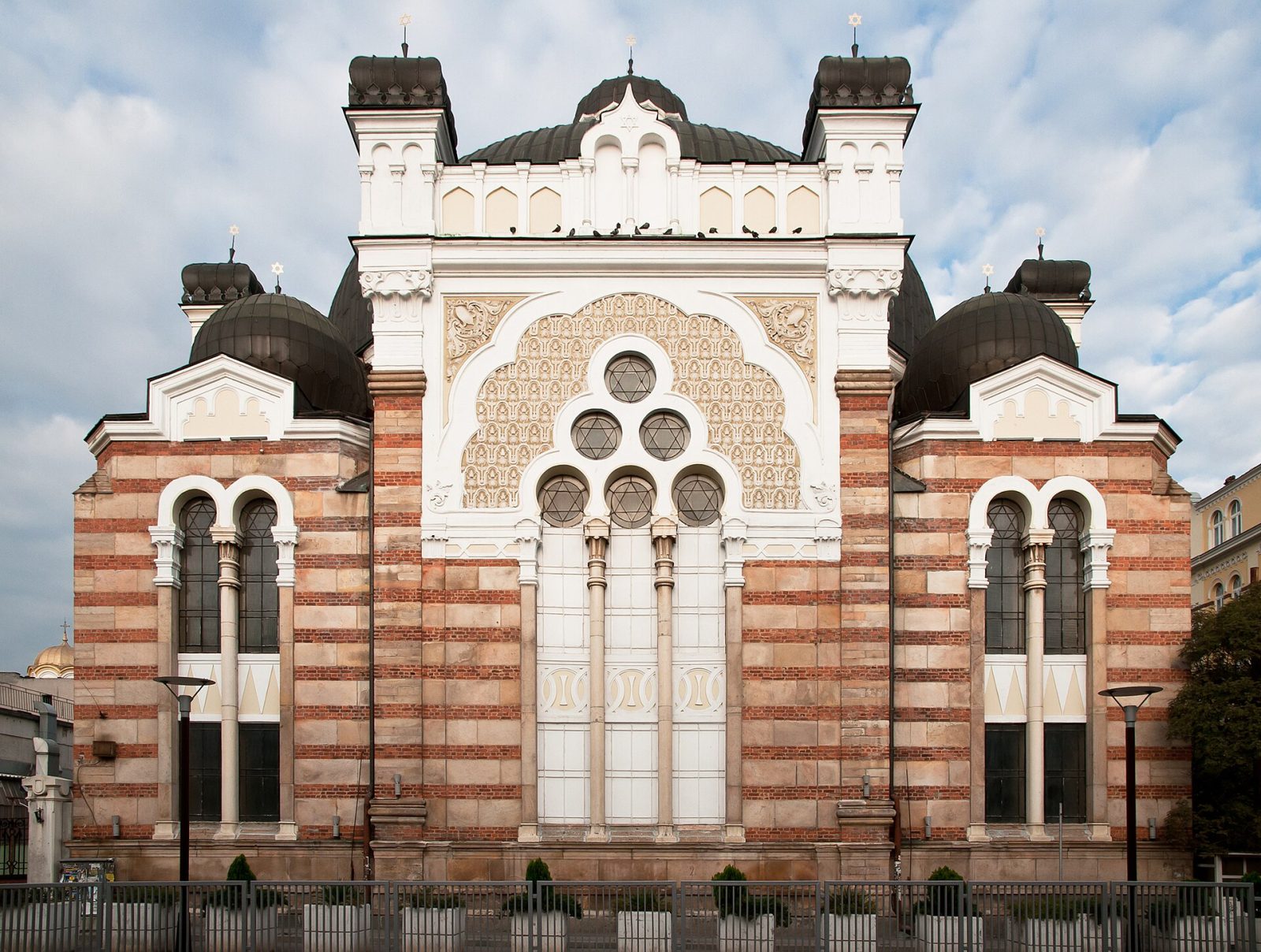
The building is in a Spanish-Moorish style with elements of the Vienna Secession. The main hall is octagonal, with four half-domes and the women’s gallery on arches; the altar, the Aron Hakodesh, stands on a white marble pedestal. The interior has multicoloured Venetian mosaics, marble columns and wood carving, and the chairs are of Slavonian oak.2
| Feature | Figure given by the synagogue |
|---|---|
| Seats in the main prayer hall | 1,170 |
| Height to the top of the dome | 31 m |
| Inner dome | 23 m high, 19 m across |
| Building footprint / total built-up area | 659 m² / 1,000 m² |
| Central chandelier | 1,700 kg of Vienna-made brass, with about 400 six-pointed stars |
| Cost of the building | 437,000 gold leva |
Source: Sofia Synagogue: History2
Since 8 May 1992 the building has housed the Jewish Museum of History, with exhibitions on the Jewish communities in Bulgaria, the Holocaust and the rescue of the Bulgarian Jews.3
The figures differ between sources. The synagogue gives 1,170 seats and a 1,700 kg chandelier; the Bulgarian Tourist Union gives room for about 1,200 worshippers and a chandelier of almost 2 tonnes; the English Wikipedia’s history section mentions about 1,300 worshippers. The synagogue calls itself one of the three largest Sephardic synagogues in Europe and the largest on the Balkan Peninsula.1,2,3
Visiting hours and entry
| Day | Hours listed by the Bulgarian Tourist Union |
|---|---|
| Sunday to Thursday | 9:00–17:00 |
| Friday | 9:00–15:00 |
| Saturday | Closed |
Source: Bulgarian Tourist Union: Sofia Synagogue (100 National Tourist Sites, in Bulgarian)1
The synagogue’s own website does not give visiting hours or entry fees. The Bulgarian Tourist Union lists 10 leva for individual visitors and 7 leva each for groups, with free entry for children under 13 and organised school visits; these are older prices in leva. Check by phone on 02 983 12 73 before visiting.1,2
The No. 65a stamp
The synagogue is site No. 65a in “Know Bulgaria – 100 National Tourist Sites”, the movement the Bulgarian Tourist Union started in 1966. Walkers collect a stamp at each site in a booklet: 25 stamps earn a bronze badge, 50 a silver badge and all 100 a gold badge with a certificate.4
More stamps nearby
- No. 68: the National Archaeological Museum.
- No. 63a: the National Gallery, in the former royal palace.
- No. 62: the National Ethnographic Museum.
- No. 65: the National Museum of Natural History.
Source: Bulgarian Tourist Union: 100 National Tourist Sites4
For the city itself, see our Sofia city guide.
Frequently Asked Questions
When was the Sofia Synagogue built?
Construction began in 1905 to a design by Friedrich Grünanger, and the synagogue opened on 9 September 1909.
Can I visit on Saturday?
No. The Bulgarian Tourist Union lists the synagogue as closed on Saturdays and on official and Jewish holidays; it is open Sunday to Thursday 9:00–17:00 and Friday 9:00–15:00.
How heavy is the chandelier?
The synagogue gives 1,700 kg of Vienna-made brass; the Bulgarian Tourist Union says almost 2 tonnes.
Which tourist-site number is the Sofia Synagogue?
No. 65a in the Bulgarian Tourist Union’s 100 National Tourist Sites.
Sources
- Bulgarian Tourist Union: Sofia Synagogue (100 National Tourist Sites, in Bulgarian)
- Sofia Synagogue: History (in Bulgarian)
- Wikipedia: Sofia Synagogue
- Bulgarian Tourist Union: 100 National Tourist Sites (in Bulgarian)
Figures checked 11 November 2026. Information only, not investment, tax or legal advice.