UNESCO World Heritage site
About Boyana Church
At a glance
| Full name | Church of St Nicholas and St Panteleimon, known as Boyana Church |
|---|---|
| Where | Boyana quarter, on the outskirts of Sofia, at the foot of Vitosha mountain |
| Address | 3 Boyansko Ezero Street, Sofia 1616 |
| Built | In three phases: late 10th or early 11th century, 13th century and mid-19th century |
| Main frescoes | 1259, commissioned by Sebastocrator Kaloyan and his wife Desislava |
| UNESCO | Inscribed in 1979 under criteria (ii) and (iii) |
| Run by | National Historical Museum, as one of its branches since 2003 |
| Ticket | €10 for adults, €3 for students and children over 7 |
Source: UNESCO World Heritage Centre: Boyana Church; Wikipedia: Boyana Church; Wikipedia: Боянска църква; Boyana Church: visitor information1,2,3,5
Why it matters
Boyana Church is a small building with a large place in the history of European art. UNESCO calls it one of the most complete and perfectly preserved monuments of east European medieval art. Its paintings of 1259 follow the Byzantine canon, but the figures have, in UNESCO’s words, a special spiritual expressiveness and vitality and harmonious proportions.1
The portraits of the donors and of the royal couple are among the oldest portraits of figures from Bulgarian history. The church is the only wholly preserved monument of the Tarnovo School of Painting from the 13th century.2
UNESCO listed the church under criterion (ii), as one of the most remarkable medieval monuments with especially fine wall paintings, and criterion (iii), for its three parts from the 10th, 13th and 19th centuries, which form a homogeneous whole.1
Three churches in one
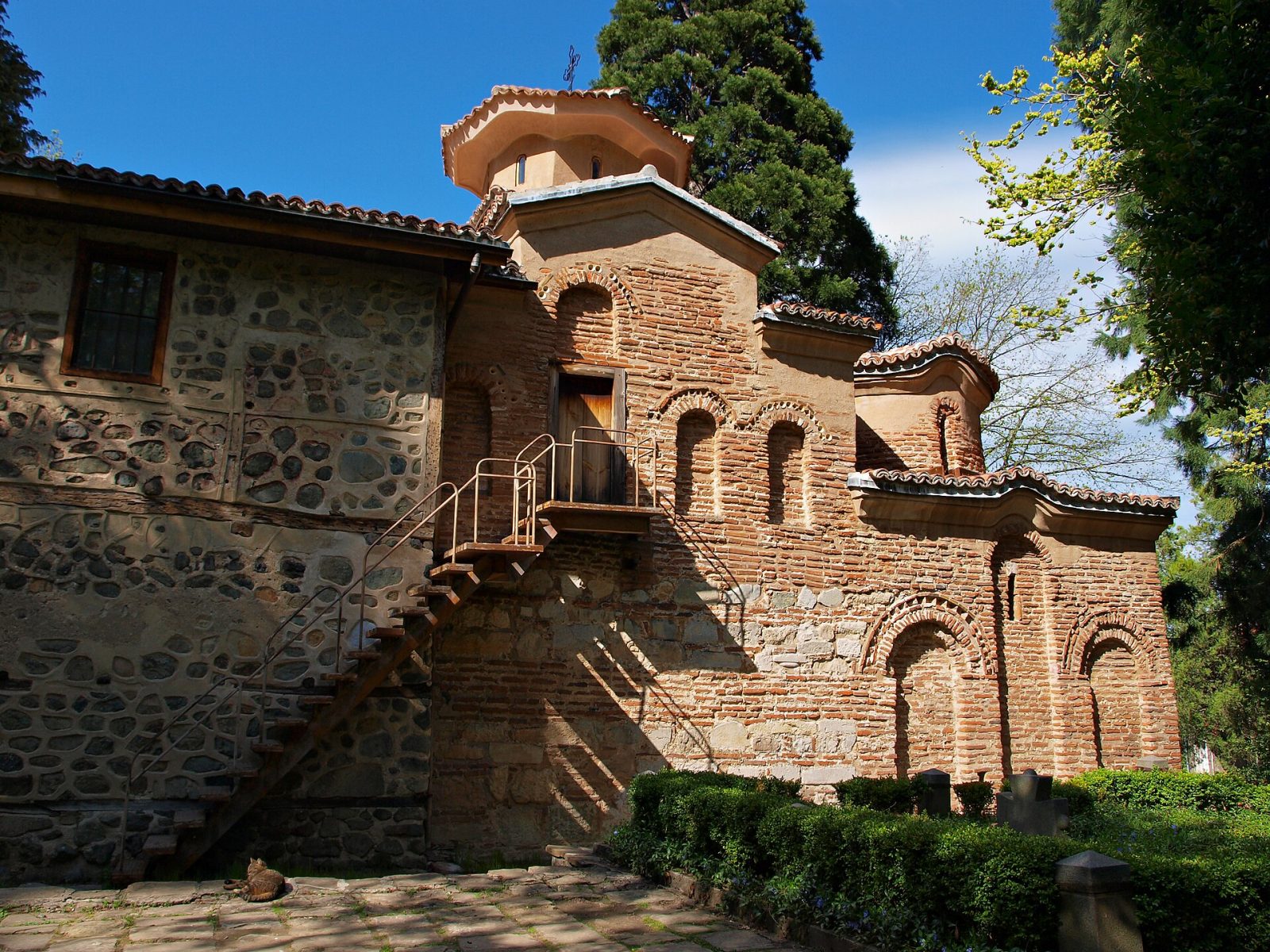
What looks like one church is in fact three buildings joined together, put up over about 900 years.1
| Part | Date | What it is |
|---|---|---|
| Eastern church | Late 10th or early 11th century | A small single-apse church with a cross-shaped vault, the oldest part of the building |
| Middle church | 13th century, painted in 1259 | A two-storey tomb church built for Sebastocrator Kaloyan and Desislava: a crypt with two burial niches below, a family chapel above |
| Western church | Mid-19th century | An extension paid for by the people of Boyana village |
Source: UNESCO World Heritage Centre: Boyana Church; Wikipedia: Boyana Church1,2
The middle church is built in the so-called painterly style, with alternating rows of stone and brick and decorative glazed ceramic cups set into the walls. Kaloyan was a cousin of the tsar and a grandson of St Stefan, King of Serbia; he probably governed the region of Sredets, as Sofia was then called.2,3
The date comes from the donors’ inscription in the narthex, which names Kaloyan and Desislava and gives the year 6767 from the creation of the world, indiction 7: the year 1259.2
The frescoes of 1259: what to look for
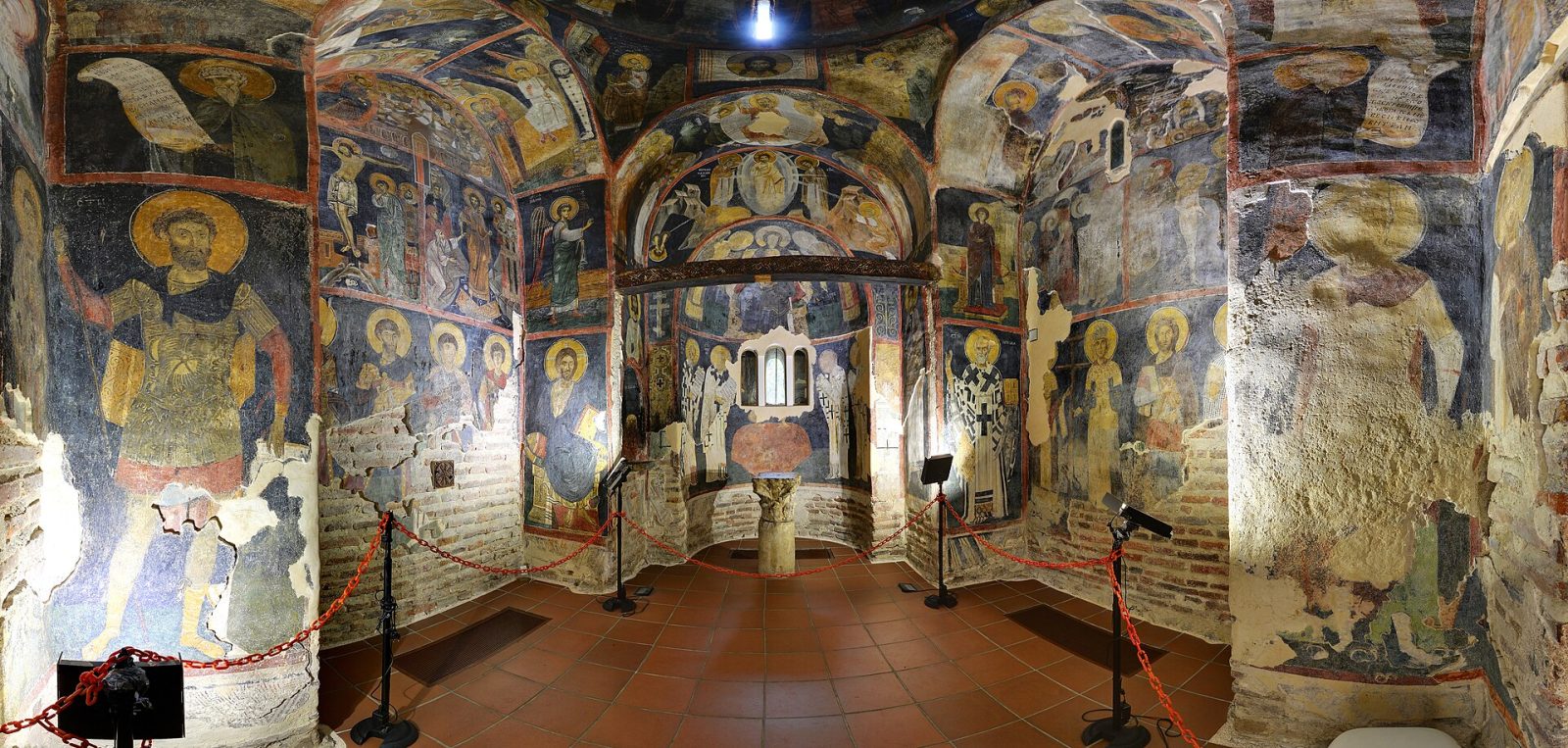
The walls carry 89 scenes with 240 human figures. Several layers of painting survive: from the 11th, 13th, 15th to 17th and 19th centuries. The second layer, of 1259, is the one that made the church famous.1,2
- The donor portraits. Sebastocrator Kaloyan and Desislava, and Tsar Konstantin Tih Asen and Tsaritsa Irina, painted with precision, great skill and feeling.
- The life of St Nicholas. Eighteen scenes in the narthex tell the story of the saint. In the Miracle at Sea, the ship and the sailors’ hats look Venetian, a detail often read as a sign of contact with Western Europe.
- Christ Pantocrator in the dome, with a host of angels in the drum below and the four evangelists in the pendentives.
- Ten warrior saints among the full-length saints in the lowest tier.
- St John of Rila, the oldest known image of the Bulgarian hermit saint, and St Paraskeva.
- Christ Disputing with the Doctors in the south burial niche, and the Presentation of the Virgin in the north one.
Source: Wikipedia: Boyana Church2
Later painters added their own work: a 14th-century Presentation of the Virgin, scenes from the 16th and 17th centuries and images of St Nicholas and St Panteleimon of 1882.2
Who painted Boyana
The name of the main painter is not known for certain, so art historians call him the Boyana Master. He worked with at least one assistant and belonged to the Tarnovo School, centred on the capital of the Second Bulgarian Empire.2
During the conservation work of the 2000s an inscription reading “I, Vasiliy, inscribed” was found under a layer of plaster. Some scholars take it as the signature of the master painter; others think it could equally have been left by an assistant. The question is still open.2,3
How the church was saved
| Year | Event |
|---|---|
| 1844–1847 | The Russian scholar Viktor Grigorovich finds the Boyana Pomenik and the Boyana Palimpsest, two medieval manuscripts, in the church |
| 1912–1915 | First restorations of the wall paintings |
| 1917 | Tsaritsa Eleonora, who had saved the church from demolition, is buried by its south wall; a park with sequoias is laid out around it |
| 1924 | André Grabar publishes his monograph on the church, which makes it known to scholars abroad |
| 1927 | Declared a national antiquity |
| 1934 and 1944 | Further conservation of the frescoes |
| 1954 | Ceases to be a parish church and is closed for conservation |
| 1979 | Added to the UNESCO World Heritage List |
| 2003 | Becomes a branch of the National Historical Museum |
| 2006–2008 | Partly reopened in 2006 and fully reopened on 2 October 2008, after long conservation |
Source: Wikipedia: Boyana Church; Wikipedia: Боянска църква; Boyana Church museum2,3,4
Today the church is kept at a steady temperature of 17–18 °C, is under constant surveillance and admits only small groups for short visits. These limits protect the paintings from the warmth and humidity that visitors bring.1,2
Opening hours
| Season | Open | Ticket desk closes |
|---|---|---|
| Winter, 1 November to 31 March | 09:00–17:30 | 17:20 |
| Summer, 1 April to 31 October | 09:30–18:00 | 17:50 |
Source: Boyana Church: visitor information5
The church is open every day of the week. It is closed on 1 January, Easter Sunday, 24 December and 25 December.5
Tickets and free days
| Ticket | Price |
|---|---|
| Adult | €10 |
| Children over 7 and students | €3 |
| Groups of 10 or more, per person | €7 |
| School groups of 10 or more, per pupil | €2 |
| Guided talk in Bulgarian | €8 |
| Guided talk in a foreign language | €10 |
| Guided talk in Bulgarian with translation | €5 |
Source: Boyana Church: visitor information5
Entry is free for:
- Children under 7
- Visitors with disabilities and their companions
- The last Monday of every month, after 15:00
- 18 May, International Museum Day
- 17 September, Sofia Day
- 1 November, Day of the National Awakeners
Source: Boyana Church: visitor information5
Bookings are not taken for the free times. Prices were checked on the museum’s site in November 2026 and can change.5
Rules inside the church
- No more than 9 people may be inside at the same time.
- A visit to the medieval part of the church lasts up to 10 minutes.
- No photography or filming, with a camera or a phone.
- No food, drink, smoking or vaping on the museum grounds, and no drones.
- Guide dogs may enter the churchyard only; other dogs are not allowed.
- There is a ramp for wheelchairs and prams, and there are toilets.
Source: Boyana Church: visitor information5
Individual visitors and groups of up to 5 people can come with or without a booking. Organised groups, including tour operators, travel agents and schools, are admitted only with a booking confirmed by email at reservation@boyanachurch.info. Because of the limits on numbers, the museum recommends booking ahead.5
Getting there
The church is at 3 Boyansko Ezero Street in the Boyana quarter, on the southern outskirts of Sofia.5
| How | Route |
|---|---|
| Bus 64 | From Vitosha metro station on line M2 to the Boyansko Hanche stop, then a short walk uphill |
| Bus 65 | To its last stop, Boyanska Tsarkva, right by the church |
Source: How2Sofia: getting to Boyana Church6
Check routes and times with Sofia’s public transport operator before you travel, as lines can change.
Plan your visit
- Book ahead if you can: only 9 people may be inside at once, so visitors often wait their turn in the park.
- You have 10 minutes in the medieval church and cannot take photos, so decide beforehand what to look at: the donor portraits, the dome and the St Nicholas cycle.
- Arrive well before closing: the ticket desk shuts 10 minutes before the church.
- Visit the grave of Tsaritsa Eleonora by the south wall and the park with its old sequoias.
Living in Boyana
Boyana is a residential quarter of houses and small apartment buildings at the foot of Vitosha. Its median asking price for apartments, about €2,889 per m², compares with €2,304 in neighbouring Ovcha Kupel and €4,072 in Lozenets.7
| Apartment | Median asking price | Per m² |
|---|---|---|
| One-room | €149,617 | €2,579 |
| Two-room | €210,172 | €2,871 |
| Three-room | €375,799 | €2,938 |
| All apartments | €2,889 |
Source: imot.bg: average property prices in Sofia7
These are asking prices in listings on imot.bg on 5 November 2026, not completed sales.7
Frequently Asked Questions
Why is Boyana Church famous?
For its wall paintings of 1259, which show faces with individual features and real emotion. UNESCO calls it one of the most complete and perfectly preserved monuments of east European medieval art.
How much is a ticket to Boyana Church?
An adult ticket costs 10 euros and a ticket for students and children over 7 costs 3 euros. Children under 7 enter free, and entry is free for everyone on the last Monday of the month after 15:00.
What are the opening hours of Boyana Church?
From 1 April to 31 October it is open from 09:30 to 18:00, and from 1 November to 31 March from 09:00 to 17:30, every day. It is closed on 1 January, Easter Sunday and on 24 and 25 December.
Can I take photos inside Boyana Church?
No. Photography and filming are not allowed inside, with a camera or a phone, to protect the frescoes.
Do I need to book a visit?
Individual visitors and groups of up to 5 people can come without a booking. Organised groups need a booking confirmed by email, and the museum recommends booking ahead for everyone.
How long does a visit take?
Groups of up to 9 people spend up to 10 minutes in the medieval part of the church, plus the time spent waiting in the park.
How do I get to Boyana Church by public transport?
Take bus 64 from Vitosha metro station to the Boyansko Hanche stop, or bus 65 to its last stop, Boyanska Tsarkva.
When was Boyana Church added to the UNESCO list?
In 1979, at the third session of the World Heritage Committee, as site number 42.
Sources
- UNESCO World Heritage Centre: Boyana Church
- Wikipedia: Boyana Church
- Wikipedia: Боянска църква (in Bulgarian)
- Boyana Church museum
- Boyana Church: visitor information (in Bulgarian)
- How2Sofia: getting to Boyana Church (in Bulgarian)
- imot.bg: average property prices in Sofia (in Bulgarian)
Figures checked 9 November 2026. Information only, not investment, tax or legal advice.