National Tourist Site
About Oborishte Historic Site and Rayna Knyaginya House Museum
At a glance
| Site | Where | Access |
|---|---|---|
| Oborishte historic site | 8 km from Panagyurishte | Open access, no entry fee |
| Rayna Knyaginya House Museum | 26 Rayna Knyaginya Street, Panagyurishte | Every day 9:30–17:00; Monday morning closed until 12:00 |
Source: Bulgarian Tourist Union: Oborishte historic site (100 National Tourist Sites, in Bulgarian); Bulgarian Tourist Union: Rayna Knyaginya House Museum1,2
The Oborishte assembly
In 1876 Panagyurishte was the centre of the Fourth Revolutionary District, and after the April Uprising was crushed the town was burned. On 14–16 April 1876 the delegates of the district met on a forest meadow at Oborishte. The Bulgarian Tourist Union and the Bulgarian Wikipedia call it the first Bulgarian national assembly.1,3
The delegates sat at a table with a sabre, a pistol and Father Gruyu’s church cross for the oath, with oil lanterns hung in the trees. Georgi Benkovski chaired the meeting, which confirmed him and Panayot Volov as leaders, set the start of the uprising for 1 May 1876 and named a commission to draw up the plan. The Bulgarian Wikipedia notes that because the uprising broke out early, much of the plan was never put into action.1,3
Sources disagree on how many delegates attended. The Bulgarian Tourist Union says 64 delegates with proper mandates and over 300 people in all. The Bulgarian Wikipedia lists counts from 55 to 108 in different historical sources, notes that 67 names are carved on the monument and concludes that the total of representatives was probably not above 75.1,3
| Source quoted by the Bulgarian Wikipedia | Delegates | From how many places |
|---|---|---|
| Zahari Stoyanov, “Notes on the Bulgarian Uprisings” (1884) | 56 | 50 |
| Dimitar Strashimirov, “History of the April Uprising” (1907) | 65 | 58 |
| “Oborishtentsi” (1972), the first detailed study | 64 | 54 |
| Toma Georgiev, “A Short History of the Sredna Gora Uprising” (1901) | 80 | – |
| Nikola Belovezhdov, “The First Rifle” | 108 | – |
Source: Wikipedia (Bulgarian): The Oborishte Assembly3
What to see at Oborishte
A white stone monument was raised in 1928, with the names of the apostles and the delegates on its lower part. Every year on 1 and 2 May national celebrations are held here. On request, the Panagyurishte History Museum can send a curator to meet groups at the site; the talk is in Bulgarian only.1
In Panagyurishte itself few Revival houses survived the fire. The Tuteva house, where the uprising was proclaimed on 20 April 1876, keeps the guest room where the apostles stayed, and the town museum holds one of the copies of the “Bloody Letter” that started the uprising.1
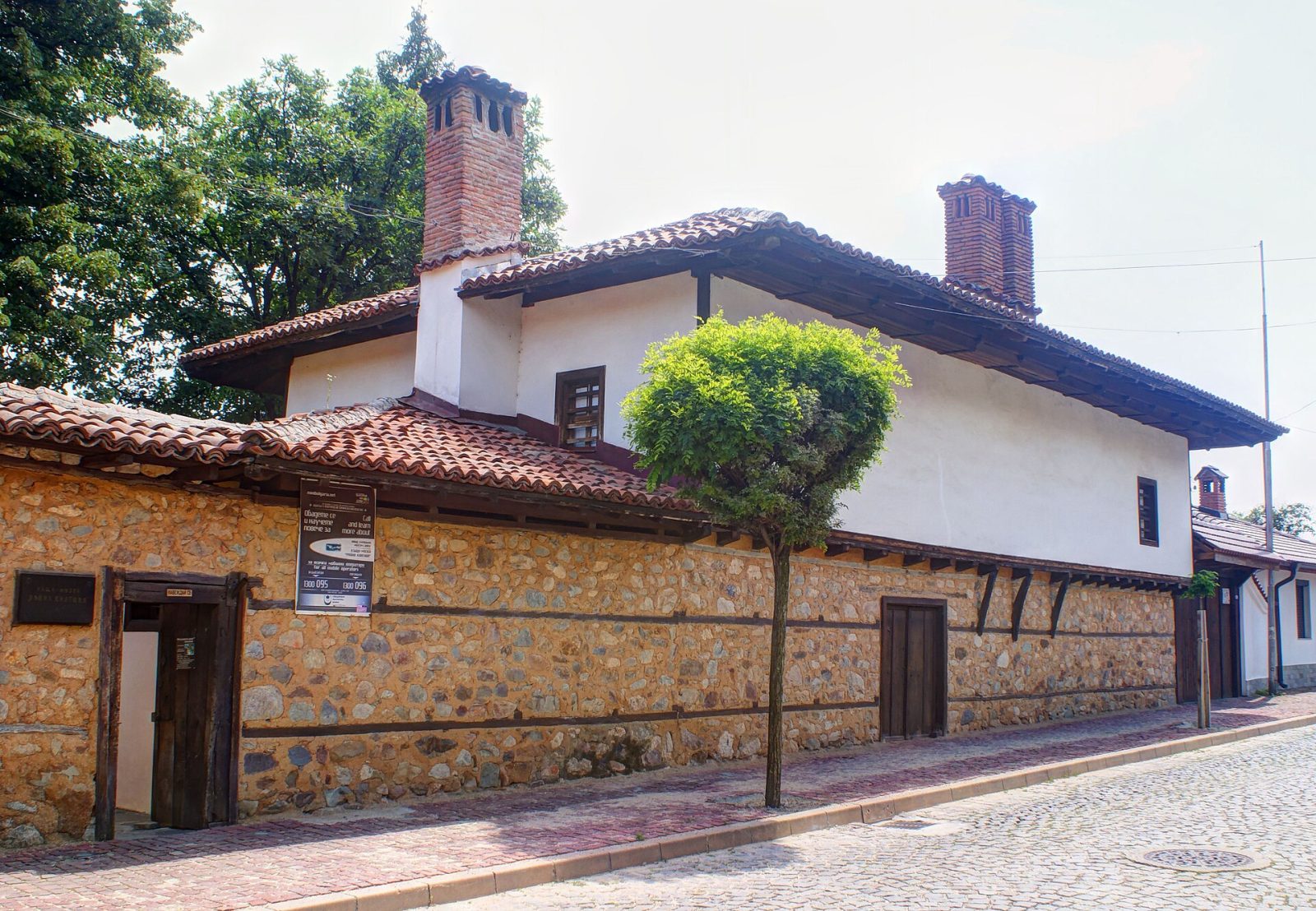
The Rayna Knyaginya House
Rayna Futekova was born in this house on 18 January 1856. As the 20-year-old head teacher of the girls’ school, she sewed the main flag of the rebels and on 22 April 1876, the day it was blessed, led the procession on horseback with a sabre and a revolver. After the uprising she was imprisoned in Plovdiv and saved from the gallows by foreign diplomats; she studied midwifery in Russia and became guardian of 32 rescued children from Panagyurishte.2,4
- A date of 1673 is carved on a beam of the main gate; the house was restored in 1979–1981.
- The ground floor, once a craft workshop, covers her life at the time of the uprising; the upper floor has an ethnographic exhibition.
- The house keeps one of the copies of the main flag that she sewed in 1901 for the 25th anniversary of the uprising; the Bulgarian Tourist Union says she made three, of which the other surviving one is in the Military History Museum in Sofia.
- In the yard stands a marble statue of Rayna; her remains were placed beneath it in 1976, for the centenary of the uprising.
Source: Bulgarian Tourist Union: Rayna Knyaginya House Museum; Wikipedia (Bulgarian): Rayna Knyaginya House Museum2,4
The Bulgarian Wikipedia says the house has had over two million visitors in more than half a century, and that users of the iLoveBulgaria app voted it the most visited tourist site in 2022. These are the encyclopaedia’s figures. It also calls the flag in the house the only copy of the main flag, while the union says two of her three copies survive.2,4
Tickets and opening hours
| Ticket for the Rayna Knyaginya House | Price listed by the Bulgarian Tourist Union |
|---|---|
| Adults | 3 leva |
| Students and pensioners | 2 leva |
| Guided talk for an organised group | 20 leva |
| Oborishte historic site | Free |
Source: Bulgarian Tourist Union: Oborishte historic site (100 National Tourist Sites, in Bulgarian); Bulgarian Tourist Union: Rayna Knyaginya House Museum1,2
The house opens every day from 9:30 to 17:00, with a half-day closure on Monday mornings until 12:00. The ticket desk stops selling at 17:00 and visitors leave by 17:30. The museum is closed on 1 January and 24 and 25 December. Phone: 0357 63712 for the curators.2
The union lists prices in leva, the currency before the euro, so they may have changed. The Bulgarian Wikipedia gives hours of 9:30–17:30. Checked in November 2026.2,4
The No. 36 stamp
Oborishte and the Rayna Knyaginya House share No. 36 in “Know Bulgaria – 100 National Tourist Sites”, the movement the Bulgarian Tourist Union started in 1966. Walkers collect a stamp at each site in a booklet: 25 stamps earn a bronze badge, 50 a silver badge and all 100 a gold badge with a certificate.5
More stamps nearby
- No. 36a: the Strelcha History Museum.
- No. 75: the Koprivshtitsa museum reserve.
- No. 35: the Pazardzhik museums and cathedral.
- No. 70: the Bratsigovo History Museum.
Source: Bulgarian Tourist Union: 100 National Tourist Sites5
For the town itself, see our Panagyurishte guide and the Pazardzhik province page.
Frequently Asked Questions
What happened at Oborishte?
On 14–16 April 1876 delegates of the Fourth Revolutionary District met here, confirmed Georgi Benkovski and Panayot Volov as leaders and set the start of the April Uprising for 1 May 1876.
How many delegates were there?
The sources differ. The Bulgarian Tourist Union says 64 with proper mandates and over 300 people in all; the Bulgarian Wikipedia lists counts from 55 to 108 and puts the likely total at no more than 75.
Is there an entry fee at Oborishte?
No. The site is open access and free.
Who was Rayna Knyaginya?
Rayna Futekova, the teacher from Panagyurishte who sewed the rebels’ main flag in 1876 and carried it at the head of the procession.
Which tourist-site number are Oborishte and the Rayna Knyaginya House?
No. 36 in the Bulgarian Tourist Union’s 100 National Tourist Sites.
Sources
- Bulgarian Tourist Union: Oborishte historic site (100 National Tourist Sites, in Bulgarian)
- Bulgarian Tourist Union: Rayna Knyaginya House Museum (in Bulgarian)
- Wikipedia (Bulgarian): The Oborishte Assembly
- Wikipedia (Bulgarian): Rayna Knyaginya House Museum
- Bulgarian Tourist Union: 100 National Tourist Sites (in Bulgarian)
Figures checked 12 November 2026. Information only, not investment, tax or legal advice.