National Tourist Site
About Lepenitsa Cave
At a glance
| Tourist site | No. 55a, “Lepenitsa Cave – the Dionysus Cave” |
|---|---|
| Location | Under Syutkya peak, Rakitovo municipality, Pazardzhik province; about 9.3 km south of Kleptuza in Velingrad |
| Season | 1 April–30 November, every day, 10:00–16:00 |
| Visits | Only with a guide and gear (boots, helmet, headlamp), in groups of up to 10 |
| Not allowed | Children under 7 and visitors with mobility problems or certain illnesses |
| Phone | 0895 755 885, 0877 808 770 |
Source: Bulgarian Tourist Union: Lepenitsa Cave – the Dionysus Cave (100 National Tourist Sites, in Bulgarian); Wikipedia (Bulgarian): Lepenitsa (cave)1,2
History and research
Lepenitsa is a horizontal marble cave on three levels, part of the Rhodope karst. Academician Ivan Buresh carried out biological research in it in 1925 and 1927, and in 1930 the people of Rakitovo founded the first branch of the Bulgarian Caving Society to explore it. They also dug a second entrance because the natural one had flooded.2
About 400 metres were surveyed and mapped in 1931, and full mapping was done only in 1973. The cave was declared a natural landmark on 10 October 1962. Since 2010 visitors have been allowed up to 600 metres into the dry second level.1,2
The Bulgarian Tourist Union gives a length of about 2 km and says the cave first opened to visitors in 1931. The Bulgarian Wikipedia gives a total length of 1,525 metres, of which 1,356 metres are mapped, and describes 1931 as the year the first 400 metres were mapped.1,2
What to see inside
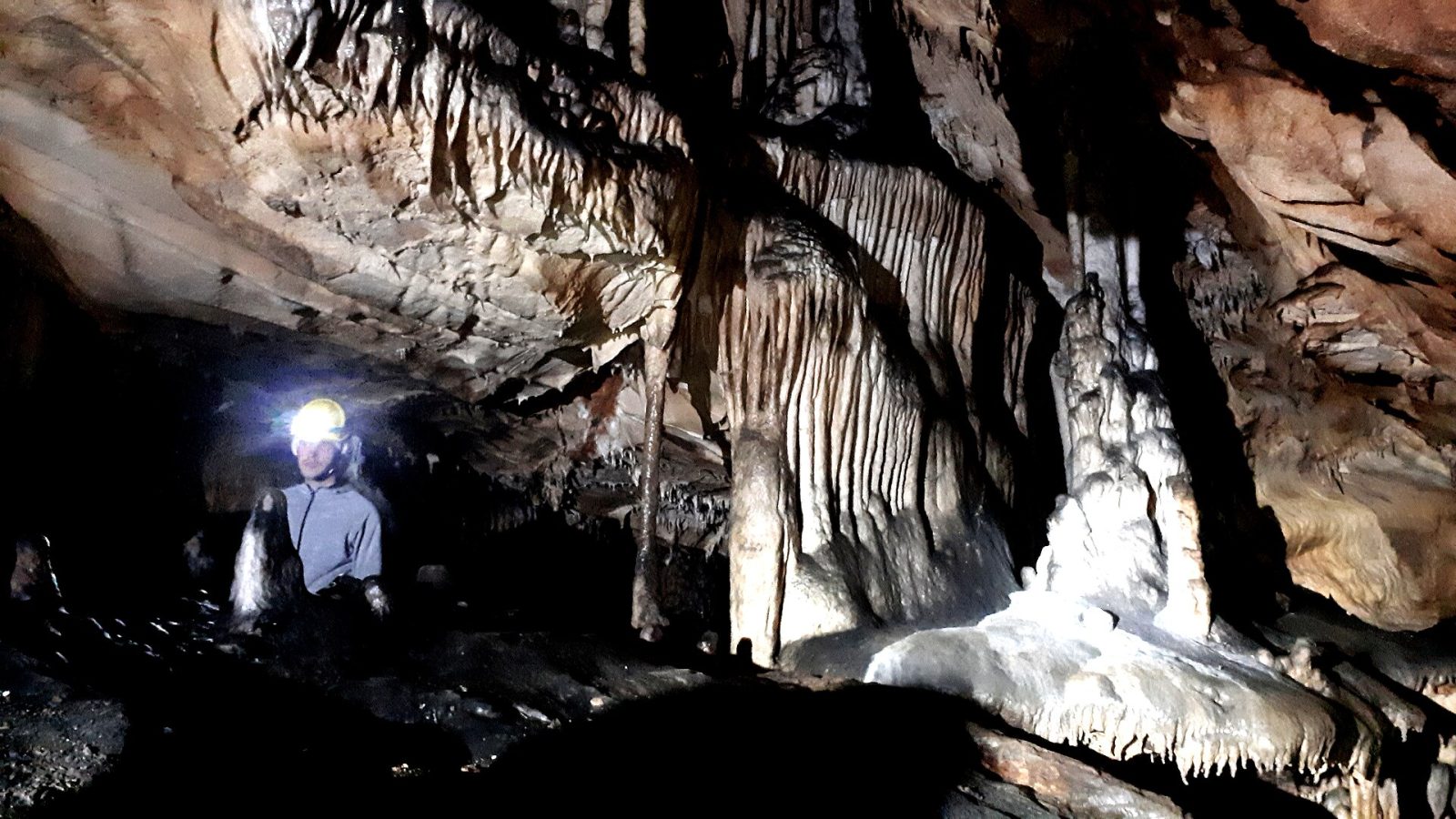
The Lepenitsa river flows along the lowest level. The dry middle level, which visitors walk, has two lakes, or four in wet weather, and a wide variety of formations. The cave is not fitted out, only made safe, so visitors feel like real cavers; the only difference from 1931, the union says, is that kerosene and carbide lamps have given way to battery headlamps.1,2
The guides point out the underground river, the Hall of the Starry Sky, the “tiger skin” and the “crocodile”, the waterfalls, the icon of the Virgin, the Hall of the Newlyweds, the “Leaning Tower of Pisa”, the singing draperies and the Hall of the Guardsmen. Seven cave pearls found here are kept at the National Museum of Natural History in Sofia.1,2
| Wildlife | Detail |
|---|---|
| Species known | 24, of which 18 troglophiles and 6 troglobionts that live only in caves |
| Found only here | Buresh’s beetle, Drenski’s spider and the “Lepenitsa” millipede, according to the Bulgarian Tourist Union |
| Bats | 7 species, including the greater and lesser horseshoe bats and the barbastelle |
Source: Bulgarian Tourist Union: Lepenitsa Cave – the Dionysus Cave (100 National Tourist Sites, in Bulgarian); Wikipedia (Bulgarian): Lepenitsa (cave)1,2
Visitors keep to a set route to protect the cave’s wildlife.1
Getting there
| Starting point | Route described by the Bulgarian Tourist Union |
|---|---|
| Rakitovo, by bus or low car | 11 km of asphalt through a forest checkpoint to the Removo holiday area; by bus, then a marked 1 km path of about 20 minutes; by car, a further 3 km of asphalt and 3 km of gravel to the entrance |
| Velingrad | From Kleptuza in the Chepino quarter towards Sarnitsa: about 10 km of asphalt, then just over 2 km of gravel. Off-road cars reach the entrance; low cars stop at the end of the asphalt and visitors walk about 2,200 metres |
Source: Bulgarian Tourist Union: Lepenitsa Cave – the Dionysus Cave (100 National Tourist Sites, in Bulgarian)1
The Bulgarian Tourist Union’s page gives the opening season and phone numbers but no ticket prices, and refers to www.sutkya.org for more information, which could not be checked for this guide. The Bulgarian Wikipedia gives a temperature of 10 °C inside. Call ahead to book a guided group. Checked in November 2026.1,2
The No. 55a stamp
The cave is site No. 55a in “Know Bulgaria – 100 National Tourist Sites”, the movement the Bulgarian Tourist Union started in 1966. Walkers collect a stamp at each site in a booklet: 25 stamps earn a bronze badge, 50 a silver badge and all 100 a gold badge with a certificate.3
The union notes on the cave’s page that, until No. 55a appears in the booklet, a stamp placed on the last page counts as a visited site.1
More stamps nearby
- No. 55: the Velingrad History Museum.
- No. 38: the Batak History Museum.
- No. 37: Snezhanka Cave, near Peshtera.
- No. 37a: the Peristera fortress, in Peshtera.
Source: Bulgarian Tourist Union: 100 National Tourist Sites3
For a base nearby, see our Velingrad guide and the Pazardzhik province page.
Frequently Asked Questions
Can anyone visit Lepenitsa Cave?
Visits are only with a guide and gear, in groups of up to 10. Children under 7 and visitors with mobility problems are not allowed in.
When is the cave open?
Every day from 10:00 to 16:00, from 1 April to 30 November.
How long is the visit route?
Up to 600 metres along the dry second level.
How do I get there from Velingrad?
From Kleptuza towards Sarnitsa: about 10 km of asphalt and just over 2 km of gravel; in a low car, park at the end of the asphalt and walk about 2,200 metres.
Which tourist-site number is Lepenitsa Cave?
No. 55a in the Bulgarian Tourist Union’s 100 National Tourist Sites.
Sources
- Bulgarian Tourist Union: Lepenitsa Cave – the Dionysus Cave (100 National Tourist Sites, in Bulgarian)
- Wikipedia (Bulgarian): Lepenitsa (cave)
- Bulgarian Tourist Union: 100 National Tourist Sites (in Bulgarian)
Figures checked 12 November 2026. Information only, not investment, tax or legal advice.