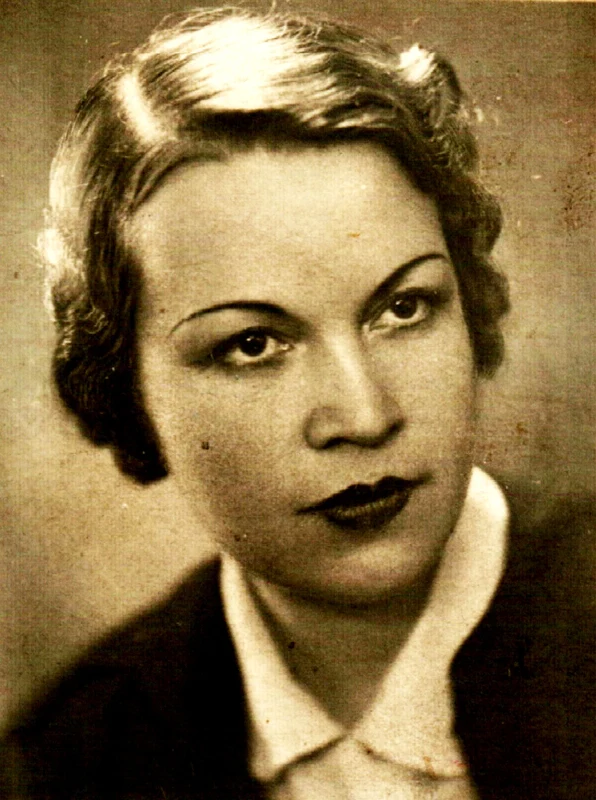
Elisaveta Bagryana
At a glance
| In Bulgarian | Елисавета Багряна (Елисавета Любомирова Белчева) |
|---|---|
| Born | 1893, Sofia |
| Died | 23 March 1991, Sofia |
| Known for | Poetry: “The Eternal and the Holy”, “The Sailor’s Star”, “Human Heart” |
| Honours | Gold medal, Rome (1969); Hero of the People’s Republic of Bulgaria (1983) |
Source: Wikipedia: Elisaveta Bagryana; Wikipedia (Bulgarian): Елисавета Багряна1,2
Sources differ on her date of birth. English Wikipedia gives 16 April 1893; Bulgarian Wikipedia gives 29 April 1893, which is 16 April in the old-style calendar.1,2
Tarnovo, Aftane and Sofia University
Bagryana was the first of seven children of Maria and Lyubomir Belchev. In 1907–08 the family lived in Tarnovo, where she wrote her first poems. After finishing school in Sofia in 1910 she taught for a year in the village of Aftane, today Nedyalsko, where she saw village life at first hand. From 1911 to 1915 she studied Slavic philology at Sofia University, attending lectures by Ivan Shishmanov, Krastyo Krastev and Boyan Penev, among others.1,2
In 1915 the magazine “Contemporary Thought” printed her first two poems, “Evening Song” and “Why”. She taught at high schools in Vratsa and Kyustendil, returned to Sofia in 1921 and joined literary life, writing for “The Women’s Newspaper”, “Contemporary”, “Zlatorog” and other publications. Her relationship with the literary historian Boyan Penev, under whose influence she began to write in free verse, ended with his sudden death in 1927.1,2
Collections and style
Bulgarian Wikipedia describes several transformations in her work. In “The Sailor’s Star” (1931) and “Human Heart” (1936) the early joyful lyricism gives way to intellectual unrest that breaks the classical metres. In the 1950s she turned to the declarative style of the period in “Five Stars” (1953), and after the 1960s she returned to her own manner in “Counterpoints” (1972), “Chiaroscuro” (1977) and “On the Shore of Time” (1983). The same article describes her style as a combination of folk-song vocabulary and modern poetic means.2
English Wikipedia describes her poems as straightforward, sensitive and serious, and names “The Well”, in which a well she dug as a little girl stands for the source of poetry in her soul. Her poems are available in English in “Penelope of the Twentieth Century”, translated by Brenda Walker.1
Sources differ on how many languages her poems have been translated into. English Wikipedia says over 30; Bulgarian Wikipedia says over 20 in its introduction and 30 later in the article.1,2
Nobel nominations and honours
Both Wikipedia articles say she was nominated for the Nobel Prize in Literature in 1943, 1944 and 1945, and Bulgarian Wikipedia names the nominator as Stefan Mladenov. The Nobel nomination archive lists those three nominations and a fourth, in 1969, by Anna Kamenova, president of the Bulgarian PEN Club.1,2,3
- Gold medal of the poets’ association in Rome, 1969; English Wikipedia calls it the National Association of Poets, Bulgarian Wikipedia the International Association of Poets.
- Title “Hero of the People’s Republic of Bulgaria”, 1983.
- Bagryana Point in Antarctica and a street in the Geo Milev district of Sofia bear her name.
Source: Wikipedia: Elisaveta Bagryana; Wikipedia (Bulgarian): Елисавета Багряна1,2
Bulgarian Wikipedia adds that she was called as a witness at the 1942 trial of Nikola Vaptsarov. She died in Sofia on 23 March 1991, a month before her 98th birthday.2
Sources
- Wikipedia: Elisaveta Bagryana
- Wikipedia (Bulgarian): Елисавета Багряна
- NobelPrize.org nomination archive: nominees from Bulgaria
Facts checked 10 November 2026. Prepared by InvestBulgaria for general information.