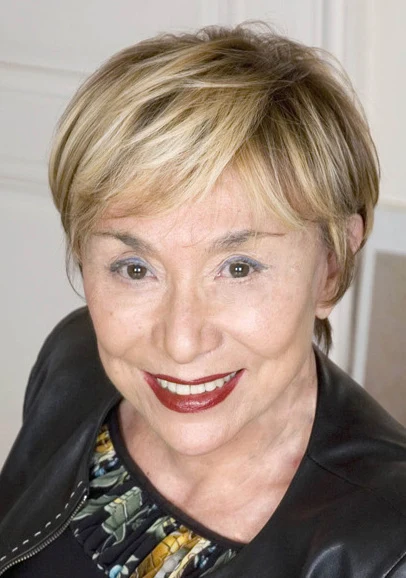
Julia Kristeva
At a glance
| In Bulgarian | Юлия Кръстева |
|---|---|
| Born | 24 June 1941, Sliven |
| Education | French philology, Sofia University (1964); doctorates in Paris (1968, 1973) |
| Fields | Semiotics, literary theory, psychoanalysis, feminism, fiction |
| Married | Philippe Sollers (1936–2023), married in 1967 |
Source: Wikipedia: Julia Kristeva; Wikipedia (Bulgarian): Юлия Кръстева; BTA: Julia Kristeva turns 851,2,4
Sources differ on when she left Bulgaria. English Wikipedia says a research fellowship enabled her to move to France in December 1965, when she was 24; Bulgarian Wikipedia and BTA give 1966.1,2,4
From Sliven to Paris
Kristeva and her sister attended a French-language school run by Dominican nuns, and she graduated in French philology from Sofia University in 1964. In Paris she studied at the École pratique des hautes études under Lucien Goldmann and Roland Barthes, and joined the Tel Quel group founded by the novelist Philippe Sollers, whom she married on 2 August 1967. She received doctorates in 1968 and 1973, and BTA says her dissertation, published as “La Révolution du langage poétique”, earned her a professorship of linguistics at the University of Paris VII in 1974.1,2,4
Books and ideas
Her first book, “Semeiotikè” (1969), made her influential in literary theory, cultural studies and feminism. The Holberg committee wrote that in “Revolution in Poetic Language” she first advanced the theory that meaning in language is formed by two interacting elements, the symbolic and the semiotic, “thus bringing the living body back into language”. It described “Powers of Horror” (1980), “Tales of Love” (1983) and “Black Sun” (1987) as offering “original and powerful theories of abjection, love and depression”, and said “Strangers to Ourselves” (1988) gave “crucial insights into the problems of migration, exile and otherness”.1,3
Kristeva trained as a psychoanalyst and began practising in 1979. In the trilogy “Female Genius” she wrote on Hannah Arendt, Melanie Klein and Colette. Her novels include “The Samurai” (1990), “The Old Man and the Wolves” (1991), “Possessions” (1996) and “Murder in Byzantium” (2004); BTA notes that some of them deal with Bulgaria and the Balkans.1,4
Honours
- Holberg Prize, 2004; BTA describes her as its first holder
- Hannah Arendt Prize for Political Thought, 2006
- Václav Havel Prize of the Parliamentary Assembly of the Council of Europe, 2008
- Honorary doctorates including Harvard (1999) and Sofia University (2002)
Source: Wikipedia: Julia Kristeva; Wikipedia (Bulgarian): Юлия Кръстева; Holberg Prize: Julia Kristeva; BTA: Julia Kristeva turns 851,2,3,4
The 2018 State Security file
In 2018 Bulgaria’s Dossier Commission announced that Kristeva had been a collaborator of the communist-era State Security under the code name “Sabina”, recruited in 1971, and published the related documents online. Kristeva denies the claim: English Wikipedia quotes her calling the allegations “grotesque and false”, and BTA reports that she dismissed the disclosure as “a lamentable farce”.1,2,4
Sources
- Wikipedia: Julia Kristeva
- Wikipedia (Bulgarian): Юлия Кръстева
- Holberg Prize: Julia Kristeva
- BTA: Julia Kristeva turns 85
Facts checked 10 November 2026. Prepared by InvestBulgaria for general information.