
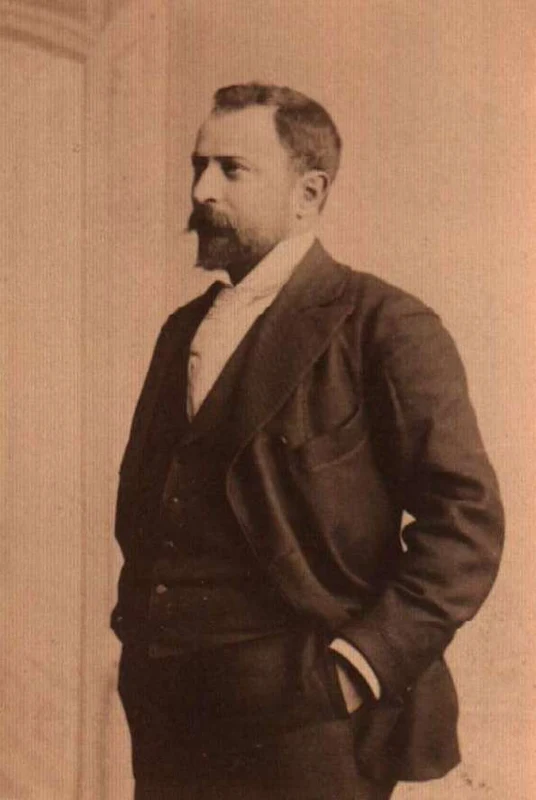
Aleko Konstantinov
At a glance
| In Bulgarian | Алеко Иваницов Константинов |
|---|---|
| Born | 13 January 1863 (1 January Old Style), Svishtov |
| Died | 23 May 1897 (11 May Old Style), near Radilovo, killed in an ambush |
| Pen name | Shtastlivetsa (“The Happy Man”) |
| Education | Aprilov High School, Gabrovo; law at the university in Odessa, graduated 1885 |
| Best-known works | “To Chicago and Back” (1894); the Bay Ganyo stories (from 1895) |
Source: Wikipedia: Aleko Konstantinov; Wikipedia (Bulgarian): Алеко Константинов1,2
A judge who would not bend
Konstantinov was born in the Danube town of Svishtov into a wealthy trading family. He studied at the Aprilov High School in Gabrovo and then law in Odessa, graduating in 1885.1,2
Back in Bulgaria he worked as a judge and prosecutor in Sofia. He opposed political interference in the courts and was dismissed; he became a judge again at the Sofia Court of Appeal in 1890–1892 and was dismissed a second time. After that he worked as a lawyer in private practice in Sofia for the rest of his life. He was a member of Petko Karavelov’s Democratic Party and wrote for its newspaper “Zname”.2
Paris, Prague and Chicago
Konstantinov visited the world exhibition in Paris in 1889, the exhibition in Prague in 1891 and the World’s Columbian Exposition in Chicago in 1893, including a trip to Niagara Falls. His travel notes from America, “To Chicago and Back”, appeared as a book in 1894. Bulgarian Wikipedia describes it as the first Bulgarian travelogue about a journey beyond the country’s borders.1,2
The book helped start a lasting interest in Chicago among Bulgarians. A bust of Konstantinov stands in the University of Chicago’s Regenstein Library, and a section of Irving Park Road in Chicago is named after him.1
Bay Ganyo
From 1895 Konstantinov published his feuilletons about Bay Ganyo, a travelling rose-oil seller whose rough manners abroad and political scheming at home made him one of the most popular characters in Bulgarian fiction. In the second part of the book, when Bay Ganyo returns home and goes into politics, the humour gives way to disgust and anger at the direction public life was taking in newly liberated Bulgaria.1,2
The ascent of Cherni Vrah
On Konstantinov’s initiative, the first mass ascent of Cherni Vrah, the highest peak of Vitosha above Sofia, took place on 27 August 1895. The event is seen as the start of organised tourism in Bulgaria. The first tourist society, founded after his death in 1899, took his name.2
Death and memory
On 23 May 1897 Konstantinov was travelling from Peshtera to Pazardzhik with his party colleague Mihail Takev, the member of parliament for Peshtera. Near the village of Radilovo their carriage was ambushed and Konstantinov was shot dead. English Wikipedia says he was most likely killed by mistake, having changed places with Takev shortly before. Bulgarian Wikipedia notes that the killers said in court that Takev was the target, but several researchers argue that the attack was aimed at both men.1,2
- His portrait is on the 100-leva banknote issued in 2003.
- Two hotels on Vitosha are named “Aleko” and “Shtastlivetsa” after him.
- His house in Svishtov is a museum and one of the 100 National Tourist Sites.
Source: Wikipedia: Aleko Konstantinov; Wikipedia (Bulgarian): Алеко Константинов1,2
Sources
Facts checked 10 November 2026. Prepared by InvestBulgaria for general information.