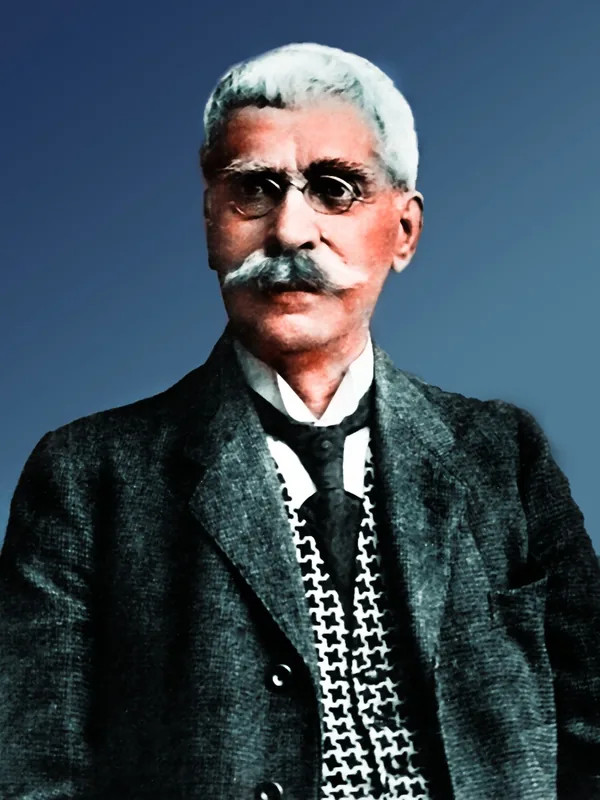
Ivan Vazov
At a glance
| In Bulgarian | Иван Минчов Вазов |
|---|---|
| Born | 9 July 1850, Sopot, Ottoman Empire |
| Died | 22 September 1921 |
| Occupations | Poet, novelist and playwright |
| Known for | The novel Under the Yoke |
| Minister | Education and People Enlightenment, 7 September 1897–30 January 1899 |
| Academy | Academician of the Bulgarian Academy of Sciences |
Source: Wikipedia: Ivan Vazov1
Life and career
Vazov was born in Sopot, then part of the Ottoman Empire. His parents, Saba and Mincho Vazov, influenced his early life. After primary school in Sopot, he studied in Kalofer and worked there as an assistant teacher. He later attended Naiden Gerov’s school in Plovdiv, where he took his first steps as a poet.1
His father tried to direct him towards trade, first sending him to Oltenița in Romania to apprentice with an uncle. Vazov instead pursued literature and went to Brăila, where he lived among Bulgarian exiled revolutionaries and met the poet and revolutionary Hristo Botev. Vazov was born on 9 July 1850, although the exact date is disputed.1
Writing and works
In 1874, Vazov joined the struggle for Bulgaria’s independence from the Ottoman Empire. After returning to Sopot, he joined the local revolutionary committee. Following the failure of the April Uprising in 1876, he fled to Galaţi and became secretary of the committee there. His first published work was Priaporetz and Gusla in 1876, followed by Bulgaria’s Sorrows in 1877.1
After Bulgaria regained independence in 1878, Vazov wrote the Epic of the Forgotten. His 1888 novel Under the Yoke portrays Ottoman oppression in Bulgaria and has been translated into more than 30 languages. Other works include the novels New Country and Under Our Heaven, and the plays Vagabonds and Borislav. He also wrote a science fiction story and a fantasy poem, the first works of their kinds in Bulgarian.1
Public life and legacy
Vazov edited the political reviews Science and Dawn, and later began publishing the review Dennitsa in Sofia. He served as Education and People Enlightenment Minister from September 1897 to January 1899, representing the People’s Party. In 1917, he was nominated for the Nobel Prize in Literature. The Bulgarian Academy of Sciences awarded him its highest honorary title, Academician.1
Vazov died on 22 September 1921. The National Theatre in Sofia and the National Library in Plovdiv bear his name, as does a neighbourhood in Sofia. His home in Sofia is a museum, and a crater on Mercury was named in his honour in June 2020.1
Sources
Facts checked 13 October 2026. Prepared by InvestBulgaria for general information.
