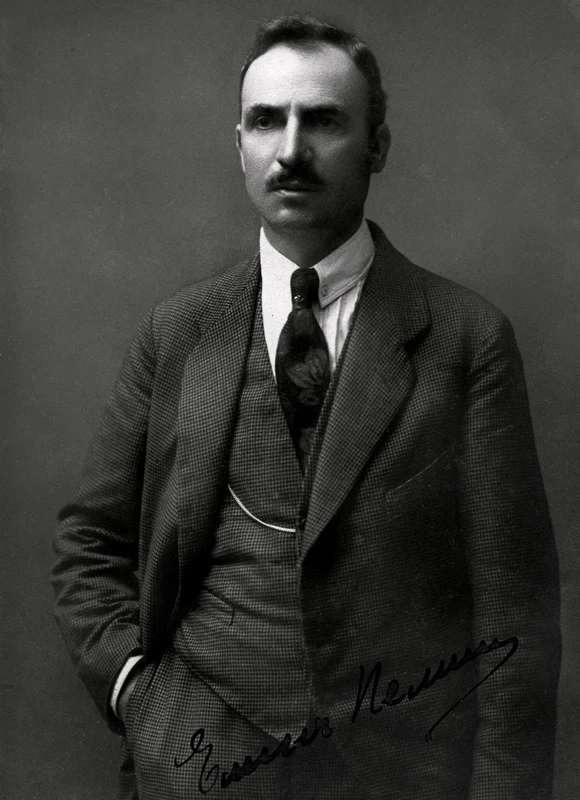
Elin Pelin
At a glance
| In Bulgarian | Елин Пелин (Димитър Иванов Стоянов) |
|---|---|
| Born | July 1877, Bailovo, near Sofia |
| Died | 3 December 1949, Sofia |
| Known for | Short stories of village life; “The Gerak Family”; “Yan Bibiyan” |
| Named after him | The town of Elin Pelin; Elin Pelin Point in Antarctica |
Source: Wikipedia: Elin Pelin; Wikipedia (Bulgarian): Елин Пелин1,2
Sources differ on his date of birth. English Wikipedia gives 8 July 1877; Bulgarian Wikipedia gives 18 July 1877 and notes that other sources say 8 July.1,2
Teacher, librarian and editor
Dimitar Stoyanov finished primary school but not secondary school. He taught in his native Bailovo in 1895–96, and in November 1897 he first signed a piece, “Quiet Sorrows”, with the pen name Elin Pelin. Through the literary historian Ivan Shishmanov he became a librarian at the Sofia University library in 1903, and from 1910 to 1916 he worked at the National Library.1,2
He studied in France together with the poet Peyo Yavorov. He edited the children’s magazines “Veselushka” (1908–10) and “Svetulka”, and during the First World War he was a war correspondent. He later ran the Ivan Vazov house museum in Sofia.1,2
Sources differ on dates. English Wikipedia places his stay in France in 1904–05 and says he worked at the Ivan Vazov museum from 1922; Bulgarian Wikipedia says he was sent to Paris and Nancy in 1906–07 and was curator of the museum from 1924 to 1944.1,2
Stories of the village
His best-known prose is about peasant life. The novella “The Gerak Family” (1911) tells of the misfortunes of a village family falling apart as old traditions fade, and English Wikipedia calls it one of the best-known pieces of Bulgarian literature. It was followed by the novella “Earth”. His other books include the collection “Pizho and Pendo” (1917) and “Under the Monastery Vine” (1936), a cycle of philosophical stories and parables. According to English Wikipedia, Stoyan Christowe called him “Bulgaria’s leading writer”.1,2
English Wikipedia counts him among the initiators of Bulgarian children’s literature. For young readers he wrote “Yan Bibiyan” (1933) and its sequel “Yan Bibiyan on the Moon” (1934). “Earth” was filmed in 1930 and 1957, and “The Gerak Family” in 1958.1,2
Sources differ on the date of “Earth”. English Wikipedia gives 1922; the list of works in Bulgarian Wikipedia gives 1928.1,2
Honours and later years
In 1940 he became a full member of the Bulgarian Academy of Sciences and chairman of the Union of Bulgarian Writers. Bulgarian Wikipedia says that after 9 September 1944 he was sidelined because of his friendship with Tsar Boris III, while English Wikipedia says he avoided being blacklisted. In 1949 he received a gold medal for science and art, according to English Wikipedia. He died in Sofia on 3 December 1949.1,2
- The town of Elin Pelin, east of Sofia, bears his name.
- Elin Pelin Point in Antarctica is named after him.
- Bulgarian Wikipedia counted 12 schools named after him in mid-2022.
Source: Wikipedia: Elin Pelin; Wikipedia (Bulgarian): Елин Пелин1,2
Sources
Facts checked 10 November 2026. Prepared by InvestBulgaria for general information.