Theodosii Spassov
At a glance
| In Bulgarian | Теодосий Спасов Йорданов |
|---|---|
| Born | 4 March 1961 |
| Known for | Playing the kaval and combining folklore with jazz |
| Training | Kotel Music School; Academy of Music and Dance in Plovdiv |
| Current role | Solo artist with Bulgarian National Radio |
| Other role | Artistic Director of the Philip Koutev Ensemble of Music, Drama and Dance |
Source: Wikipedia: Theodosii Spassov1
Training and style
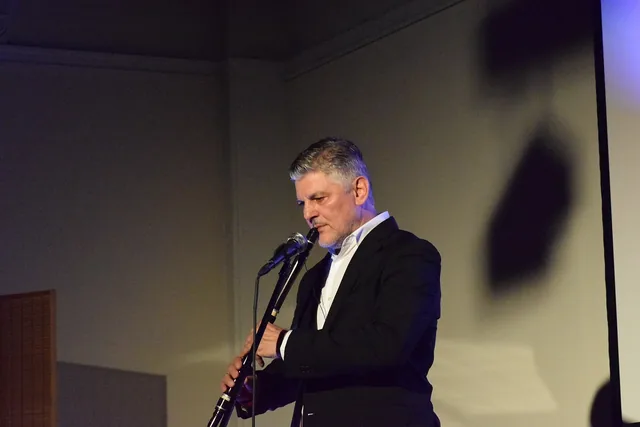
Spassov trained on the kaval at the Music School in Kotel and the Academy of Music and Dance in Plovdiv, Bulgaria. The kaval is an eight-hole wooden flute associated with shepherds. Spassov developed a personal approach to the instrument by bringing together traditional Bulgarian folklore, jazz, fusion and classical music. His work centres on the kaval and its range of tones and playing techniques.1
Career and recordings
For more than 20 years, Spassov toured in Europe, Asia, the Middle East, Australia, Canada and the United States. In 1994 he performed with the Sofia Women’s Radio Choir, which received a Grammy Award for “Le Mystère des Voix Bulgares”. Newsweek included him in its 1995 “Best of the East” article. He has contributed to 20 CDs, including four of his own, and performed as a soloist in countries including Argentina, Japan, India, Brazil and the United Kingdom.1
Film and recognition
Spassov composed and performed music for films, including the 1993 French-Bulgarian feature Granitza (The Border). He also recorded themes for films by Italian composers Carlos Siliotto and Ennio Morricone. His awards include the Special Prize of the Detroit Flute Festival in 1994, Music Artist of the Year at the National Music Awards in 1997 and 2002, and a 2006 National Film Centre award for best film music composer. He was named a UNESCO Artist for Peace in 2015.1
Sources
Facts checked 13 October 2026. Prepared by InvestBulgaria for general information.
