Yordan Radichkov
At a glance
| In Bulgarian | Йордан Димитров Радичков |
|---|---|
| Born | 24 October 1929, Kalimanitsa |
| Died | January 2004, Sofia |
| Known for | Stories, the novel “Gunpowder Primer”, the play “Commotion” |
| Translations | More than 30 languages (English Wikipedia); 37 languages in 50 countries (Bulgarian Wikipedia) |
Source: Wikipedia: Yordan Radichkov; Wikipedia (Bulgarian): Йордан Радичков1,2
Sources differ on his date of death. English Wikipedia gives 21 January 2004; Bulgarian Wikipedia says he died in Sofia on 22 January 2004.1,2
From Kalimanitsa to the newspapers
Radichkov was born into a poor family in Kalimanitsa, in today’s Montana Province, and finished high school in Berkovitsa in 1947. English Wikipedia notes that his village was destroyed and now lies under the waters of the Ogosta dam (1983), which became a recurring theme in his writing. He worked as a correspondent and editor of “Narodna mladezh” (1951–54), as an editor of “Vecherni novini” (1954–60), at Bulgarian Cinematography (1960–62) and at “Literaturen front” (1962–69).1,2
Stories, novels and plays
His first book, the story collection “The Heart Beats for People”, came out in 1959. English Wikipedia says his early, socialist-realist manner gave way to parody, the grotesque and folk fantasy, sometimes described as a Balkan magic realism, and that the ruling party at first met it with hostility. Key books include “Fierce Mood” (1965), “We, the Sparrows” (1968), “Gunpowder Primer” (1969), the novels “All and Nobody” (1975) and “Slingshot” (1977), and “Noah’s Ark” (1988).1,2
He wrote the screenplays for the films “Hot Noon” (1966) and “The Tied-up Balloon” (1967), and the plays “Commotion” (1967), “January” (1974), “Lazaritsa” (1979) and “An Attempt at Flying” (1979), which Bulgarian Wikipedia says have been staged in Austria, Germany, Greece, Poland, Russia, the United States and other countries. Some critics, English Wikipedia notes, have called him the Bulgarian Kafka or Gogol.1,2
Honours and public life
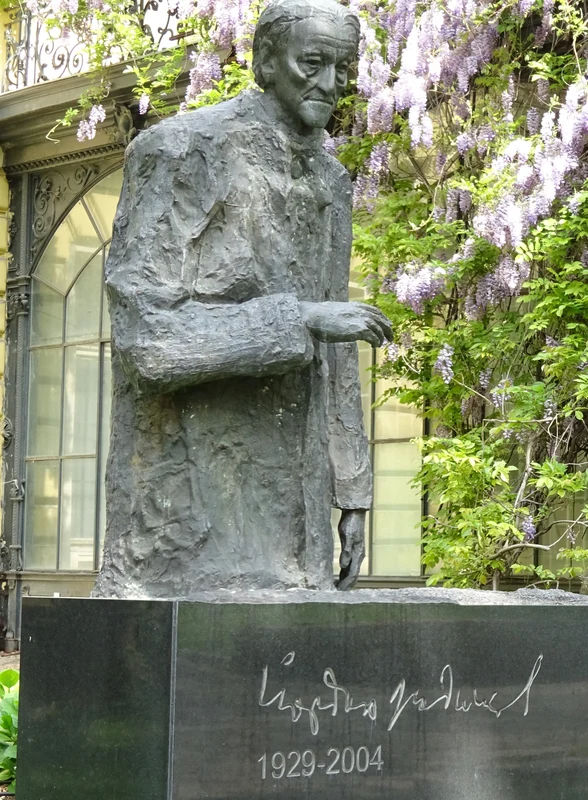
In 1988 he received the Swedish Order of the Polar Star; English Wikipedia adds that he was the first president of the Bulgarian-Swedish Friendship Association (1984–91). He was deputy chairman of the Union of Bulgarian Writers from 1986 to 1989, and in 2001 he was elected an MP for the Bulgarian Socialist Party but soon resigned. In 2007 a monument to him was unveiled in the garden of the former Royal Palace, now the National Art Gallery, in central Sofia, and Radichkov Peak in Antarctica bears his name.1,2
Sources differ on several honours. On the Order of Stara Planina, English Wikipedia gives both 2000 and 2003, while Bulgarian Wikipedia gives 2000, first class. On the Italian Grinzane Cavour Prize (1984), English Wikipedia calls him a finalist and Bulgarian Wikipedia says he was awarded it. On the Nobel Prize, English Wikipedia says he was nominated in 2001 and Bulgarian Wikipedia says twice.1,2
Sources
Facts checked 10 November 2026. Prepared by InvestBulgaria for general information.