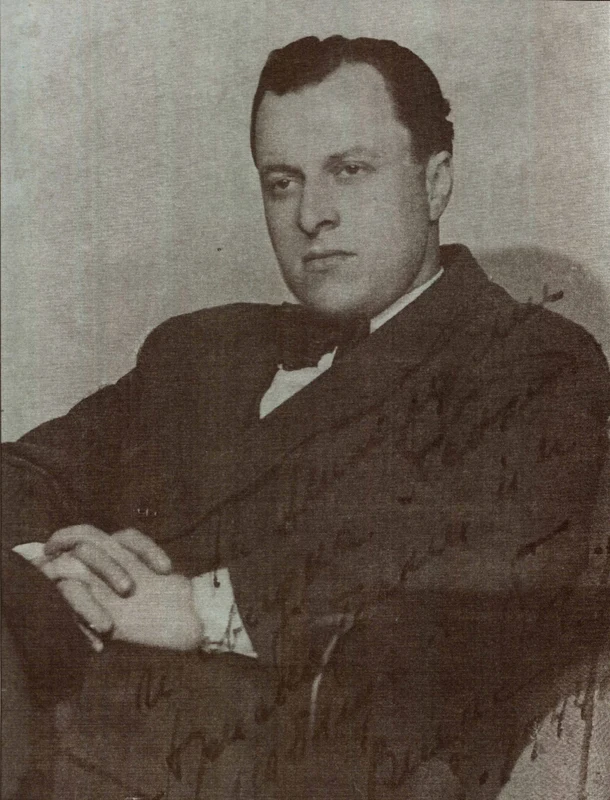
Boris Christoff
At a glance
| In Bulgarian | Борис Кирилов Христов |
|---|---|
| Born | 18 May 1914, Plovdiv |
| Died | 28 June 1993, Rome; buried in Sofia Central Cemetery |
| Voice | Bass |
| Best-known roles | Boris Godunov; Philip II in Don Carlo; Mephistopheles in Faust |
| Family | Brother-in-law of the Italian baritone Tito Gobbi |
Source: Wikipedia: Boris Christoff; Wikipedia (Bulgarian): Борис Христов1,2
From the law courts to Italy
Christoff was born in Plovdiv; as a child he moved with his family to Sofia, to his mother’s house at 43 Tsar Samuil Street. He graduated in law in 1938 and began work as a magistrate, singing in his spare time with the Gusla choir, the choir of the Alexander Nevsky Cathedral and the Academic Choir. In 1940 he had great success as a soloist with Gusla.1,2
With a government grant he left for Italy in May 1942 and studied the Italian bass repertoire for two years with the baritone Riccardo Stracciari. He then went to Austria, where he was arrested in 1944 and held in a camp near Feldkirch until French troops freed him in May 1945.1
An international career
Christoff made his opera debut as Colline in La bohème at Reggio Calabria on 12 March 1946. In the following years he sang at La Scala, La Fenice, the Rome Opera and Covent Garden, among others. In 1950 he was invited to the Metropolitan Opera in New York but was refused entry to the United States under the McCarran Act, which barred citizens of Eastern Bloc countries. He made his American debut at the San Francisco Opera in 1956, turned down later invitations from the Met and never sang there.1
In 1952 in Paris, at the suggestion of the conductor Issay Dobrowen, he sang all three bass roles in a recording of Boris Godunov: Boris, Varlaam and Pimen. The recording won the Grand Prix du Disque in 1953. He recorded the opera again in Paris in 1963, once more in all three roles, with the chorus of the Sofia Opera under André Cluytens.1
He made studio recordings of eight operas and more than 200 Russian songs. English Wikipedia says he was the first to record all 63 of Mussorgsky’s songs. He also recorded Orthodox chants with the choir of the Alexander Nevsky Cathedral in Sofia.1
Rivalries and exile
Off stage Christoff had difficult relations with some colleagues. In 1955 he fell out with Maria Callas during performances of Medea in Rome, and in 1961 his contract with La Scala ended after an open conflict with the Bulgarian bass Nicolai Ghiaurov. English Wikipedia notes that the communist regime was so hostile to Christoff that he was not allowed to return to Bulgaria for his father’s funeral.1
Last years and memory
After surgery for a brain tumour in 1964, Christoff returned to the stage, though his appearances became rarer in the 1970s. He gave his final concert at the Accademia di Bulgaria in Rome on 22 June 1986. He died in Rome in 1993; his body was brought to Sofia, lay in state in the Alexander Nevsky Cathedral and was buried in Sofia Central Cemetery.1,2
- His house at 43 Tsar Samuil Street in Sofia is a museum.
- Awards include the Grand Prix du Disque (1953), the Edison Award (1964) and the Sonning Award (1969).
- A rocky cliff at Aytos Point on Livingston Island in Antarctica is named after him.
Source: Wikipedia: Boris Christoff; Wikipedia (Bulgarian): Борис Христов1,2
Sources
Facts checked 10 November 2026. Prepared by InvestBulgaria for general information.