
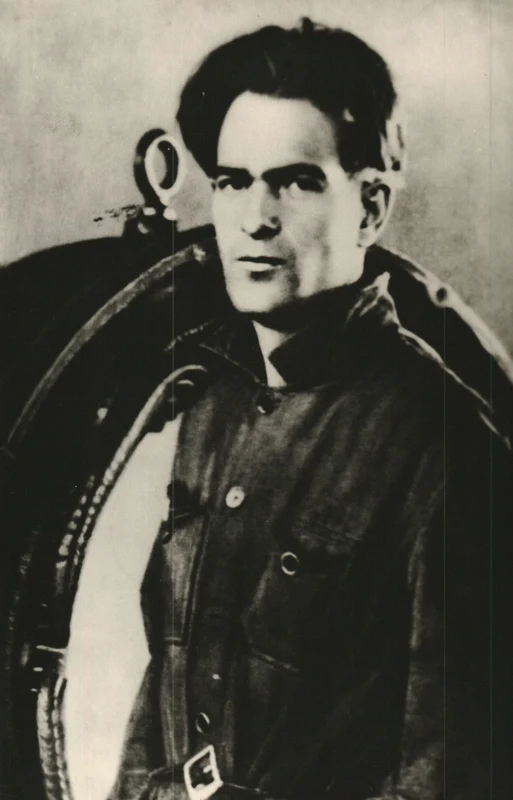
Nikola Vaptsarov
At a glance
| In Bulgarian | Никола Йонков Вапцаров |
|---|---|
| Born | 7 December 1909, Bansko |
| Died | 23 July 1942, Sofia (executed) |
| Known for | “Motor Songs” (1940); poems such as “Faith” and “Farewell” |
| Profession | Marine engineer, stoker and mechanic |
Source: Wikipedia: Nikola Vaptsarov; Wikipedia (Bulgarian): Никола Вапцаров1,2
Bansko, Varna and the factory
Vaptsarov was born in Bansko, then still in the Ottoman Empire. His father, Yonko Vaptsarov, took part in the Bulgarian national liberation movement in Macedonia, and his mother, Elena, had studied at the American College in Samokov. After the high school in Razlog he studied at the Naval Machinery School in Varna from 1926 to 1932, and in April and May 1932 he sailed on the ship “Burgas” to Istanbul, Famagusta, Alexandria, Beirut, Port Said and Haifa.1,2
He then worked at a factory in Kocherinovo, first as a stoker and then as a mechanic, and organised, wrote and acted in amateur theatre. He married Boyka Vaptsarova; their son Yonko fell ill and died as a small child. In 1936, after an accident, he was dismissed and moved to Sofia, where for a long time he could not find work.2
“Motor Songs” and the trial
“Motor Songs” appeared in 1940 under the name Nikola Yonkov. It was the only collection he published; his travel writing, stories, criticism, children’s poems and a play were mostly published after his death. In November 1940, during the campaign for a pact with the Soviet Union known as the Sobolev action, he collected signatures in Bansko. He was arrested, interned in Godech and acquitted at trial.1,2
After Germany attacked the Soviet Union in 1941 he took part in the underground resistance of the then illegal Bulgarian Communist Party. He was arrested in March 1942, tried by the Sofia military court from 6 July and sentenced to death under the Law for the Defence of the State on 23 July 1942. He was shot the same evening at the garrison firing range in Sofia, with other members of the resistance. He was amnestied posthumously after 1944.1,2
Sources differ on how many men were shot with him. English Wikipedia says eleven others; Bulgarian Wikipedia names five: Anton Ivanov, Anton Popov, Petar Bogdanov, Georgi Minchev and Atanas Romanov.1,2
The Macedonian question
Vaptsarov’s identity is read differently in Bulgaria and North Macedonia. English Wikipedia describes him in the later part of his life as a Macedonian nationalist and the driving force of the pro-communist Macedonian Literary Circle in Sofia, which promoted the idea of a Macedonian nation and language. Bulgarian Wikipedia says he showed a Bulgarian national consciousness, was strongly influenced by the Comintern’s 1934 thesis on Macedonia, and quotes his 1938 report to the circle: “We are Macedonians…”1,2
Both articles note that he wrote in standard Bulgarian and that in police statements he called himself a Bulgarian. In North Macedonia he is regarded as an ethnic Macedonian. English Wikipedia quotes the Slavist Jolanta Sujecka: “Vapcarov/Vaptsarov is part of Bulgarian literature, and not just because of the Bulgarian language of his poems. The Bulgarian dimension of his identity as well as the Macedonian and universal – international dimensions are part of his multi-layer consciousness.”1,2
Sources differ on the date of that police statement. English Wikipedia places it in spring 1941, after Bulgarian troops entered Macedonia; Bulgarian Wikipedia dates it to 1940.1,2
Memory
- In 1949 the Naval Academy in Varna was renamed the Nikola Vaptsarov Naval Academy.
- Museums dedicated to him opened in Bansko and Sofia in 1952.
- He was awarded an international peace prize posthumously; on 3 December 1953 it was handed to his mother, Elena.
- Vaptsarov Peak in Antarctica is named after him.
Source: Wikipedia: Nikola Vaptsarov; Wikipedia (Bulgarian): Никола Вапцаров1,2
Sources
Facts checked 10 November 2026. Prepared by InvestBulgaria for general information.