UNESCO World Heritage site
About Thracian Tomb of Kazanlak
At a glance
| Name | Thracian Tomb of Kazanlak (Казанлъшка гробница) |
|---|---|
| Where | Tyulbe park, in the north-east of Kazanlak, Stara Zagora Province |
| Dated | End of the 4th or beginning of the 3rd century BC, the early Hellenistic period |
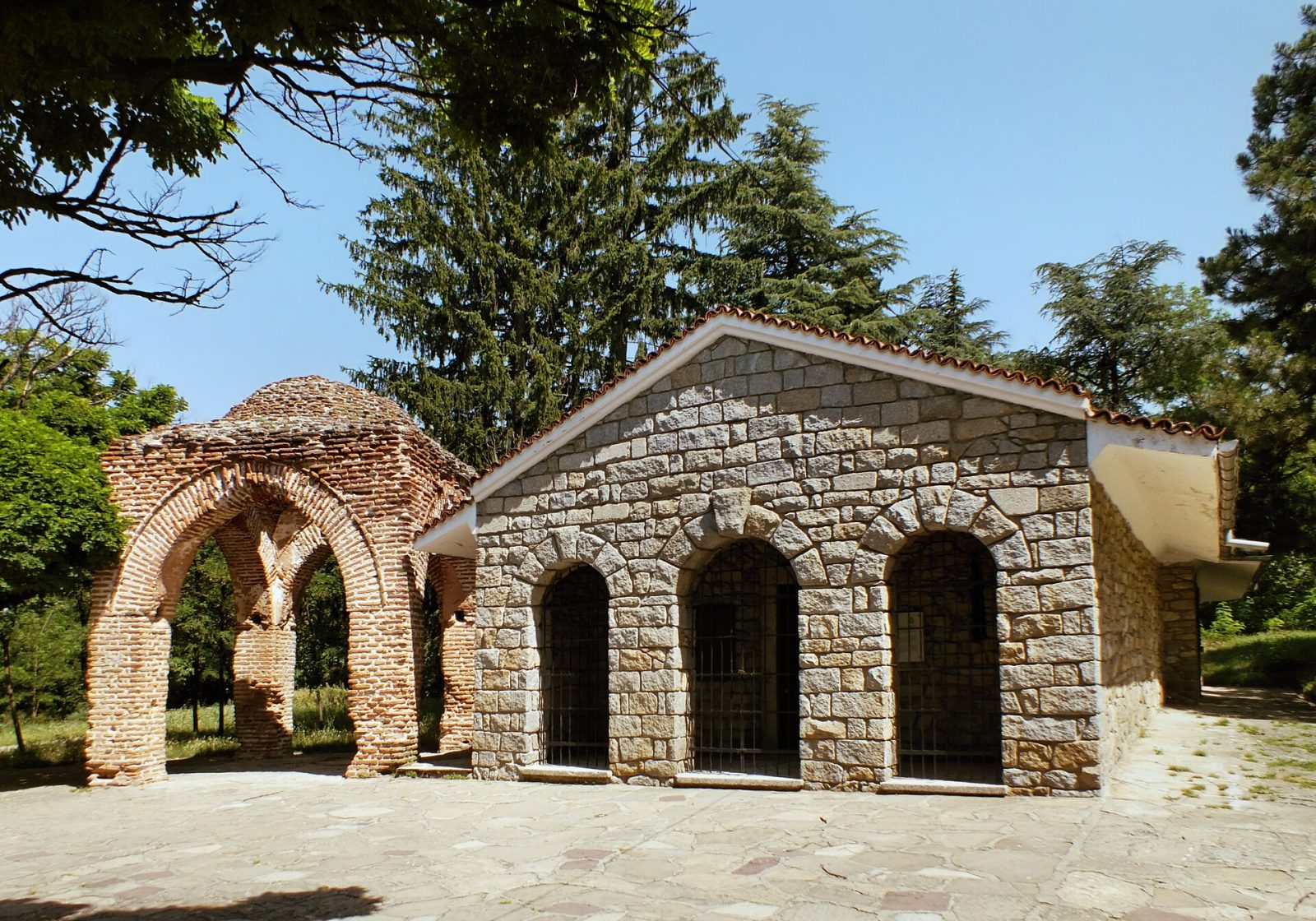
| What it is | A brick “beehive” (tholos) tomb with a corridor and a round domed chamber, both painted |
| UNESCO | Inscribed in 1979 under criteria (i), (iii) and (iv) |
| Can you go in? | No; the original is closed, and visitors see a full-size replica next to it |
| Run by | Iskra Historical Museum, Kazanlak |
| Ticket | 6 leva for adults and 2 leva for pupils and students, as listed by the museum |
Source: UNESCO World Heritage Centre: Thracian Tomb of Kazanlak; Wikipedia: Thracian Tomb of Kazanlak; Wikipedia: Казанлъшка гробница; Iskra Historical Museum, Kazanlak: sites, hours and tickets1,2,3,4
Why it matters
UNESCO calls the tomb a masterpiece of the Thracian creative spirit and says the monument is the only one of its kind anywhere in the world. Its paintings are, in UNESCO’s words, Bulgaria’s best-preserved artistic masterpieces from the Hellenistic period.1
The tomb is part of a large Thracian necropolis near Seuthopolis, the capital of the Thracian king Seuthes III. The Kazanlak Valley, between the Balkan Mountains and Sredna Gora, holds more than a thousand tombs of Thracian rulers and nobles, and is often called the Valley of the Thracian Rulers.1,2
UNESCO listed the tomb under criterion (i), as a masterpiece of the Thracian creative spirit; criterion (iii), because the frescoes show the high level of culture and painting in Thrace; and criterion (iv), as a significant stage in Hellenistic funerary art.1
How it was found
The tomb was found by chance on 19 April 1944, when soldiers digging a trench in the north-east of Kazanlak hit a stone wall inside a mound that looked like a natural hill. The mound was 7 m high and 40 m across. They broke through the wall, crawled along a low corridor and reached a round vaulted room, and then called an archaeologist.3
The remains of a man and a woman lay in the chamber, with horse bones in the corridor. Few objects were left, so the tomb is thought to have been robbed in antiquity. Those that survived include 140 small gold buttons, clay rosettes, a silver jug with a gilded band of laurel leaves, part of an iron bridle and an iron spearhead.3
The Bulgarian Wikipedia article says the tomb belonged to a Thracian ruler named Roygos.3
What the murals show
The tomb is built of brick bound with lime mortar. A small antechamber, 2.60 m long and 1.84 m wide, leads into the corridor (the dromos) and then into the domed burial chamber. The painting covers about 40 m² and shows moments from the earthly, military and afterlife of the ruler buried there.3
- The battle frieze in the corridor shows foot soldiers and horsemen; at its centre two warriors face each other, one in a short red chiton and a yellow helmet, the other in blue.
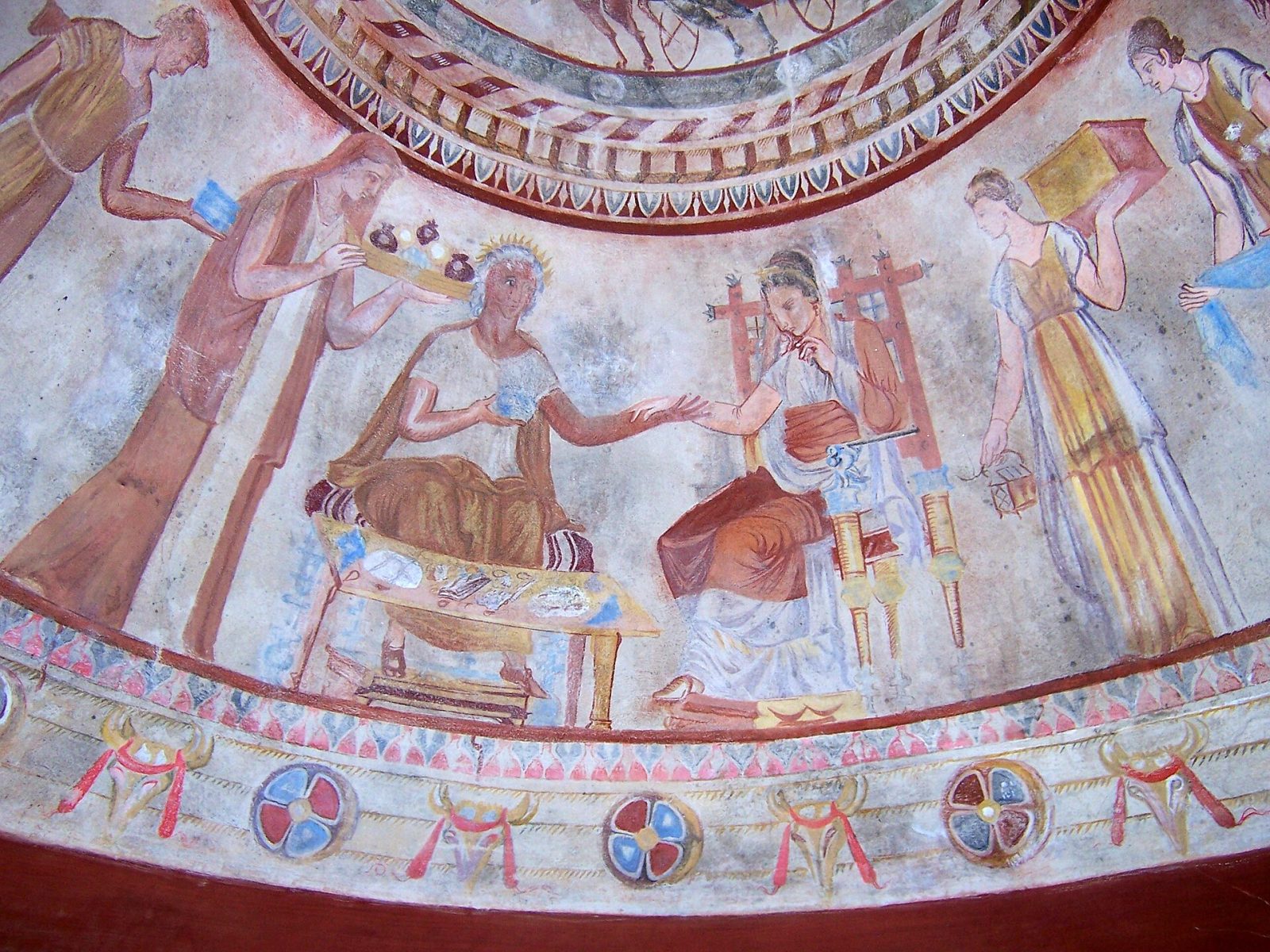
- The funeral feast fills the main frieze of the dome: a man and a woman sit at a small table with food, and the couple grasp each other’s wrists.
- The procession brings gifts on trays, with servants, grooms, horn players, saddled horses without riders and a chariot.
- A tall figure with a tray of pomegranates is probably a mother goddess of the Demeter type, receiving the dead.
- The top of the dome, above the cornice, is split into three fields of galloping horses, which the English Wikipedia article describes as a chariot race.
Source: Wikipedia: Thracian Tomb of Kazanlak; Wikipedia: Казанлъшка гробница2,3
The painter is known by the name Kodzimasis Hrestos. He worked with four main colours, black, red, yellow and white, using wet fresco for the figures and ornament and tempera for the floor and walls.3
Scholars read the scenes differently. For the battle frieze, Ivan Venedikov saw a real event in the ruler’s life and Ivan Marazov a mythic scene of his valour. For the joined hands of the couple, Lyudmila Zhivkova saw a farewell to the dead and Marazov a sacred marriage in the afterlife; the English Wikipedia article adds that Zhivkova’s view is not shared by all specialists.2,3
Why you see a replica
In 1946 the tomb was enclosed in a protective building, which was rebuilt in 1960, and in 1961 air conditioning was installed to keep the murals at a steady temperature. UNESCO set up an international commission in 1966 to check their condition. The murals were cleaned and strengthened without being retouched.1,3
To protect the paintings, access to the original tomb is strictly limited. A full-size, exact replica was built nearby to a design by the architect Mladen Panchev, and the murals were recreated by Professor Lyuben Prashkov, Zlatka Kozhuharova and Slavi Voykov. UNESCO notes that this copy protects the original from the effects of visitors.1,2,3
Opening hours and tickets
| Season | Open |
|---|---|
| Summer | 09:00–17:30, Monday to Sunday |
| Winter | 09:00–17:00, Monday to Sunday |
Source: Iskra Historical Museum, Kazanlak: sites, hours and tickets4
| Ticket | Price listed by the museum |
|---|---|
| Adult | 6 leva |
| Pupil or student | 2 leva |
| Child under 7 | Free |
| Last Monday of the month | Free for visitors not in an organised group |
Source: Iskra Historical Museum, Kazanlak: sites, hours and tickets4
The Iskra Museum’s page still lists prices in leva, the currency before the euro, so ask at the desk for the current price in euros. The replica’s phone number is +359 431 6 47 50. Checked in November 2026.4
More Thracian tombs nearby
The Iskra Museum runs several other sites in the Kazanlak area, each with its own ticket and the same daily hours.4
| Site | Where |
|---|---|
| Golyama Kosmatka mound, tomb of Seuthes III | 1 km south of Shipka |
| Shushmanets mound tomb | 2 km east of Shipka; open Monday to Saturday |
| Museum of the Rose | Rozarium park, Kazanlak |
| Kulata ethnographic complex | 18 Nikola Petkov Street, Kazanlak |
| Iskra Historical Museum, main exhibition | 9 Sv. sv. Kiril i Metodiy Street, Kazanlak |
Source: Iskra Historical Museum, Kazanlak: sites, hours and tickets4
The tomb is also No. 91 among the 100 National Tourist Sites of the Bulgarian Tourist Union.3
On a Bulgarian coin
The seated woman from the dome mural appeared on the reverse of the Bulgarian 50 stotinki coin issued in 2005.2
Frequently Asked Questions
Can you see the original Thracian Tomb of Kazanlak?
Not usually. Access to the original is strictly limited to protect the murals, and visitors see a full-size, exact replica built next to it in Tyulbe park.
How old is the Kazanlak tomb?
UNESCO dates it to around the end of the 4th century BC; the Bulgarian Wikipedia article gives the end of the 4th or the beginning of the 3rd century BC.
What do the murals show?
A battle in the corridor and, in the dome, a funeral feast with a seated couple holding each other’s wrists, a procession with gifts, horses and a chariot, and racing horses at the top.
When was the tomb discovered?
On 19 April 1944, by soldiers digging a trench in the north-east of Kazanlak.
Why is it on the UNESCO list?
UNESCO listed it in 1979 as a masterpiece of the Thracian creative spirit, as evidence of the high level of painting in Thrace, and as an important stage in Hellenistic funerary art.
How much is a ticket?
The Iskra Museum lists 6 leva for adults and 2 leva for pupils and students, with free entry for children under 7. Ask at the desk for the current price in euros.
What are the opening hours?
The museum lists 09:00 to 17:30 in summer and 09:00 to 17:00 in winter, every day of the week.
Sources
- UNESCO World Heritage Centre: Thracian Tomb of Kazanlak
- Wikipedia: Thracian Tomb of Kazanlak
- Wikipedia: Казанлъшка гробница (in Bulgarian)
- Iskra Historical Museum, Kazanlak: sites, hours and tickets (in Bulgarian)
Figures checked 11 November 2026. Information only, not investment, tax or legal advice.