Tsar Samuil
At a glance
| In Bulgarian | Цар Самуил |
|---|---|
| Ruled | Army commander and co-ruler from 977; tsar 997–1014 |
| Family | One of the four Cometopuli, sons of the komit Nikola and Rhipsime |
| Capital | Ohrid, moved from Skopje |
| Resting place | Basilica of St Sofia, Sofia, since October 2026 |
Source: Wikipedia: Samuel of Bulgaria; Wikipedia (Bulgarian): Самуил; BNR: Bulgarians on Tsar Samuil’s return1,2,5
Sources differ on two figures. English Wikipedia says around 14,000 Bulgarian soldiers were captured at Kleidion, “according to some sources even 15,000”; Bulgarian Wikipedia gives 15 000. English Wikipedia dates the discovery of the grave by Nikolaos Moutsopoulos to 1965; Bulgarian Wikipedia gives 1969.1,2
The Cometopuli and the war with Basil II
Samuil was one of four brothers known as the Cometopuli, “sons of the komit”. From 977 to 997 he was a general under Roman, the son of Tsar Peter I, who gave him command of the army and effective royal power. On 17 August 986 he defeated Basil II at Trajan’s Gates. Ten years later, on the night of 19 July 996, the Byzantine general Nikephoros Ouranos surprised his army at the Spercheios river; Samuil was wounded in the arm and barely escaped.1,2
Samuil moved the capital from Skopje to Ohrid and made it the seat of the Bulgarian Patriarchate, which is why his realm is sometimes called the Western Bulgarian Empire. English Wikipedia says that historiography in Yugoslavia, and later in North Macedonia, presented his state as distinct from the Bulgarian Empire, and describes that historiography as nationalist-driven.1
Kleidion and the end of the empire
On 29 July 1014 a Byzantine force attacked the Bulgarians from the rear in the Kleidion pass on Belasitsa and captured thousands of soldiers. On Basil II’s orders the captives were blinded, with one man in every hundred left with one eye to lead the others home. Both Wikipedias say the sight of the blinded men caused Samuil a heart attack; English Wikipedia says he died two days later, on 6 October 1014. Basil II later became known as the “Bulgar-slayer”, and the Bulgarian state fell to Byzantium in 1018.1,2
The grave and the return to Sofia
The Greek archaeologist Nikolaos Moutsopoulos found Samuil’s grave in the basilica of St Achillios on the island of the same name in Lake Prespa, a church Samuil had built. English Wikipedia says the remains were later kept in the Museum of Byzantine Culture in Thessaloniki, and a facial reconstruction shows a man of about 70.1,3
On 3 October 2026 Greece handed the remains to Bulgaria at a ceremony at the Museum of Byzantine Culture, hosted by Greek Prime Minister Kyriakos Mitsotakis and attended by Bulgarian Prime Minister Rumen Radev. Remains from two other sarcophagi, believed to belong to Tsar Gavril Radomir and other members of the royal family, were handed over as well. The culture ministers Evtim Miloshev and Lina Mendoni signed the documents, and in return Bulgaria gave Greece 48 church relics, including icons, crosses and a bishop’s throne.3
The same day a Spartan military aircraft, escorted through Bulgarian airspace by MiG-29 and F-16 fighters, brought the remains to Sofia, where thousands gathered on Prince Alexander I Square for a state ceremony. Bulgarian National Radio says the return came after six decades of negotiations. The remains were then laid to rest in the Basilica of St Sofia.4,5
Memory
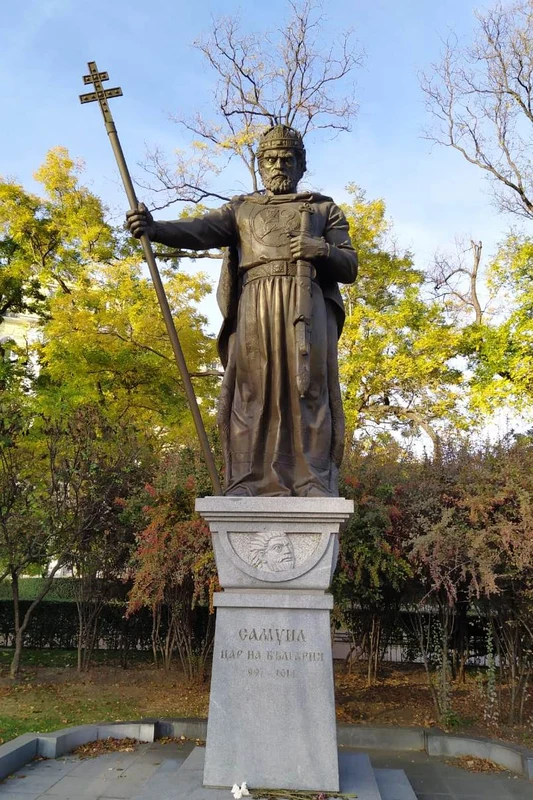
Monuments to Samuil stand in Bulgaria and North Macedonia, including in Petrich and Ohrid. In Sofia a monument by the sculptor Aleksandar Haytov was unveiled next to the Basilica of St Sofia on 8 June 2015, as part of the events marking 1000 years since his death. Four Bulgarian villages and Samuel Point on Livingston Island in Antarctica bear his name, and he is the central figure of novels by Dimitar Talev, Anton Donchev and Stefan Tsanev.1,2
Sources
- Wikipedia: Samuel of Bulgaria
- Wikipedia (Bulgarian): Самуил
- BNR: Greece hands over the remains of Tsar Samuel to Bulgaria
- BNR: Thousands welcome the remains of Tsar Samuil in Sofia
- BNR: Bulgarians on Tsar Samuil’s return
Facts checked 10 November 2026. Prepared by InvestBulgaria for general information.