
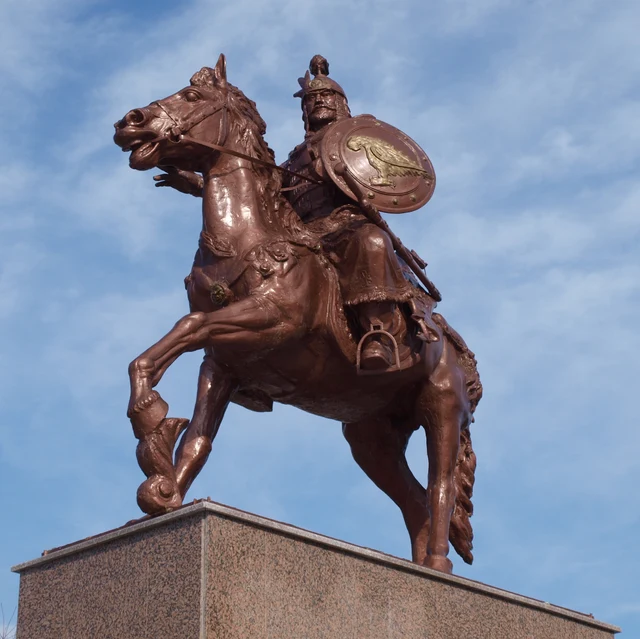
Khan Asparuh
At a glance
| In Bulgarian | Аспарух (Исперих) |
|---|---|
| Title | Khan of the Bulgars |
| Clan | Dulo |
| Father | Kubrat, ruler of Old Great Bulgaria |
| Reign | Second half of the 7th century; c. 668–695 in Moskov’s chronology, other chronologies end it in 700 or 701 |
| Died | Around 700, according to tradition in battle with the Khazars |
Source: Wikipedia: Asparuh of Bulgaria; Wikipedia (Bulgarian): Аспарух1,2
From the steppes to the Danube
Byzantine sources describe Asparuh as a younger son of Kubrat, who had built a large state, “Great Bulgaria”, in the steppes of today’s Ukraine. The Nominalia of the Bulgarian Khans places him in the Dulo clan and gives him 61 years of rule. Historians do not accept that figure as a reign; it may instead be the length of his life.1
Great Bulgaria broke up under Khazar attack in 668, and Kubrat’s sons went separate ways. Asparuh led his people west to the Danube delta, where they settled, probably on Peuce, an island that no longer exists. English Wikipedia puts the size of his following at 30,000 to 50,000 Bulgars; Bulgarian Wikipedia says the number and origin of the group are still debated.1,2
The Battle of Ongal and the treaty of 681
In 680 Emperor Constantine IV marched against the Bulgars and their Slav allies by land and sea, and the Bulgars withdrew into a fortified camp. The emperor then left the army to be treated for gout. His troops took it as flight, began to retreat, and the Bulgars routed them in what became known as the Battle of Ongal.1,2
Sources differ on where the emperor went for treatment: English Wikipedia says Anchialos (today’s Pomorie), Bulgarian Wikipedia says Mesembria (today’s Nesebar).1,2
Asparuh went on to take control of Moesia and formed an alliance with the local Slavic groups, the Severi and the Seven Slavic tribes. When he began raiding Byzantine Thrace in 681, Constantine IV agreed to a treaty under which Byzantium paid the Bulgars an annual tribute. Bulgarian Wikipedia adds that Byzantium gave up Lower Moesia as far as the Iskar river, but not Odessos. These events are seen as the founding of the Bulgarian state and its recognition by Byzantium.1,2
Building the new state
Later tradition credits Asparuh with building Pliska and Drastar (today’s Silistra), the main centres of the new state, and at least one of the defensive earth walls between the Danube and the Black Sea.1
Bulgarian Wikipedia describes further fighting with Byzantium around 688–690 and steady pressure from the Khazar Khaganate in the north-east, which it calls the main threat to the young state. Holding the northern frontier was Asparuh’s most important task, and the many earth walls in Dobruja and Wallachia were built against attacks from the north.2
Legacy
Asparuh came third in the “Great Bulgarians” vote held by Bulgarian National Television. The town of Isperih is named after him, as are several villages, streets in many Bulgarian towns, Asparuh Peak on Livingston Island in Antarctica and the Asparuhov Bridge in Varna, one of the largest bridges in Bulgaria. His life is the subject of the 1981 epic film “Khan Asparuh”.1,2
Sources
Facts checked 10 November 2026. Prepared by InvestBulgaria for general information.