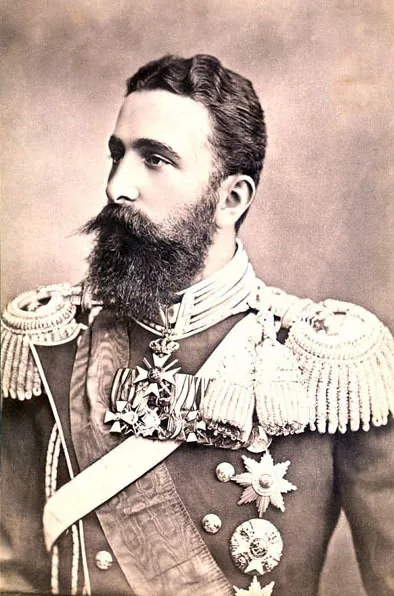
Alexander of Battenberg
At a glance
| In Bulgarian | Александър I Батенберг |
|---|---|
| Born | 5 April 1857, Verona, Kingdom of Lombardy–Venetia, Austrian Empire |
| Died | 17 November 1893, Graz, Duchy of Styria, Austria-Hungary |
| Known for | First prince of the autonomous Principality of Bulgaria |
| Office | Prince of Bulgaria, 29 April 1879–7 September 1886 |
| Spouse | Johanna Loisinger, married in 1889 |
Source: Wikipedia: Alexander of Battenberg1
Early life
Alexander Joseph was born in Verona in 1857, the second son of Prince Alexander of Hesse and by Rhine and Julia, Princess of Battenberg. His mother’s title followed her morganatic marriage to his father. Alexander was a nephew of Tsar Alexander II of Russia and, in his youth, often visited Saint Petersburg.1
Prince of Bulgaria
Under the Treaty of Berlin, Bulgaria became an autonomous principality under Ottoman suzerainty. On the Tsar’s recommendation, the Bulgarian Grand National Assembly unanimously elected Alexander as prince on 29 April 1879. He travelled to Bulgaria and took an oath to the Tarnovo Constitution at Veliko Tarnovo that July.1
Alexander suspended the Constitution in 1881, but restored it in 1883 after the measure proved unsuccessful. This led to a serious breach with Russia. In 1885, he consented to the union of Eastern Rumelia with Bulgaria. During the Serbo-Bulgarian War, he led Bulgarian forces to victory at Slivnitsa. In 1886, the Ottoman Sultan nominated him governor-general of Eastern Rumelia for five years.1
Abdication and later life
On 20 August 1886, officers in a military plot seized Alexander and forced him to abdicate. A counter-revolution led by Stefan Stambolov briefly brought him back to Bulgaria, but Alexander’s position remained untenable. He issued a manifesto resigning the throne and left the country on 8 September. After his abdication, he claimed the title Prince of Tarnovo.1
Alexander married actress Johanna Loisinger in 1889 and took the style Count von Hartenau. They had a son and a daughter. He later held a local command in the Austrian army and died in Graz in 1893. His remains were taken to Sofia, where he was buried in a mausoleum.1
Sources
Facts checked 13 October 2026. Prepared by InvestBulgaria for general information.
