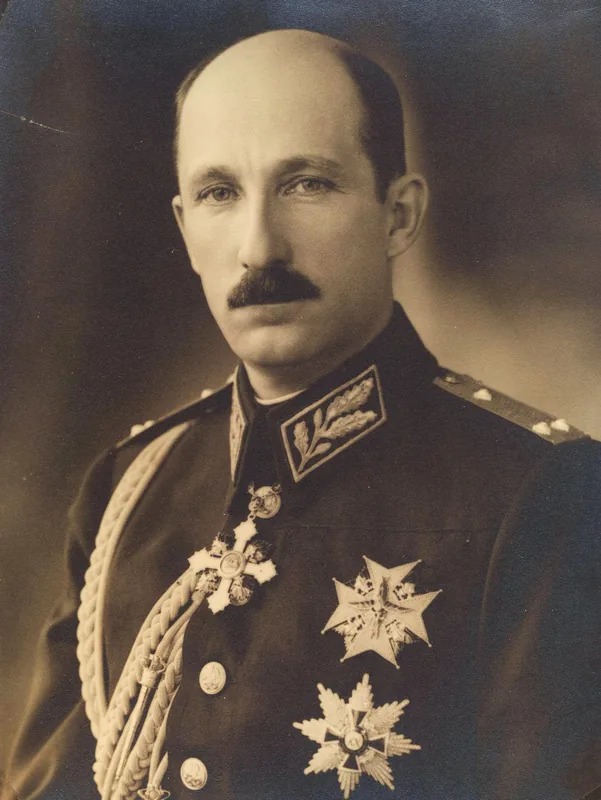
Boris III of Bulgaria
At a glance
| In Bulgarian | Борис III |
|---|---|
| Born | 30 January 1894, Sofia, Bulgaria |
| Died | 28 August 1943, Sofia, Bulgaria |
| Reign | 3 October 1918–28 August 1943 |
| Father | Ferdinand I of Bulgaria |
| Spouse | Giovanna of Savoy |
| Successor | Simeon II |
Source: Wikipedia: Boris III of Bulgaria1
Early life and reign
Boris was born in Sofia, the eldest son of Ferdinand I and Princess Marie Louise of Bourbon-Parma. In 1896, he was converted from Catholicism to Eastern Orthodoxy as part of his father’s effort to reconcile Bulgaria and Russia. He studied at the Palace Secondary School and the Military School in Sofia, took part in the Balkan Wars and served as a liaison officer during the First World War.1
After Bulgaria’s defeat in 1918, Ferdinand abdicated and Boris became Tsar. Political conflict marked the early reign. A military coup overthrew Prime Minister Aleksandar Stamboliyski in 1923, and a bombing at Saint Nedelya Church in 1925 killed 213 people. In 1934, the Zveno movement staged a coup and abolished political parties. Boris removed Zveno from power the following year and thereafter ruled as a de facto absolute monarch.1
War and policy
Bulgaria initially remained neutral in the Second World War. In 1940, it received Southern Dobrudja from Romania under the Treaty of Craiova. In March 1941, Boris aligned Bulgaria with the Axis powers. The country then received territories including parts of Yugoslav Macedonia and Greek Thrace. Boris did not send Bulgarian troops to fight the Soviet Union alongside Germany.1
In January 1941, Boris approved the antisemitic Law for Protection of the Nation, which denied Bulgarian Jews citizenship and restricted their rights. Bulgarian authorities deported 11,343 Jews from occupied territories to Nazi camps in 1943. After protests within Bulgaria, Boris stopped planned deportations of Jews from the country’s pre-war territory. Nearly 20,000 Bulgarian Jews were instead expelled to the countryside for forced labour. Most Jews deported from the occupied territories perished in camps.1
Death and succession
Boris died in Sofia on 28 August 1943, shortly after returning from a meeting with Hitler. His death was attributed to heart failure, but theories of poisoning circulated. No firm proof of foul play emerged. His six-year-old son, Simeon II, succeeded him, with a regency council exercising royal authority. Boris was buried at Rila Monastery after a state funeral. His body was later exhumed and secretly moved; only his heart was recovered and reinterred at the monastery in 1994.1
Sources
Facts checked 13 October 2026. Prepared by InvestBulgaria for general information.
