Baba Vanga
At a glance
| In Bulgarian | Баба Ванга |
|---|---|
| Born | 3 October 1911, Strumica, Ottoman Empire |
| Died | 11 August 1996, Sofia, Bulgaria |
| Birth name | Vangeliya Pandeva Surcheva |
| Known for | Clairvoyance and healing, both attributed |
| Spouse | Dimitar Gushterov, married 1942 |
Source: Wikipedia: Baba Vanga1
Life and work
Vangeliya Pandeva Surcheva was born prematurely in Strumica, then part of the Ottoman Empire. Her mother died when she was three, and her father was conscripted during the First World War. At 13, Vanga was reportedly caught in a whirlwind and found with dirt and grit in her eyes. After unsuccessful operations, she gradually lost her sight. She later attended a school for blind students in Zemun, where she learnt Braille and practical skills.1
During the Second World War, people visited Vanga seeking healing or information about relatives. She married Dimitar Gushterov in 1942 and moved with him to Petrich. After his death in 1962, she continued receiving visitors. In the 1960s, she was employed by the Petrich municipality and the Institute of Suggestology, which studied her alleged abilities. The municipality supported her and took part of her income; it also charged visitors an admission fee.1
Predictions
There are no written records of Vanga’s alleged predictions. Followers have attributed to her predictions about events including the beginning of the Second World War, Indira Gandhi’s assassination, the dissolution of the Soviet Union and the Kursk submarine disaster. Some people close to Vanga said she had not made certain predictions later ascribed to her.1
Other claims attributed to her included that the 44th US president would be the country’s last. That prediction, like a forecast of nuclear war between 2010 and 2016 that would lead to Europe’s abandonment, proved false. Her name and persona nevertheless remained popular after her death, including in parts of Southeast and Eastern Europe.1
Legacy
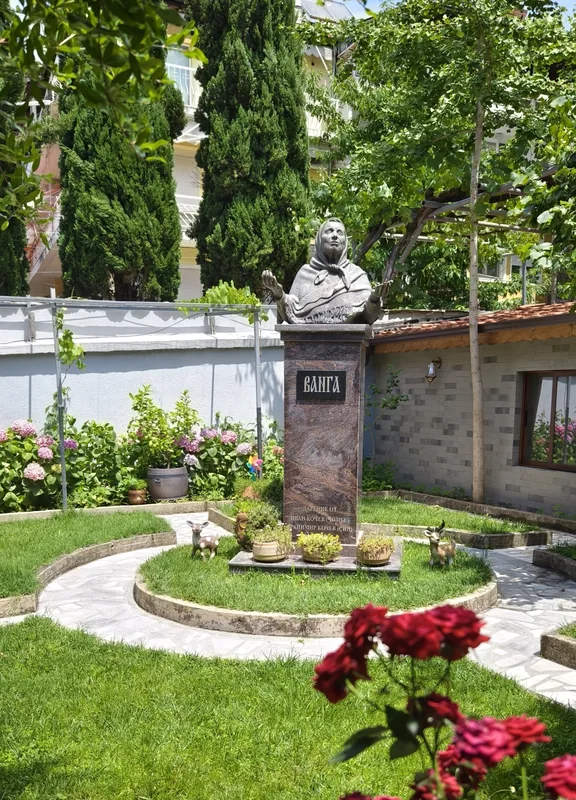
Vanga had Orthodox Christian beliefs and in 1990 declared St Petka her patron saint. A church dedicated to St Petka was built in Rupite with money left by visitors and consecrated in 1994. Its paintings of Vanga, by artist Svetlin Rusev, drew objections because Orthodox canon law permits depictions only of saints. Vanga was buried near the church after her death from breast cancer in 1996.1
Her niece Krasimira Stoyanova published a biography in Bulgarian in 1989. Vanga’s Petrich house became a museum in 2008, and her house in Rupite opened to visitors in 2014. In 2012, the Municipal Council of Petrich posthumously awarded her the title of Honorary Citizen. Her alleged predictions and public image continued to circulate online in the 2020s.1
Sources
Facts checked 13 October 2026. Prepared by InvestBulgaria for general information.
