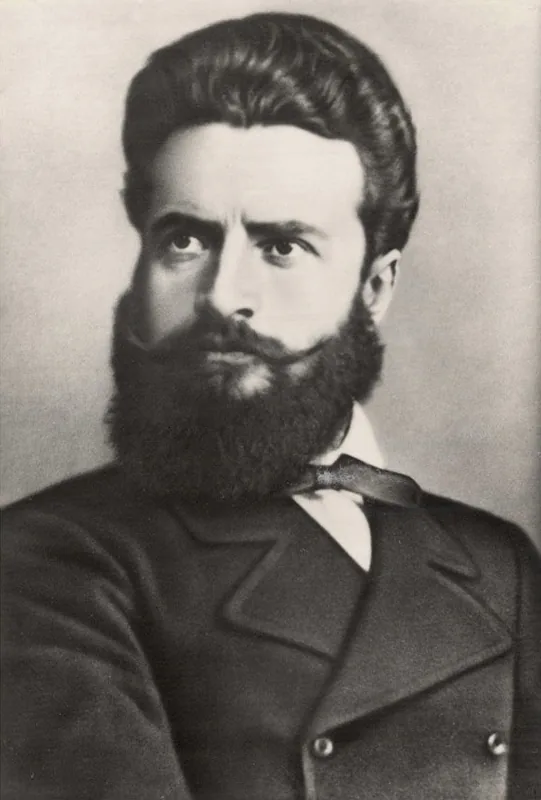
Hristo Botev
At a glance
| In Bulgarian | Христо Ботев |
|---|---|
| Born | 6 January 1848, Kalofer, Ottoman Empire; birthplace disputed |
| Died | 1 June 1876, near Vratsa, Ottoman Empire |
| Occupation | Poet, journalist and revolutionary |
| Movement | Bulgarian Revolutionary Central Committee |
| Spouse | Veneta Boteva |
| Child | Ivanka Boteva |
Source: Wikipedia: Hristo Botev1
Life and activism
Botev was born in Kalofer, then part of the Ottoman Empire. Some historians have disputed his birthplace, suggesting Karlovo or the village of Osen. His father, Botyo Petkov, was a teacher and a figure of the Bulgarian National Revival. Botev studied in Kalofer before travelling to Odessa in 1863 on a Russian government scholarship.1
After returning to Kalofer in 1867, Botev taught in place of his ill father. He later settled among Bulgarian émigrés in Romania and worked as a teacher, journalist and editor. He published poetry and wrote for revolutionary newspapers. Following the death of Vasil Levski in 1873, Botev supported preparations for an uprising and was elected president of the Bulgarian Revolutionary Central Committee in 1875.1
Uprising and death
During the April Uprising of 1876, a recruited leader declined to command a rebel company, and Botev took overall command. In May, the group crossed the Danube aboard the Austro-Hungarian passenger ship Radetzky, after boarding in disguise at Romanian ports and seizing control of the vessel. Ottoman forces and irregular troops attacked the company after it entered Ottoman territory.1
Botev was shot dead near Vratsa on 1 June 1876, aged 28. The precise place of his death is uncertain, with Okolchitsa or Vola suggested. His company was dismantled after his death. Local people did not join or assist the band.1
Poetry and legacy
Botev’s poetry addressed oppression and the struggle for freedom. His 1875 book, co-authored with Stefan Stambolov, included works such as “My Prayer”, “Hadzhi Dimitar” and “The hanging of Vasil Levski”. His writing drew on Bulgarian folklore and on influences including Lord Byron, Alexander Pushkin and Mikhail Lermontov. He also wrote about political and social revolution in his journalism.1
After his death, Botev became a central figure in Bulgaria’s national commemorations, and his poems entered the school curriculum. Different groups presented him in different ways: Bulgarian leftists described him as a forerunner of socialist ideas, while anarchists also claimed him as an influence. His name was given to the highest peak of the Balkan Mountains in 1950, as well as to schools, streets and other institutions.1
Sources
Facts checked 13 October 2026. Prepared by InvestBulgaria for general information.
