
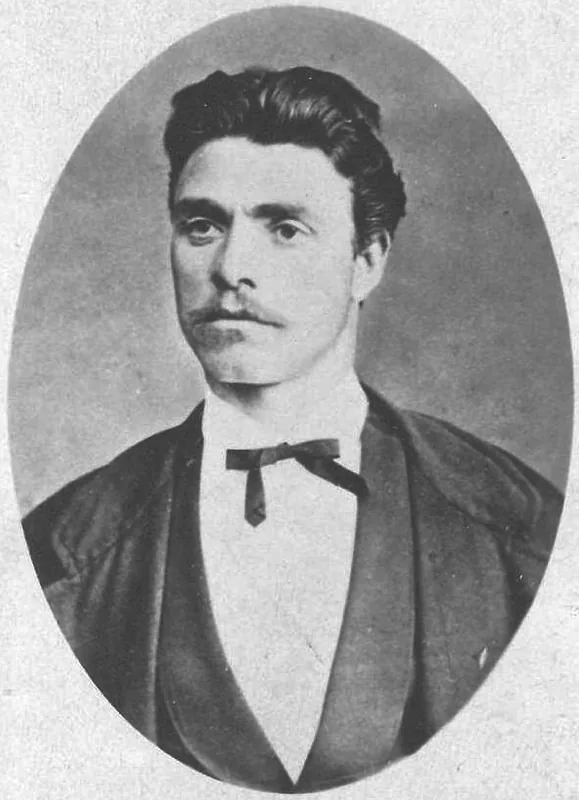
Vasil Levski
At a glance
| In Bulgarian | Васил Левски |
|---|---|
| Born | 18 July 1837, Karlovo, Ottoman Empire |
| Died | 18 February 1873, Sofia, Ottoman Empire |
| Birth name | Vasil Ivanov Kunchev |
| Known for | Founding the Internal Revolutionary Organisation |
| Occupation | Revolutionary |
Source: Wikipedia: Vasil Levski1
Life and activism
Vasil Levski was born Vasil Ivanov Kunchev in Karlovo on 18 July 1837. He became an Orthodox monk in 1858, taking the religious name Ignatius, and was later made a hierodeacon. In 1862, he left his monastic service to join the First Bulgarian Legion in Belgrade, where his courage earned him the nickname Levski, meaning “Lionlike”.1
After returning to Bulgarian lands, Levski worked as a teacher and organised patriotic groups. He later joined revolutionary detachments and the Second Bulgarian Legion. In 1868, he rejected the strategy of sending armed groups from abroad to provoke revolt. Instead, he began travelling through Bulgarian lands to build support for an internally organised movement.1
Revolutionary ideas
Levski founded the Internal Revolutionary Organisation, a network of secret committees centred on the Lovech Central Committee. The committees prepared for a coordinated uprising, acquired weapons and organised volunteer detachments. Levski also helped establish the Bulgarian Revolutionary Central Committee in Romania and served as its representative in the Bulgarian lands.1
He envisioned Bulgaria as a democratic republic, independent of foreign powers. Levski argued that people of different ethnicities and religions should have equal rights in a free Bulgaria. He distinguished the Ottoman government from the Turkish people and their religion, saying the struggle was against the sultan’s government and its laws.1
Capture and legacy
After an unauthorised robbery by members of the revolutionary movement exposed its network, Levski went to collect documents from the committee archive in Lovech. Ottoman authorities arrested him at an inn in Kakrina on 27 December 1872. He was tried in Sofia and sentenced to death. He did not reveal details of his organisation or its members, and was executed by hanging on 18 February 1873.1
Levski is commemorated with monuments and museums in Bulgaria and monuments abroad. Bulgarian institutions, including the national stadium and a military university, bear his name. A nationwide television poll in 2007 named him the greatest Bulgarian of all time. On 17 February 2025, Bulgaria’s president named Sofia Airport after Levski.1
Sources
Facts checked 13 October 2026. Prepared by InvestBulgaria for general information.
