Nestinarstvo: Fire Dancing in Strandzha
At a glance
| Bulgarian name | Нестинарство |
|---|---|
| Also called | Anastenaria in Greek |
| Where | Bulgari, in the Strandzha region of south-east Bulgaria |
| Date | 3–4 June in Bulgari; a May observance is also described |
Source: Anastenaria; Nestinarstvo, messages from the past: the Panagyr of Saints ...1,2
Dates and setting
In Bulgari, the Panagyr for Saints Constantine and Helena takes place on 3 and 4 June. Source 1 describes an annual cycle from 21 to 23 May, with a major festival in May and another in January. The accounts therefore give different dates and describe related observances in different places.1,2
The ritual
In Bulgari, the day includes consecrated and ceremonial rites, followed by a procession carrying the saints’ icons to a spring. Drum and bagpipes accompany the procession. At the spring, people receive holy water and candles for good health. The ritual is intended to ensure the well-being and fertility of the village.2
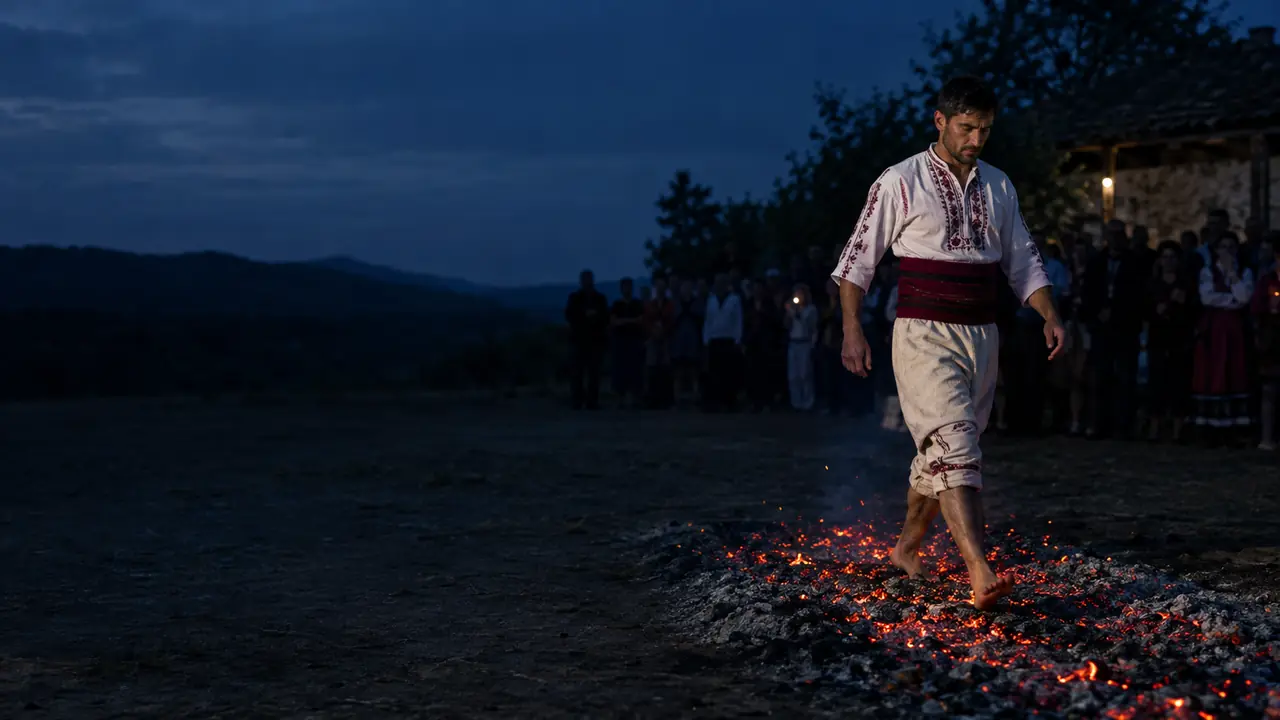
The fire dance takes place in the evening. People form a circle around burning embers, led by the sacred drum. Nestinari, described as spiritual and physical leaders through whom the saints express their will, enter the circle and tread the embers. Source 1 also describes participants dancing barefoot over glowing coals while carrying icons of Saints Constantine and Helena.1,2
Stories and practice
One story says the custom began when the church of Saint Constantine in Kosti caught fire and villagers entered the flames to rescue the saints’ icons, protected from harm. Other ethnographers have suggested that the rite preserves ancient practices connected with cults of Dionysus. In Bulgaria, the right to perform the ritual was traditionally hereditary.1
Today and heritage
UNESCO inscribed the Panagyr in Bulgari on its Representative List of the Intangible Cultural Heritage of Humanity in 2009. UNESCO’s account says the rite was formerly celebrated in about thirty nearby Bulgarian and Greek villages and remains in Bulgari. Source 1 lists six Bulgarian villages where the tradition survives and also notes that firewalking is performed for tourists at some seaside resorts.1,2
Sources
Facts checked 13 October 2026. Prepared by InvestBulgaria for general information.
