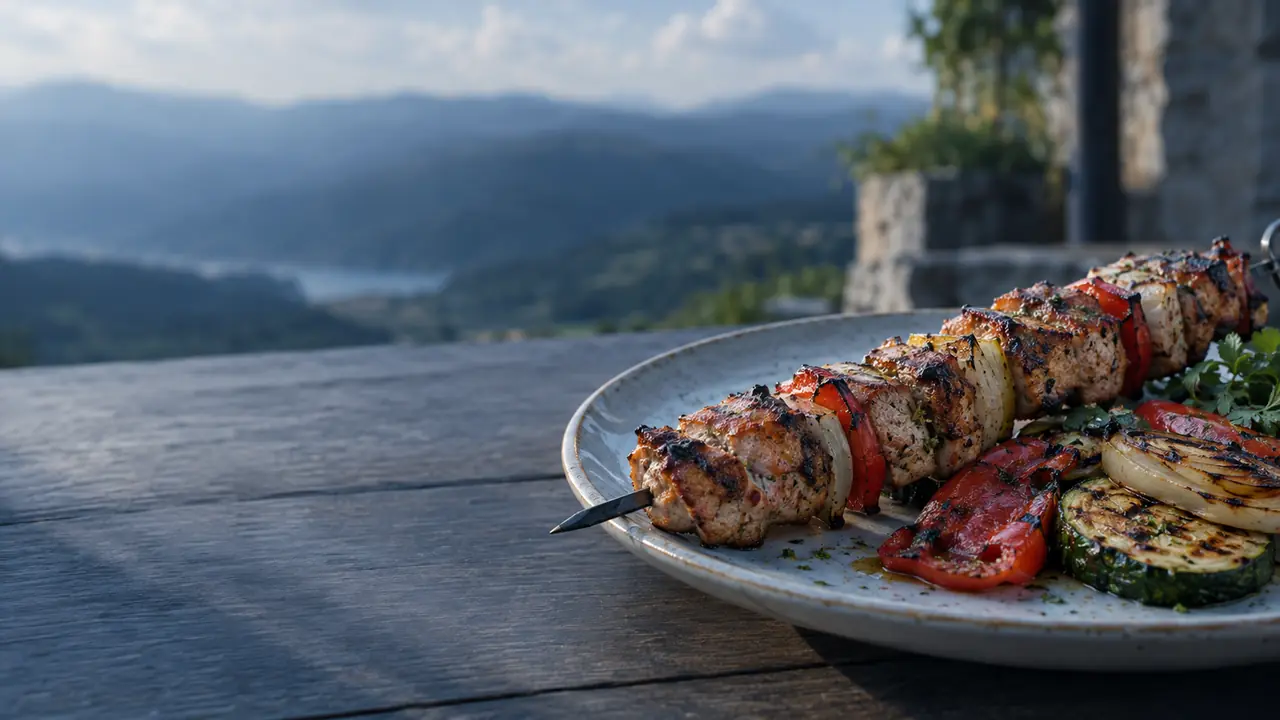
Shishche (Shish Kebap)
At a glance
| Bulgarian name | шишче (shishche); plural шишчета (shishcheta) |
|---|---|
| Type of dish | Grilled skewer |
| Main ingredients | Pork or chicken, with peppers, onions and other vegetables |
| Cooking | On the grill (skara) |
| Part of | Meshana skara, the mixed grill |
| Related dishes | Kebapche, kyufte, shish kebab, Adana kebab |
Source: Wikipedia: Bulgarian cuisine; Wikipedia (Bulgarian): Шишчета; TasteAtlas: Best rated meat dishes in Bulgaria1,3,6
What it is
Bulgarian Wikipedia’s article on Bulgarian cuisine describes shishcheta as pieces of meat alternated with vegetables on a skewer. The meat, usually pork or chicken, is cut into pieces, often marinated, and threaded onto wooden or metal skewers between pieces of pepper, onion, mushroom or sometimes apple, then grilled.1,3,7
Where the words come from
English Wikipedia traces shish to the Old Turkic sış, a pointed stick, and kebab to the Arabic kabāb; the word kebab has been used in English since the late 17th century. In Bulgarian, шиш is a spit or skewer and шишче is its diminutive.3,4
In Bulgaria the word кебап covers more than grilled meat. Writing in the newspaper Sega in 2022, Yasen Borislavov lists tas kebap, wine kebap, shish kebap, tepsi kebap, stomna kebap, paper kebap and druzan kebap: pieces of meat roasted on a skewer or cooked in a pan, tray, pot or clay jar, with or without sauce.5
Older than the word
Meat on skewers is far older than the word kebab. Borislavov notes that a barbecue from the 17th century BC, with a mechanism for turning skewers and controlled air to the embers, was found during excavations on Santorini, and that Homer’s Greeks roasted meat on spits. English Wikipedia also mentions the Minoans, the Odyssey and Byzantine evidence.4,5
Borislavov gives two explanations that have been told for the method: a shortage of firewood in the Middle East made roasting whole animals wasteful, so small pieces were grilled instead; and Persian soldiers are said to have roasted meat on their swords over open fires. He adds that linking the method only to Persia would be an exaggeration.5
Kebabs in Bulgarian cookbooks
According to Sega, kebab entered traditional Bulgarian cooking several centuries ago under Oriental influence. The cookbook Petko Slaveykov published in Constantinople in 1870 has a whole chapter, “On kebabs”, with 19 dishes of lamb and mutton, beef, rabbit, poultry and fish, most often roasted on a skewer and heavily spiced. Cinnamon is used with meat strikingly often.5
| Druzan kebap on the grill (Sega, 2022) | Amount |
|---|---|
| Pork | 800 g |
| Onions | 2 |
| Summer savory, salt and black pepper | To taste |
Source: Sega, Yasen Borislavov, 5 August 2022: Genealogy of kebabs5
In the recipe Sega gives, the meat is cut into cubes, salted, threaded onto skewers and grilled. It is close to the shishche served in Bulgarian restaurants today.5
A restaurant standard
Anthony Georgieff wrote in Vagabond magazine in 2008 that until 1989 the shishche was one of only four dishes reliably found in Bulgaria’s state-owned restaurants, together with the kebapche, the kyufte and the pork steak. A plate with all of them, the meshana skara, was a festive meal.2
TasteAtlas describes meshana skara today as one kyufte, one pork steak, one kebapche and one pork skewer, so the shishche is still part of the standard Bulgarian mixed grill.6
Shish kebab elsewhere
| Dish | Where | Meat |
|---|---|---|
| Shishche | Bulgaria | Pieces of pork or chicken, with vegetables |
| Shish kebab | Middle East and Turkey | Traditionally pieces of lamb |
| Adana kebab | Turkey | Minced lamb on wooden skewers, served with a yoghurt sauce |
| Kebapche | Bulgaria | Minced meat grilled on its own, without a skewer |
Source: Wikipedia: Shish kebab; Sega, Yasen Borislavov, 5 August 2022: Genealogy of kebabs4,5
Shish kebab is one of many kinds of kebab and originates in the Middle East, where lamb is traditional. Sega suggests that the Bulgarian kebapche belongs to the same family and at some point slipped off the skewer to be grilled on its own; how that happened, it says, history does not record.4,5
Frequently Asked Questions
What is shishche?
Shishche is the Bulgarian shish kebap: pieces of meat, usually pork or chicken, grilled on a skewer between pieces of pepper, onion or other vegetables. The word means little skewer; the plural is shishcheta.
What is the difference between shishche and kebapche?
Shishche is pieces of meat on a skewer. Kebapche is minced meat grilled on its own, without a skewer. Both are part of meshana skara, the Bulgarian mixed grill.
Where does the word shish kebab come from?
English Wikipedia traces shish to the Old Turkic word for a pointed stick, and kebab to the Arabic kabab. In Bulgarian, shish is a spit or skewer and shishche its diminutive.
How old is kebab in Bulgarian cooking?
According to the newspaper Sega, kebab entered Bulgarian cooking several centuries ago under Oriental influence. Petko Slaveykov’s cookbook of 1870 already had a chapter on kebabs with 19 dishes, most roasted on a skewer.
What is meshana skara?
Meshana skara is the Bulgarian mixed grill. TasteAtlas describes it as one kyufte, one pork steak, one kebapche and one pork skewer. Vagabond magazine wrote that before 1989 it was a festive meal.
Sources
- Wikipedia: Bulgarian cuisine
- Vagabond, Anthony Georgieff, 2008: The rise and fall of the Bulgarian kebapche
- Wikipedia (Bulgarian): Шишчета
- Wikipedia: Shish kebab
- Sega, Yasen Borislavov, 5 August 2022: Genealogy of kebabs (in Bulgarian)
- TasteAtlas: Best rated meat dishes in Bulgaria
- Wikipedia (Bulgarian): Българска кухня
Facts checked 11 November 2026. Prepared by InvestBulgaria for general information.


