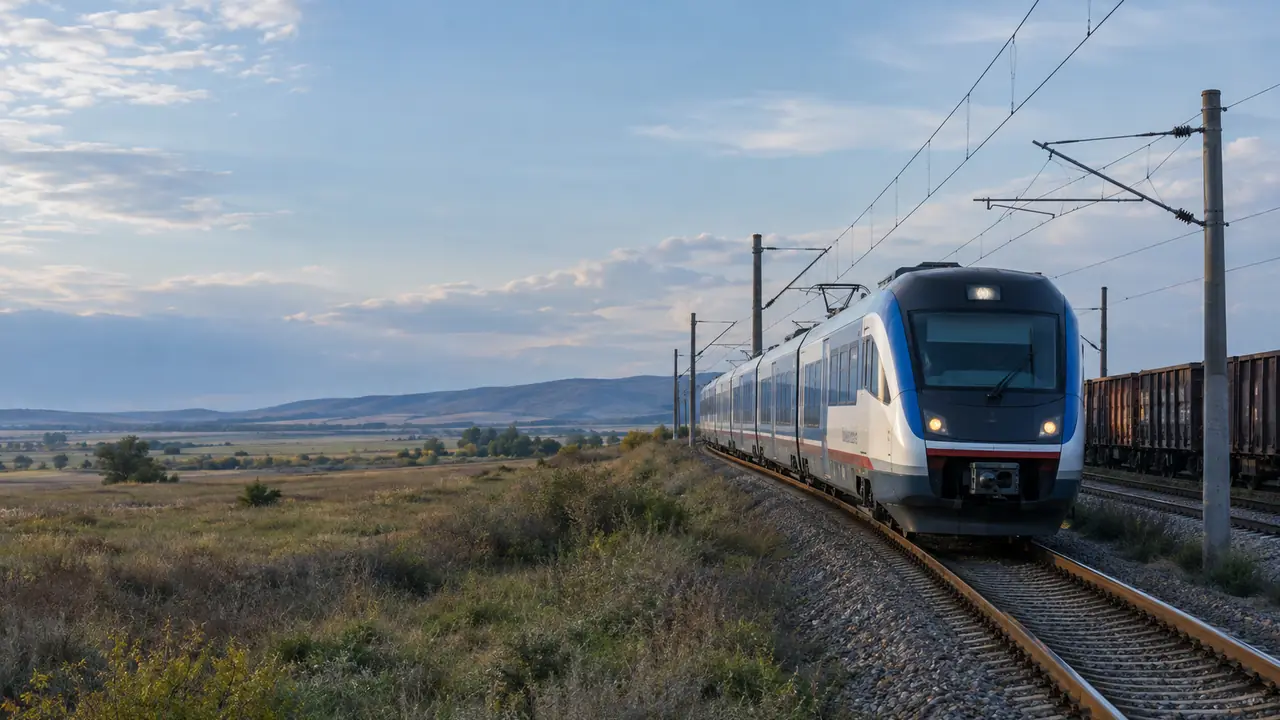
Railways in Bulgaria
The network
- About 3,900 km of open line, of which 995 km is double track, and 125 km of narrow gauge (760 mm). The rest is standard gauge.
- Electrified lines use 25 kV at 50 Hz. The network has 186 tunnels, 995 bridges, 293 stations and 397 stops.
- ETCS Level 1 train control works on Septemvri–Plovdiv and Krumovo–Svilengrad, towards the Turkish border.
Source: National Railway Infrastructure Company: Network Statement 2026–20271
The track belongs to the state and is managed by the National Railway Infrastructure Company (NRIC). The state-owned BDŽ runs passenger trains, and freight is carried by BDŽ Cargo and private operators.1,3
Border crossings by rail
| Neighbour | Crossing | Electrified |
|---|---|---|
| Turkey | Svilengrad–Kapıkule | Yes |
| Serbia | Dimitrovgrad–Kalotina | Yes |
| Greece | Svilengrad–Dikaia, Kulata–Strymon | No |
| Romania | Ruse–Giurgiu, Vidin–Golenți, Kardam–Negru Vodă | No |
Source: National Railway Infrastructure Company: Network Statement 2026–20271
Rail freight
Railways carried 13,731,200 tonnes of freight in 2025, 12.2% less than in 2024. Most freight in Bulgaria goes by road; see logistics.2
At the Port of Burgas, the Burgas West terminal can take up to 10 block trains a day since new sidings were finished in 2026.4
Modernisation
- Plovdiv–Burgas, phase 2: rehabilitation of about 140 km for speeds of up to 160 km/h, worth about €414 million, started in 2021 and expected to finish in 2026.
- Sofia–Plovdiv: modernisation in sections, Sofia–Elin Pelin, Elin Pelin–Kostenets and Kostenets–Septemvri.
- Sofia–Pernik–Radomir–Kulata towards Greece, the line to Vidin, and a new route to North Macedonia via Gyueshevo are in the government’s plans, with design speeds of 160–200 km/h.
- Ruse–Giurgiu–Bucharest: Bulgaria, Romania and Greece plan to modernise the rail link in 2028–2030 and build a new rail and road bridge over the Danube at Ruse by 2032, along with upgrading Burgas–Varna–Ruse.
Source: Railex: Plovdiv–Burgas railway rehabilitation, phase 2; National Railway Infrastructure Company: Network Statement 2026–2027; Economic.bg: Progressive Bulgaria’s plans for the motorway and railway networks; Ministry of Transport and Communications: Action plan for 25 key projects on the Aegean–Danube–Black Sea axis (29 September 2026)5,1,6,7
Bulgaria announced €1.4 billion of new trains in 2023.3
Frequently Asked Questions
How long is Bulgaria’s railway network and how much of it is electrified?
Bulgaria’s railway network totalled 6,438 km of track at the end of 2025, and over 71% was electrified. About 3,900 km is open line, including 995 km of double track.
How much rail freight did Bulgaria carry in 2025?
Bulgarian railways carried 13,731,200 tonnes of freight in 2025, 12.2% less than in 2024. Most freight transported in Bulgaria goes by road.
Which railway lines in Bulgaria are being modernised?
Plovdiv–Burgas phase 2 involves rehabilitating about 140 km for speeds of up to 160 km/h, at a cost of about €414 million; work started in 2021 and was expected to finish in 2026. Sofia–Plovdiv is being modernised in sections: Sofia–Elin Pelin, Elin Pelin–Kostenets and Kostenets–Septemvri.
How much railway investment is planned in Bulgaria?
Planned railway investment in Bulgaria for 2021–2027 totals €3.3 billion. Bulgaria also announced €1.4 billion in new trains in 2023.
Sources
- National Railway Infrastructure Company: Network Statement 2026–2027 (PDF)
- BTA: Decline in Bulgaria’s rail freight transport deepens in 2025
- Wikipedia: Rail transport in Bulgaria
- BMF Port Burgas: Strengthening Black Sea connectivity, presentation (June 2026, PDF)
- Railex: Plovdiv–Burgas railway rehabilitation, phase 2
- Economic.bg: Progressive Bulgaria’s plans for the motorway and railway networks
- Ministry of Transport and Communications: Action plan for 25 key projects on the Aegean–Danube–Black Sea axis (29 September 2026)
Figures checked 13 October 2026. Prepared by InvestBulgaria for general information. It is not investment, tax or legal advice; please confirm details with a qualified adviser before acting.
