The draft 2027 budget would make operators of stand-alone battery systems pay 5% of their revenue into the Electricity System Security Fund for one year. The storage industry warns that the levy could absorb most of its margins, while the Energy Ministry has proposed changing the base before the second reading.
What happened
A provision added to the transitional rules of Bulgaria's draft 2027 state budget would require operators of stand-alone battery storage systems to pay a one-year contribution of 5% of their revenue into the Electricity System Security Fund (ESSF). On 18 November the Association of Producers of Ecological Energy (APSTE) came out against the measure, and parliament's energy committee backed the budget at first reading by 12 votes to 6. Deputy Energy Minister Kiril Temelkov told the committee the measure was adequate and sensible, while also proposing a change to how it is calculated.
The figures and background
According to Economic.bg, the targeted contributions would apply from 1 January to 31 December 2027. Storage operators would pay 5% of their revenue, excluding VAT, from ancillary services, storage services and electricity sales. Producers and traders would also pay 5% contributions on their revenues, and the Ministry of Finance has not published a revenue estimate for the individual measures, the outlet reports. Dnevnik reports that the provision was added after the draft budget was published early this month and before it was submitted to parliament.
The base matters because a battery's revenue is mostly the resale of electricity it has bought. Capital gives an example: if an operator pays €10,000 to charge a battery and sells the stored power for €10,800, a 5% levy on the sales would be €540, leaving €260 before any other costs. Capital notes that the margin in such trading may be below 5%, and that producers, including small rooftop solar plants, already pay a similar contribution.
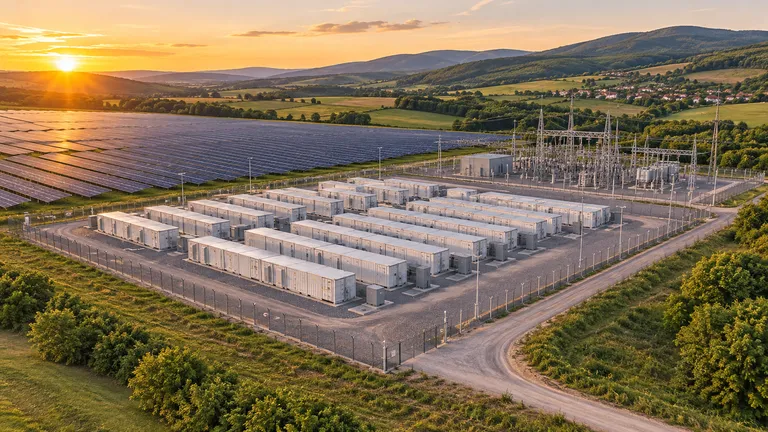
The sector has grown quickly. APSTE says more than €3 billion has been invested in storage over the past two years and more than 6.3 GW of capacity has been built. Citing data from the transmission system operator ESO for 1 January to 15 November 2026, the association says battery output rose almost nine-fold, wind and solar generation by 22% and net electricity exports by 94%. APSTE also says that in summer 2026 batteries smoothed evening peaks and helped keep Bulgarian exchange prices lower than in Romania and Greece. Comparable data on storage levies in other EU countries were not available in the sources reviewed for this article.
The fund is a central part of the government's energy policy. BNR reports that the ESSF pays compensation for high electricity prices to households and businesses and is expected to finance gas support for households. The budget projects energy-sector revenue of €595 million in 2027 against expenditure of about €42 million, with €386 million expected from the EU Modernisation Fund, according to BNR. The proposal comes alongside the €2 billion energy support package that we analysed earlier this week.
How the arguments compare
APSTE argues that the levy was introduced without public consultation, without discussion in the tripartite council and without an impact assessment or revenue estimate. Because it applies to total revenue without deducting the cost of purchased electricity and losses, the association says the real burden is many times higher than 5%. It also says the same energy would be charged twice and that balancing services ordered by ESO would be included, which could raise balancing costs for the whole system. Miroslav Karakashev of APSTE told Economic.bg that the measure amounts to a kind of 5% turnover tax and is not justified in the medium-term budget forecast, and that it may conflict with EU law.
Other industry voices agree. Meglena Roussenova of the Bulgarian Photovoltaic Association told Capital that the levy sends a bad signal to investors, and Dimitar Beleliev of AmonRa Energy, who chairs the Bulgarian Association of Electrical Engineering and Electronics, said he was categorically opposed because it would discourage investment. The government sees it differently. Temelkov told the energy committee, according to BurgasMedia, that the measure does not clash with the growth of the grid, does not break the law and does not harm investment. ESSF director Dian Chervenkondev said he had no objections.
What it means for investors and companies
For storage owners, the immediate risk is cash flow. APSTE says most systems have been operating for only a few months and were financed with bank loans, so a levy on gross revenue could threaten debt service and loan covenants and, in some cases, lead to insolvency. Lenders and buyers of projects are likely to factor a possible 2027 cost into their models until the final text is known.
For EU-funded projects, APSTE says the measure puts at risk more than €600 million in Recovery and Resilience Plan funding for storage, and it intends to ask the European Commission to check whether the levy is compatible with EU rules. That is the association's assessment; the Commission has not commented in the sources reviewed.
For energy-intensive companies and other electricity buyers, the picture is mixed. The revenue is meant to support compensation for high power prices, but APSTE warns that including balancing services could push up system costs. If storage investment slows, the evening price-smoothing effect the association describes could weaken.
BNR reports that Temelkov has proposed calculating the levy on the positive difference between revenue and the cost of electricity purchased, taking account of charging and losses, and refining the data operators declare. Dnevnik reports that the ruling majority is expected to change the provision between readings. In Capital's example, 5% of the €800 difference would be €40 rather than €540.
What to watch next
The key moment is the second reading of the 2027 budget, when amendments on the levy base are expected. Investors will also watch whether the measure stays limited to 1 January to 31 December 2027, whether the government publishes a revenue estimate, and whether APSTE takes the issue to the European Commission.
 Analysis