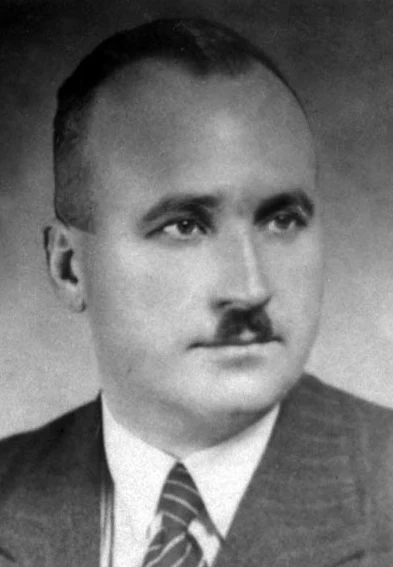
Dimitar Peshev
At a glance
| In Bulgarian | Димитър Йосифов Пешев |
|---|---|
| Born | 25 June 1894 (13 June Old Style), Kyustendil |
| Died | 1973, Sofia (20 February in both Wikipedias; 25 February in the Yad Vashem database) |
| Profession | Lawyer; judge and prosecutor, in private practice from 1932 |
| Offices | Minister of Justice 1935–1936; Deputy Speaker of the National Assembly from 1938 |
| Honours | Righteous Among the Nations (1973); Order of Stara Planina, posthumously (1997) |
Source: Wikipedia: Dimitar Peshev; Wikipedia (Bulgarian): Димитър Пешев; Yad Vashem: Righteous Among the Nations database, Dimitar Peshev1,2,3
Lawyer and politician
Peshev was born in Kyustendil and began studying law at Sofia University in 1915. He broke off his studies to fight in the First World War and graduated after it. He worked as a judge in Plovdiv and Sofia, then as a prosecutor, and from 1932 as a lawyer. In 1935–1936 he was Minister of Justice in the first government of Georgi Kyoseivanov, and in 1938 he was elected Deputy Speaker of the National Assembly.1,2
Peshev did not oppose the alliance with Nazi Germany. He voted for the antisemitic Law for the Protection of the Nation and personally chaired the sitting at which it was passed on 19 November 1940. English Wikipedia notes that the law, modelled on the Nuremberg Laws, came into force in January 1941.1,2
March 1943
On 8 March 1943 a delegation from Kyustendil came to Peshev and told him that the Jews of the town were to be deported under a secret agreement with the Third Reich. The delegation included the deputy Petar Mihalev, and one of its members was Peshev’s Jewish friend Yakov Baruh. After officials confirmed the plan, Peshev and Mihalev went to the Interior Minister, Petar Gabrovski, and insisted that he cancel it. On 9 March Gabrovski ordered the preparations in Kyustendil to stop.1,2
The Jews of Bulgarian-occupied Thrace and Macedonia were not spared. Bulgarian authorities rounded them up and handed them to the Germans, and English Wikipedia says that almost all were deported to Treblinka and Auschwitz. Yad Vashem records that the last transport left on 29 March 1943.1,4
To prevent the deportation of the Jews from Bulgaria’s pre-war territory, Peshev wrote a sharp letter of protest to Prime Minister Bogdan Filov. It was signed by 43 deputies in all, every one from the government majority, so that it could not be read as an act against the government. Under pressure from Filov some withdrew their signatures, and Peshev was removed as Deputy Speaker. The plans to deport the Jews of Bulgaria were dropped.2,4
Sources give different dates. Bulgarian Wikipedia, Yad Vashem and the Memorial Museums portal date the letter to 17 March 1943; English Wikipedia gives 19 March. Peshev’s removal is dated 24 March by English Wikipedia and 26 March by Bulgarian Wikipedia, while Yad Vashem says he was forced to resign on 30 March.1,2,4,5
Trial and recognition
In 1945 the so-called People’s Court tried Peshev for “fascist activity and antisemitism” and sentenced him to 15 years in prison, a fine and the confiscation of his property. He was released after intercession by Jews with influence in the government; Bulgarian Wikipedia says after 13 months, Yad Vashem after one year. He spent the rest of his life in obscurity and began writing his memoirs after 1968.2,4
Yad Vashem recognised Peshev as Righteous Among the Nations on 10 January 1973, a few weeks before his death. Because of the political circumstances and his death, no ceremony was held at the time; it took place at Yad Vashem on 26 February 2015, when his niece Neli Pesheva accepted the medal and certificate.4
- 1997: Order of Stara Planina, posthumously, and honorary citizen of Kyustendil.
- 16 October 1998: tribute in the Italian parliament.
- 25 January 2000: a bronze bust by Ivan Minekov, a gift of the Bulgarian parliament, unveiled in the Palace of Europe in Strasbourg.
- A house-museum at 11 Tsar Simeon I Street in Kyustendil. English Wikipedia dates its opening to 25 October 2002, the Memorial Museums portal to 9 March 2003.
- 12 November 2013: Dimitar Peshev Plaza named next to the Bulgarian embassy in Washington, D.C.
- Peshev Ridge on Livingston Island in Antarctica is named after him.
Source: Wikipedia: Dimitar Peshev; Wikipedia (Bulgarian): Димитър Пешев; Memorial Museums: Dimitar Peshev Museum1,2,5
Sources
- Wikipedia: Dimitar Peshev
- Wikipedia (Bulgarian): Димитър Пешев
- Yad Vashem: Righteous Among the Nations database, Dimitar Peshev
- Yad Vashem: Bulgarian Righteous Among the Nations honoured at Yad Vashem (24 February 2015)
- Memorial Museums: Dimitar Peshev Museum
Facts checked 10 November 2026. Prepared by InvestBulgaria for general information.