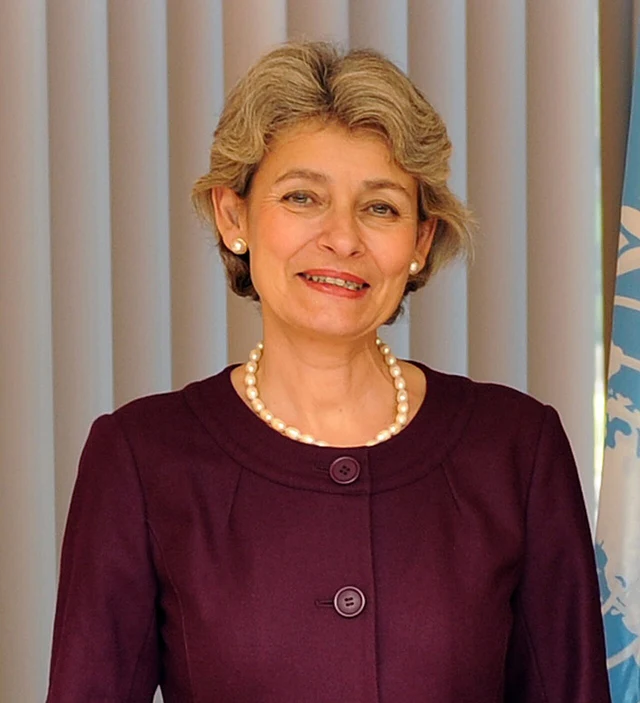
Irina Bokova
At a glance
| In Bulgarian | Ирина Бокова |
|---|---|
| Born | 12 July 1952, Sofia |
| Education | First English Language School, Sofia (1971); MGIMO, Moscow (1976) |
| Best known for | UNESCO Director-General 2009–2017 |
| Languages | Bulgarian, English, French, Spanish, Russian |
Source: Wikipedia: Irina Bokova; Wikipedia (Bulgarian): Ирина Бокова1,2
Diplomat and politician
Bokova is the daughter of Georgi Bokov, editor-in-chief of the Communist Party newspaper Rabotnichesko Delo. She joined the foreign ministry in 1977 and worked on United Nations and disarmament issues, including a posting at Bulgaria’s UN mission in New York from 1982 to 1984. In 1990–91 she was a member of the 7th Grand National Assembly and signed the new Constitution of Bulgaria.1,2
In the government of Zhan Videnov she was deputy and then first deputy foreign minister, and from 13 November 1996 to 13 February 1997 acting foreign minister. In 1996 she ran for vice-president on a ticket with Ivan Marazov. She returned to parliament in 2001–2005 for the Coalition for Bulgaria, and in 2005 became ambassador to France and Monaco and Bulgaria’s permanent delegate to UNESCO.1,2
At the head of UNESCO
On 22 September 2009 UNESCO’s Executive Board chose Bokova from ten candidates, defeating Egypt’s Farouk Hosny 31–27 in the fifth and final round. She succeeded Koïchiro Matsuura of Japan in November 2009 and was re-elected by the General Conference on 12 November 2013. UNESCO’s list of former Directors-General says she was “the first woman and Eastern European to hold this position”.1,3
Her second term was marked by the destruction of heritage in Iraq and Syria. English Wikipedia credits her work against the illicit trade in antiquities with contributing to UN Security Council Resolution 2199 of 12 February 2015, which banned all trade in cultural goods from both countries. On 28 March 2015 she launched Unite4Heritage, a campaign to protect heritage threatened by extremists.1
Her election drew mixed reactions. English Wikipedia notes that the Bulgarian-born German writer Ilija Trojanow called it “a scandal” in the Frankfurter Allgemeine Zeitung because of her father’s communist past, while The New York Times backed her nomination, citing her role in Bulgaria’s transition from Soviet satellite to EU member.1
After UNESCO
The Bulgarian government nominated Bokova for UN Secretary-General in June 2014, and she remained a candidate until the end of 2016. In 2018 she began teaching at Kyung Hee University in South Korea, which also gave her an honorary doctorate in Peace Studies. In 2020 she was elected an International Honorary Member of the American Academy of Arts and Sciences.1
Sources
Facts checked 10 November 2026. Prepared by InvestBulgaria for general information.