
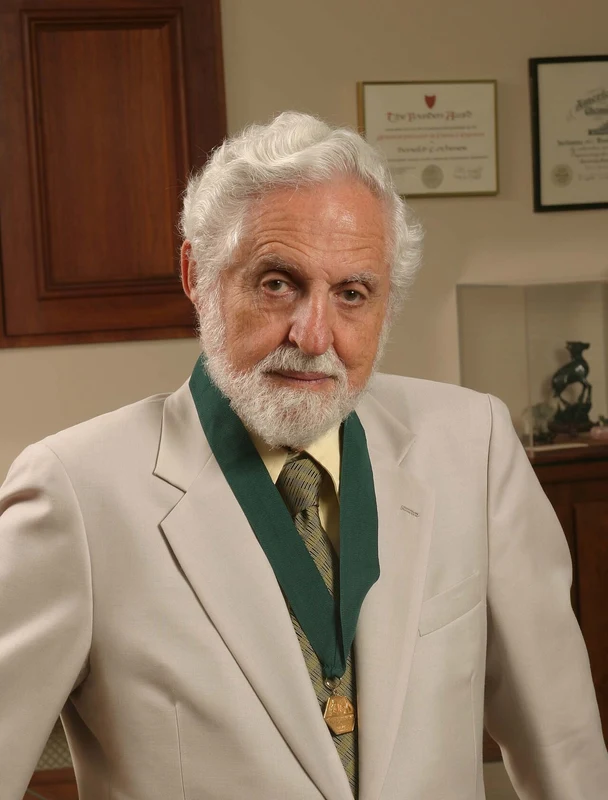
Carl Djerassi
At a glance
| In Bulgarian | Карл Джераси |
|---|---|
| Born | 29 October 1923, Vienna |
| Died | 30 January 2015, San Francisco |
| Bulgarian link | Father Samuel Djerassi, a doctor from Sofia; studied at the American College of Sofia |
| Known for | Norethisterone and the oral contraceptive; antihistamines; novels and plays |
Source: Wikipedia: Carl Djerassi; Wikipedia (Bulgarian): Карл Джераси; Stanford University: Carl Djerassi obituary1,2,3
Sources differ on when he joined Stanford. Stanford University and the National Inventors Hall of Fame give 1959; English Wikipedia gives 1960.1,3,4
Vienna, Sofia and escape
Djerassi’s father, Samuel Djerassi, was a Bulgarian Jewish doctor; his mother, Alice Friedmann, was a Viennese dentist and physician. Bulgarian Wikipedia says he spent his early childhood in Bulgaria until his parents divorced and he left for Vienna with his mother at the age of five, returning to Sofia for summer holidays. Austria refused him citizenship, and he kept the Bulgarian citizenship he had through his father.1,2
After the Anschluss in 1938, his father briefly remarried his mother so that they could leave Austria for Sofia. Djerassi lived with his father for a year and attended the American College of Sofia, where he became fluent in English. English Wikipedia notes that Bulgaria proved a safe haven and saved its entire Jewish population of 48,000 from deportation. In December 1939 he and his mother arrived in the United States almost penniless.1,2
Chemistry and the pill
Djerassi graduated summa cum laude from Kenyon College and in 1942–43 worked for CIBA in New Jersey, where he developed Pyribenzamine, one of the first commercial antihistamines. He earned a PhD in organic chemistry at the University of Wisconsin in 1945. In 1949 he joined Syntex in Mexico City, and in 1951, with Luis E. Miramontes and George Rosenkranz, he took part in the synthesis of norethisterone (norethindrone), a progestin that, unlike progesterone, works when taken by mouth. Stanford University says the work earned him the nickname “The Father of the Pill”. The National Inventors Hall of Fame lists his oral contraceptive under US Patent No. 2,744,122.1,3,4
He taught at Wayne State University in Detroit from 1952 to 1959 and then at Stanford, while keeping close links with industry; in 1968 he founded Zoecon, which worked on insect control using modified insect hormones. English Wikipedia says he published more than 1,200 papers. In 1973 he received the National Medal of Science; Stanford quotes his colleague Richard Zare saying Djerassi was the only person he knew of to receive the medal from President Nixon and be named on Nixon’s blacklist in the same year. He entered the National Inventors Hall of Fame in 1978 and received the National Medal of Technology in 1991.1,3,4
Writer, collector and patron
In the final decades of his life Djerassi wrote what he called “science-in-fiction”. His first novel, “Cantor’s Dilemma”, deals with the pressures that can push a researcher towards fraud, and “The Bourbaki Gambit” with disputes over scientific credit. His plays include “An Immaculate Misconception” (1998), about the IVF technique ICSI, and “Oxygen” (1999), written with Roald Hoffmann.1,3
In 1979 he founded the Djerassi Resident Artists Program on his ranch in Woodside, California, in memory of his daughter Pamela; Stanford says it has supported more than 2,000 artists. He arranged for his collection of works by Paul Klee to go to the Albertina in Vienna and the San Francisco Museum of Modern Art. In 2013 the American University in Bulgaria gave him an honorary doctorate. He died at his home in San Francisco on 30 January 2015, at the age of 91.1,3
Sources
- Wikipedia: Carl Djerassi
- Wikipedia (Bulgarian): Карл Джераси
- Stanford University: Carl Djerassi obituary
- National Inventors Hall of Fame: Carl Djerassi
Facts checked 10 November 2026. Prepared by InvestBulgaria for general information.