
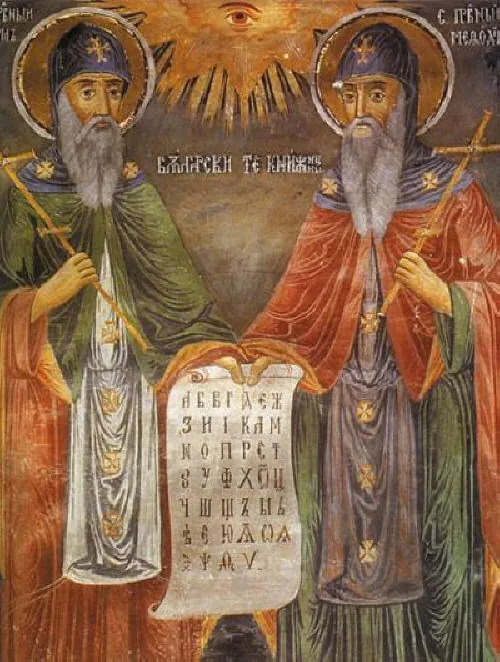
Saints Cyril and Methodius
At a glance
| In Bulgarian | Кирил и Методий |
|---|---|
| Born | Cyril: 826 or 827; Methodius: 815–820, Thessalonica |
| Died | Cyril: 14 February 869, Rome; Methodius: 6 April 885 |
| Known for | Missionary work among the Slavs and the Glagolitic alphabet |
| Church roles | Cyril was a priest; Methodius became Archbishop of Sirmium |
| Commemoration | Declared co-patron saints of Europe in 1980 |
Source: Wikipedia: Cyril and Methodius1
Early lives
The brothers were born in Thessalonica, then part of the Byzantine Empire. Cyril was born Constantine and was reportedly the youngest of seven brothers. He later took the name Cyril when he became a monk in Rome shortly before his death. Methodius was born Michael and took his monastic name at the Monastery of Polychron. Their father, Leo, served as a Byzantine official. The brothers’ exact ethnic origins are unknown.1
Mission and writing
In 862, Prince Rastislav of Great Moravia asked the Byzantine emperor and patriarch to send missionaries. Cyril and Methodius went to the region and translated the Gospels and other liturgical texts into what is now called Old Church Slavonic. In 863, they began this translation work and promoted the new liturgy. They devised the Glagolitic alphabet, the first script used for Slavonic manuscripts. Their mission brought them into conflict with German churchmen who supported Latin worship.1
Legacy
The brothers travelled to Rome, where Pope Adrian II authorised the Slavic liturgy. Cyril died there in 869. Methodius continued the mission and served as archbishop, but faced imprisonment and opposition over his authority and the use of Slavonic in worship. After his death in 885, his followers were expelled from Great Moravia. Some found refuge in Bulgaria, where Clement and Naum helped establish schools for teaching theology in Slavonic. Cyril and Methodius are venerated as saints in several Christian traditions.1
Sources
Facts checked 13 October 2026. Prepared by InvestBulgaria for general information.
