Credit to Bulgaria's non-government sector grew by 15.8% a year in September, several times the euro area pace, while the ECB kept rates on hold and warned that financing conditions have tightened. Bulgarian loan rates have barely moved so far, but deposit growth is slowing and house prices are rising more than three times as fast as in the euro area.
What happened
On 29 October the European Central Bank (ECB) left its three key interest rates unchanged, with the deposit facility rate at 2.50%, the main refinancing rate at 2.65% and the marginal lending rate at 2.90%. The ECB said euro area inflation rose to 3.8% in September from 3.2% in August, as energy price inflation reached 18.9%, that financing conditions had tightened since its previous meeting and that it would continue to decide meeting by meeting.
Two days earlier the Bulgarian National Bank (BNB) published data showing that credit to Bulgaria's non-government sector reached €67.693 billion at the end of September, equal to 52.7% of GDP and 15.8% more than a year earlier. The BNB now reports these figures as Bulgaria's contribution to euro area monetary aggregates: the country's borrowing costs are tied to ECB decisions, but its credit cycle is running far ahead of the rest of the bloc.
The figures and background
Household lending is the main driver. Loans to households rose by 20.7% year on year to €33.115 billion, the BNB said. Housing loans grew by 24.8% to €19.646 billion, slightly slower than 25.2% in August, which implies roughly €3.9 billion of additional mortgage debt in twelve months. Consumer loans rose by 16.0% to €12.419 billion. Lending to non-financial companies grew more slowly, by 12.0% to €29.401 billion, down from 13.7% in August, and total credit growth eased from 16.7% in August.
Deposits are growing, but less quickly. Total deposits of the non-government sector rose by 12.9% to €87.590 billion, compared with 15.4% in August. Household deposits increased by 16.2% to €57.222 billion, while company deposits grew by only 7.0%, down from 12.7% a month earlier. With credit growing faster than deposits, loans now equal about 77% of deposits on these figures.
Interest rates on new loans have hardly reacted to the euro area environment. According to BNB interest rate statistics, the average rate on new housing loans in September was 2.41%, against 2.42% in August, with an annual percentage rate of charge of 2.76%. New consumer loans cost 8.83% on average. For companies, the rate on new loans of up to €1 million fell to 4.25%, but the rate on loans above €1 million rose from 4.36% to 4.66%. Deposit rates edged up: household term deposits paid 1.42% and corporate term deposits 1.79%, up from 1.56%.
How Bulgaria compares
In the euro area as a whole, loans to households grew by 3.1% in September and loans to non-financial corporations by 4.2%, while broad money (M3) grew by 3.5%, ECB data show. Bulgarian household credit is therefore growing more than six times as fast as the euro area average, and Bulgaria's contribution to euro area M3 grew by 19.5%, according to the BNB. The ECB said mortgage rates in the euro area rose to 3.6% in August and that mortgage lending growth edged down to 3.0% in September. The measures are not identical, but they show Bulgarian borrowers paying less than the euro area average while borrowing much faster.
Credit conditions elsewhere in the bloc are turning. In the ECB's bank lending survey for the third quarter, euro area banks left credit standards for housing loans unchanged but tightened terms and conditions on them (a net 16%) and tightened standards for consumer credit (14%) and for loans to firms (9%). Banks reported a net fall in housing loan demand of 27% and expect a further fall of 36% in the fourth quarter, with a net 10% planning to tighten housing loan standards.
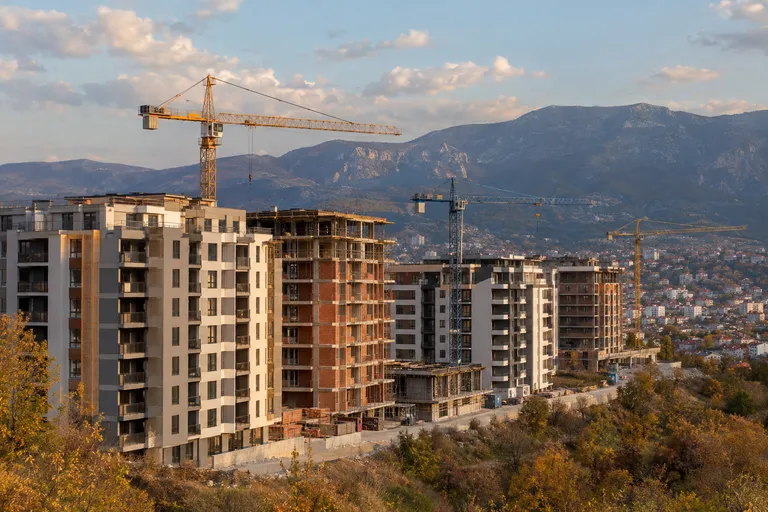
Housing prices reflect the credit boom. Eurostat data show Bulgarian house prices rose by 15.5% year on year in the second quarter of 2026, the second-highest rate in the EU after Portugal (16.5%) and well above the euro area (4.0%) and the EU (4.7%). Among neighbours with data, prices rose by 12.7% in Croatia, 12.1% in Romania, 10.2% in Hungary and 9.1% in Slovenia; Eurostat had no figure for Greece. Bulgaria's annual rate has stayed between 12.6% and 15.5% in each of the last four quarters.
What it means for investors and companies
For banks, strong volumes support income, but the gap between credit growth (15.8%) and deposit growth (12.9%) and the rise in corporate deposit rates suggest funding is becoming more competitive. If banks pay more for deposits, loan pricing is likely to follow, and the September rise in the rate on large corporate loans may be an early sign.
For residential developers and buyers, the low mortgage rates that have supported demand remain well below the euro area average at a time when the ECB describes tighter financing conditions. A rise in Bulgarian rates towards euro area levels would increase monthly payments on new loans and could slow transactions. A broker quoted in an earlier InvestBulgaria story said high prices had already pushed about a fifth of potential buyers out of the market.
For companies, credit is still available but growing more slowly, and the cost of larger loans has started to rise. Firms planning large investments may face higher borrowing costs than smaller borrowers, and euro area banks have tightened standards for corporate loans. Consumer-facing businesses benefit from consumer credit growing by 16.0%, but at an average rate of 8.83% households are exposed to any further increase.
What to watch next
The ECB Governing Council meets again in December, when it will have more data on energy prices and inflation. The BNB's October monetary and interest rate statistics, expected at the end of November, will show whether the slowdown in corporate lending and deposits continues and whether loan rates begin to rise. Eurostat's next quarterly house price release will show whether Bulgaria's price growth eases as euro area mortgage demand falls.
 Analysis